By JULIE CARLE
BG Independent News
Michael Kunst practically rubbed elbows with Galileo Galilei on Thursday when he got to hold and peruse the 17th-century work of the Italian astronomer and philosopher.
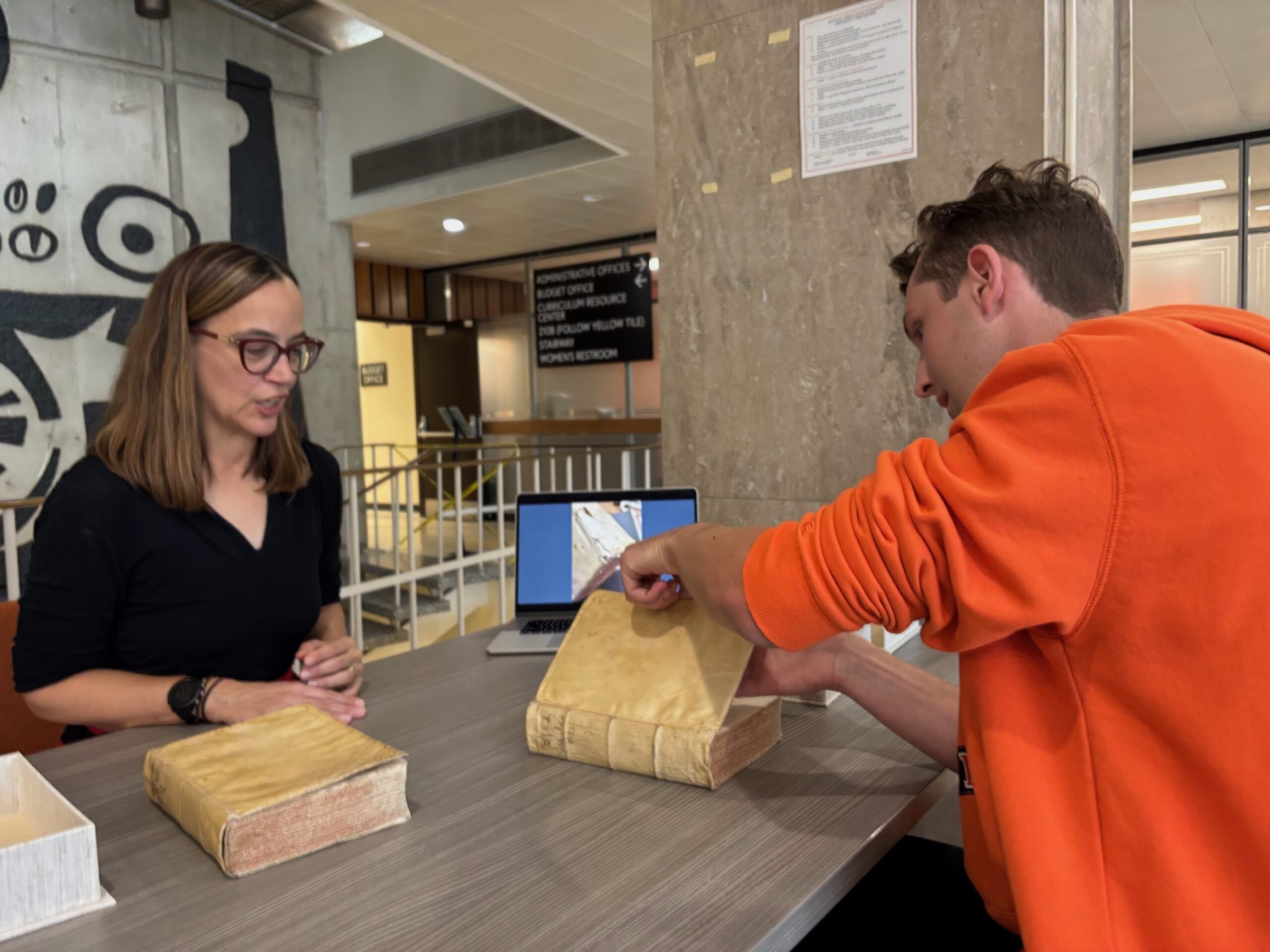
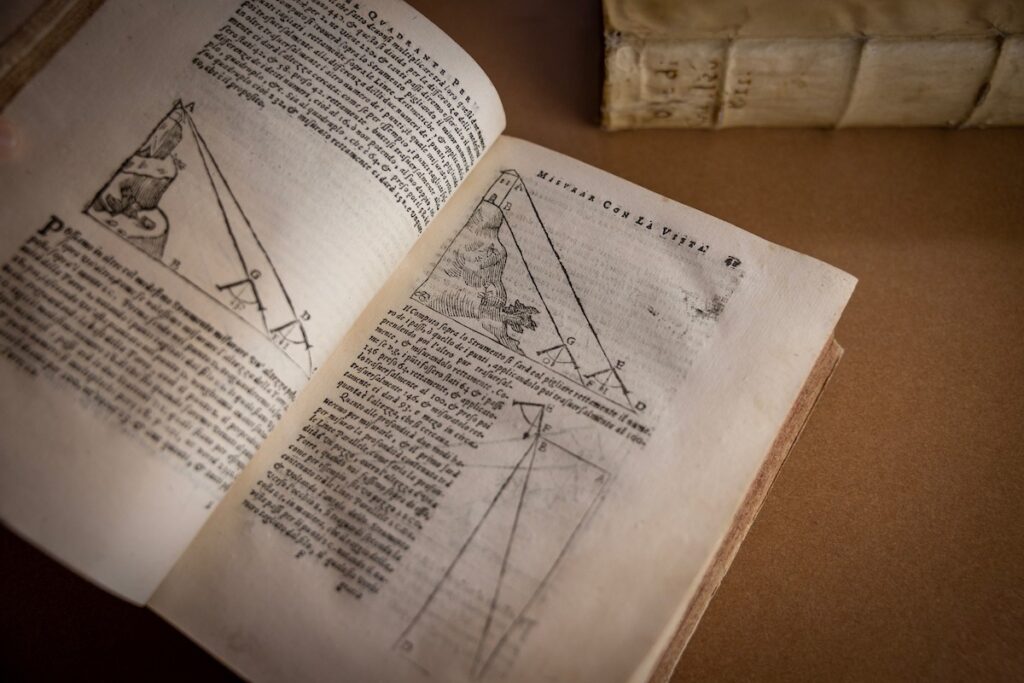
The environmental science senior at Bowling Green State University was among the first visitors to see the recently restored two-volume set of “Opere del Galileo Galilei,” translated to “Works of Galileo,” that includes manuscripts and scientific writings of Galileo. The books are part of the Rare Books and Special Collections in the University’s Center for Archival Collections.
Kunst was excited, but a bit nervous, to handle the books. His father is a history teacher, as was his grandfather, and he has taken many history classes at BGSU, so he has a deep appreciation of history. Being able to touch and look through Galileo’s manuscript was magical, he said, as he snapped a photo of him holding the books to share with his family. “Whoa, my dad’s going to get a kick out of this.”
The books have been in the collection since 1966, but only recently restored to make them more viable for handling, Michelle Sweetser, head librarian and chair of the Special Collections, said.
The University Libraries received a $5,000 grant to restore the original 1655 and 1656 manuscripts that were printed after Galileo’s 1642 death. The grant was through the State Library of Ohio from the Federal Institute for Museum and Library Services.
A conservator from Kentucky restored the two printed volumes that include his writings, drawings, commentary on and responses to his work, and unpublished letters.
“There are a bunch of individual parts where one writes about his work and his observations in the sky, and another writes about his development of mathematical tools for military navigation,” Sweetser said. She suggested scientists in the 1650s might have used Galileo’s books to learn or for use in their own examination of his works.
“There’s an index that I think they would look through if they were interested in some of his particular works on his discoveries and sunspots,” she added.
The books were written in Italian and Latin and printed in Bologna, Italy. They came into the special collections’ holdings in 1966 when BGSU Professor Frank C. Ogg and his wife, Florence, donated $500 to purchase the two volumes and a third Galileo book printed in 1710 that was not part of the restoration project.
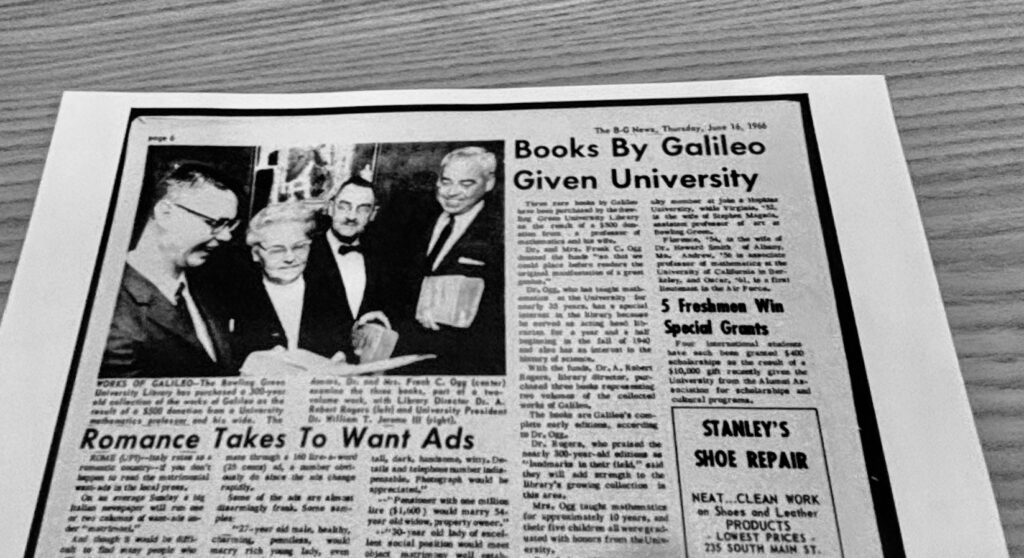
Ogg served BGSU from 1931-1969 as associate professor, professor and chair of the math department. In a resolution after Ogg’s death in 1976, the Board of Trustees recognized him for “his time and energies to enhance the standards of scholarship and to support the improvement of climate for research at the University, including service as the University Librarian in 1941-42,” further connecting his belief in the importance of books for research. The trustees also named the science and math library that was formerly housed in the Mathematical Sciences Building after Ogg.
Books’ history still somewhat a mystery
“We don’t know all of the provenance of the books,” Sweetser said. There are markings in the books that hint at some of the history. The books appear to have been in the possession of Gustavo Galletti, a known bibliophile and collector from Florence, Italy, but there are no details about the books’ purchase other than it was documented publicly, including a BG News story about the Oggs’ donation to buy the books.
Based on Sweetser’s research of “a catalog of library catalogs,” BGSU’s set is one of only 11 copies available in the world and the only one in Ohio. ”There may be more in smaller libraries or personal libraries that don’t list their items,” she said.
The special collections section does have some works that are older than the Galileo set. “Our oldest works are fragments from books from the 12 and 14 hundreds,” she said, explaining that it was common for books to get split up and pages sold in that era.
For decades, the Galileo books have been kept in a climate-controlled space off-site at the library’s repository.
“It hadn’t been forgotten, but we didn’t like to bring it out a lot because it was so fragile,” she said.
The condition of the books made it impossible to make them available for regular use or viewing.

“The vellum binding had largely come off of the work,” Sweetser said as she showed images of the book with the separated cover before they were restored. “Now it’s been reattached so that we can really feel like we can use it.” Additionally, the pages were fragile, preventing safe handling and use. But the conservator filled in the pages and stabilized them.
The restoration is what makes the Galileo books “much more stable for use by students and researchers, fulfilling the library’s mission of access,” Sweetser said.
After the viewing on Thursday, the books were to be returned to the climate-controlled environment of the repository, but they will be available under supervision to be viewed and handled for research purposes, Sweetser said. Materials can be requested and viewed within the Special Collections reading rooms.
“It’s really an honor to be able to preserve and care for these types of documents and to share them with the community,” said Sara Bushong, dean of University Libraries.
Being able to touch the historically significant book and interact with physical, historical artifacts in the digital age is quite powerful, she said.