By JULIE CARLE
BG Independent News
What does it mean when the United States steps back from the global system it helped build after World War II?
That question framed a Great Decisions talk by Dr. Amilcar Challu, a Bowling Green State University history professor, who used his own path from Argentina to the U.S. to explain how American “soft power” once shaped lives, alliances, and a rules-based international order now under strain.
To begin the talk at the Wood County Senior Center on Jan. 21, Challu set the record straight about the term “liberal internationalism.” He emphasized that “liberal” in the phrase “liberal internationalism” does not carry the same meaning as today’s American partisan political label of left-wing political ideology.
Instead, it refers to a post-World War II, rules-based system that was founded on universal rights, free expression, representative government and multilateral cooperation.
“Liberal means basically respect for the rule of law in a universal way,” he said.
The international order was built out of the major crises of the 20th century, namely the Great Depression and two World Wars, as a lesson in preventing future catastrophes.
As an Argentinian, Challu benefited from the “soft power” of liberal internationalism that included persuasion, cultural diplomacy, academic exchanges that helped to build trust between people. And it created a more durable foundation for global leadership than “hard power” or military might, he said.
He used his own life story as a primary example of its success.
As Challu was growing up, his connections with family friends from the U.S. broadened his perspectives. He started going downtown to the Lincoln Library, a project initiated through the U.S. Information Service.
The library was part of an international network, that offered “lots of open stacks, tables where you could bring out books and you could check them out,” he recalled. “It was a big part of what we call cultural diplomacy, a way to get an image of the United States and a relationship not just based on diplomacy but a way to get cultures close.”
He was able to study in the United States, earning his Ph.D. from Harvard University, before he chose to stay in the U.S. to teach rather than returning to Argentina. He came to the U.S. in 1999 and has been a citizen since 2009.
Serendipity of soft power also contributed to a nephew coming to the U.S. to be near his uncle and starting a technology-based startup.
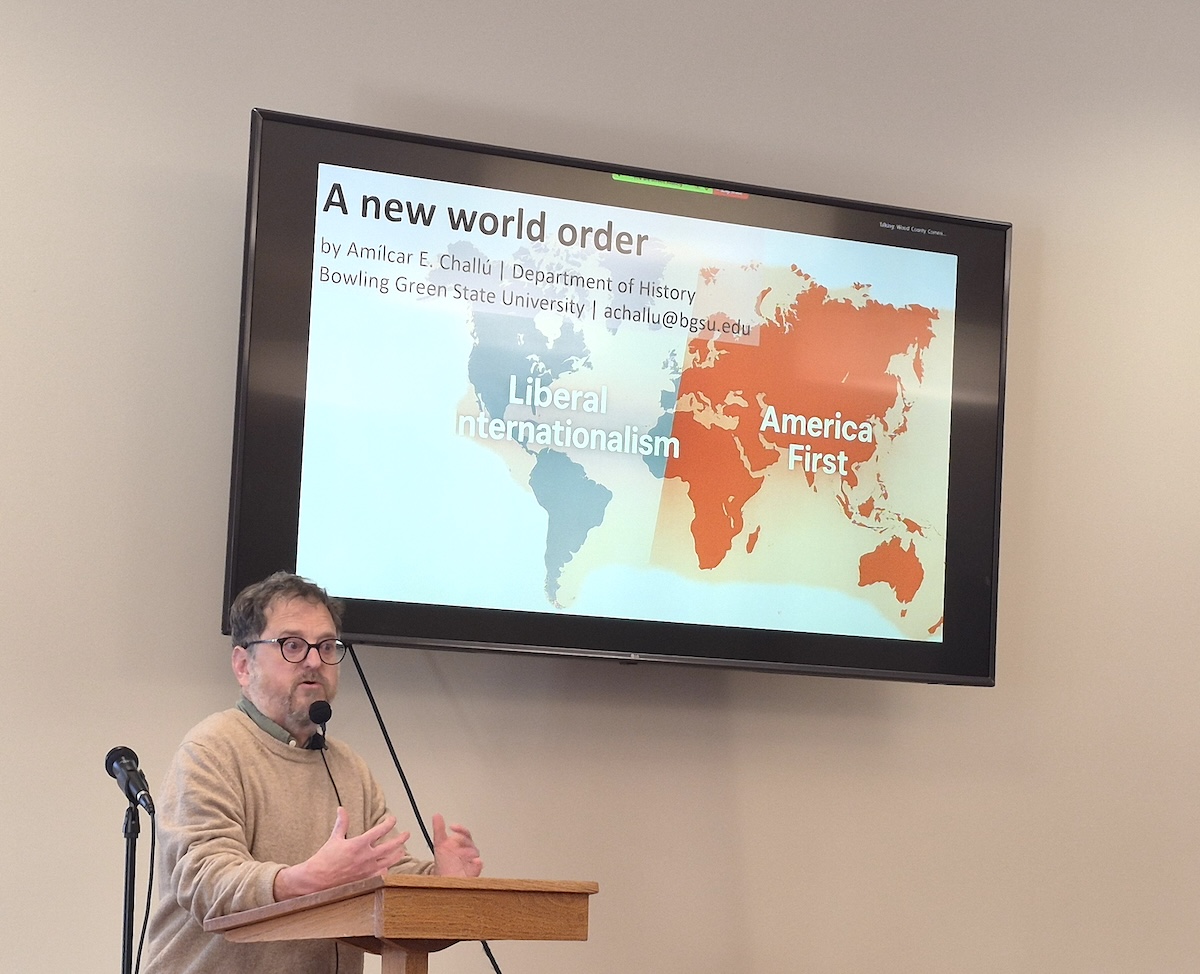
However, the soft power of liberal internationalism is in contrast to the current move towards an “America First” policy.
“Now, we’re in the middle of a huge transition in the international order from liberal internationalism to ‘America first,’” Challu said, characterizing it as a departure from the long-standing consensus that balanced idealism with realism in foreign policy.
However, he and several of the audience members concurred that the “post-war order has changed significantly, particularly with the economic rise of China.”
“The old order is not coming back. What’s going to emerge is, or is emerging is something different,” he said. “It may be that we don’t know exactly what it’s going to be, but I think it’s critical for us as citizens to think about, ‘What’s the alternative?’”
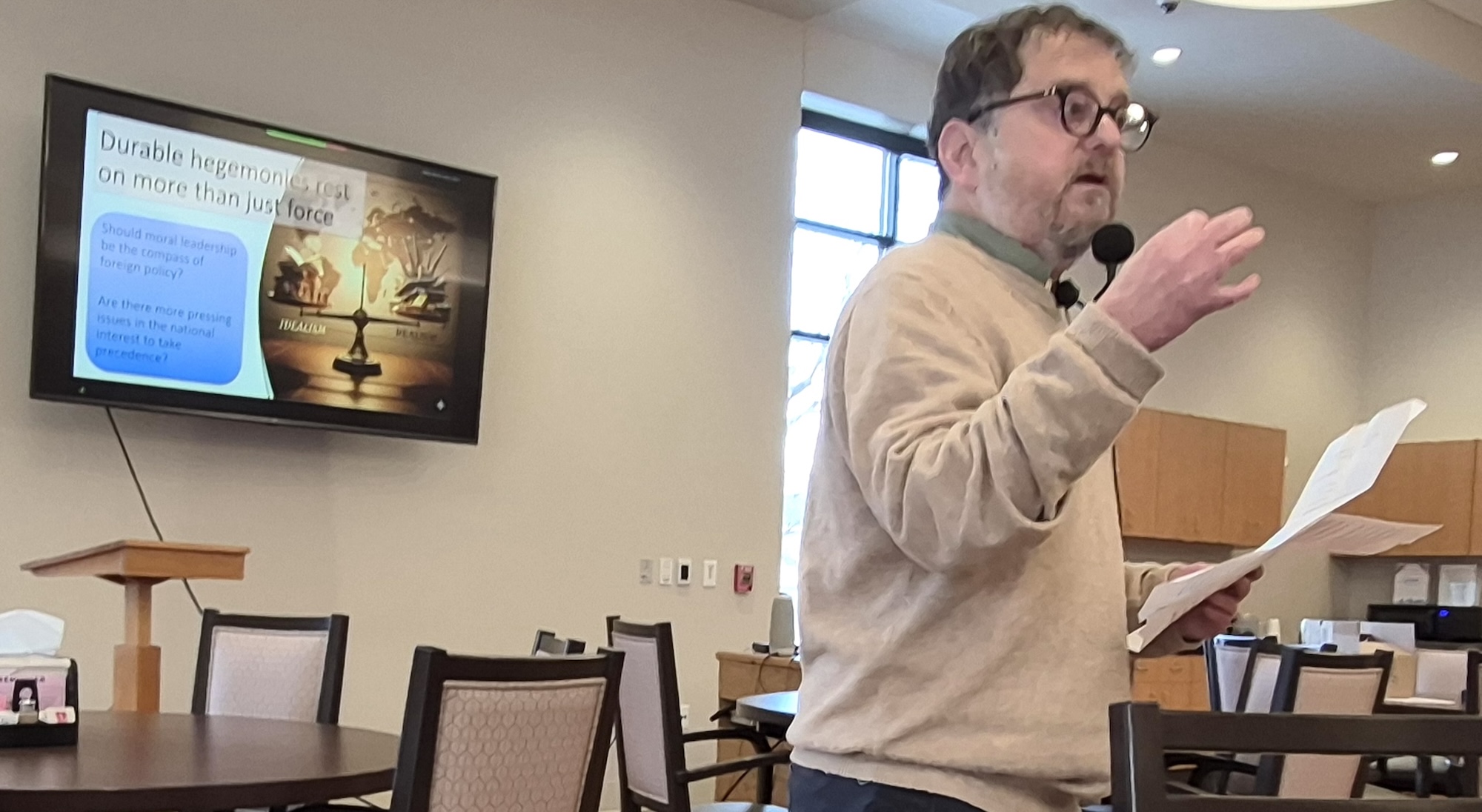
Lasting global influence of countries requires more than “the might of power” or military force, Challu said. “Durable hegemonies do not rest on hard power. They have durable hierarchical orders of power, and rest on a combination of threats to use the might of power, and most of the time using persuasion and soft connections.
“The whole premise is that the destructive dimension of ‘America first’ as a policy is breaking that liberal internationalism that preceded it,” he said. “But it doesn’t dwell much on ‘What is the positive vision? What is the promise?’”
There is a promise behind “America first.” It requires “getting a little bit outside of ourselves and seeing that more in between the lines and how other countries are reacting,” he said.
“Some of those considerations that were in place in that we were thinking about in 1823 that still today define American foreign policies. So that’s a plug to not forget about history,” he concluded.
The next Great Decisions talk is Saturday (Jan. 31). Dr. Stefan Frisch, associate professor of international relations at BGSU, will present and facilitate discussion about “Ruptured Alliances and the Risk of Nuclear Proliferation.” The sessions are free and open to the public; however, registration is required by calling the programs department at 419-353-5661 or 1-800-367-4935 or emailing programs@wccoa.net.