
By JAN McLAUGHLIN
BG Independent News
Two Ohio Supreme Court justices weighed in last week on the delicate balance between liberty and order, the need for separation of powers, and the lack of collegiality between increasingly polarized parties.
Bowling Green State University’s Day of Dialogue on Thursday featured Ohio Supreme Court Chief Justice Sharon Kennedy and Justice Jennifer Brunner, who spoke about judicial leadership on America’s 250th anniversary.
The annual gathering is intended to bring people together for civil dialogue, BGSU President Rodney Rogers said.
Introducing the luncheon topic was Mike Duffy, state chancellor of higher education, who said restraint outlined in the Constitution may mean change is “excruciatingly slow,” but it also has helped the nation avoid tyranny.
“Being consistent builds trust,” Duffy said.
The justices spoke about their responsibility to uphold the rule of law to create predictability and safety.
“It’s a concept of something that’s not concrete. It’s something that’s bigger than all of us,” Brunner said.
That predictability is lost when nations are in crisis. In Ukraine, people are focused on avoiding bombs and on not freezing when utility systems are destroyed, she said.
“You’re thinking purely about survival,” Brunner said.
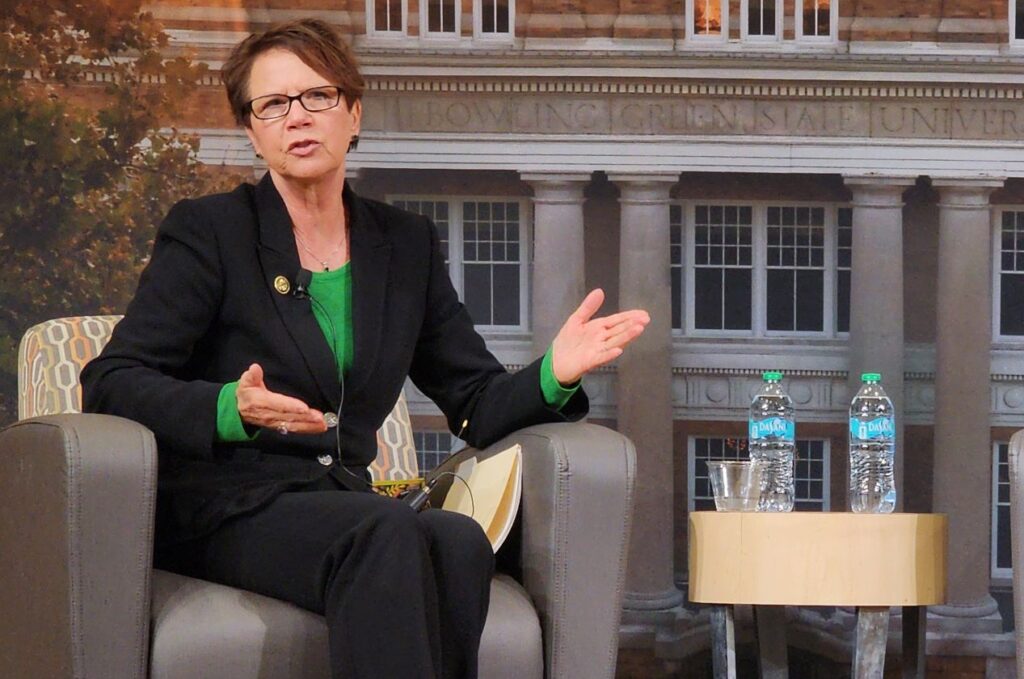
Kennedy spoke of the court’s role in maintaining the balance between liberty and order.
She talked about the need for preservation of the Fourth Amendment, the right of people to be secure in their persons, houses, papers, and effects, against unreasonable searches and seizures.
A former police officer, Kennedy talked about the restraints under the law when officers stop and frisk people.
Brunner spoke of the need to rein in illegal searches.
“It’s so important that we protect the process in our rule of law,” she said. “We are there to protect the process.”
Kennedy referred to a domestic violence case before the court that questioned if a civil protection order must be served by law enforcement – or if the offender can just be informed by someone with knowledge of the CPO. Kennedy interpreted that under Ohio law, just being informed was not enough – it must be through law enforcement.
The fallout from that ruling led to a legislative change that stated “substantial notice is enough,” she said.
That’s how the law should work.
“Those of us who choose to wear black robes” have to be comfortable making unpopular decisions based on the law as written. It’s up to the legislature to change the law to meet the need.
“I sleep just fine,” Kennedy said.
Brunner talked about the separation of powers as outlined in the Constitution. Whether a justice sees the Constitution as a “living” document or views it purely through an “originalist” lens, the three branches of government have specific roles that should not bleed over.
“Not only must they stay in their lane,” but they must occupy the entire lane, Brunner said.
Both justices spoke of the need for collegiality on the court. Moderator Dr. Joshua Boston referred to the well-known friendships between rivals such as Thomas Jefferson and John Adams, Ronald Reagan and Tip O’Neill, and Ruth Bader Ginsburg and Antonin Scalia.
Boston asked if such friendships are possible with the present polar isolation in politics.
Both justices hold out hope for civil discourse and relationships. Kennedy said as chief justice she has reinstated the Tuesday night dinners for the justices. Conversations are kept to topics such as family and vacations.
Writers of the Constitution often fought vehemently, but always returned to keep working on it – knowing it was bigger than themselves.
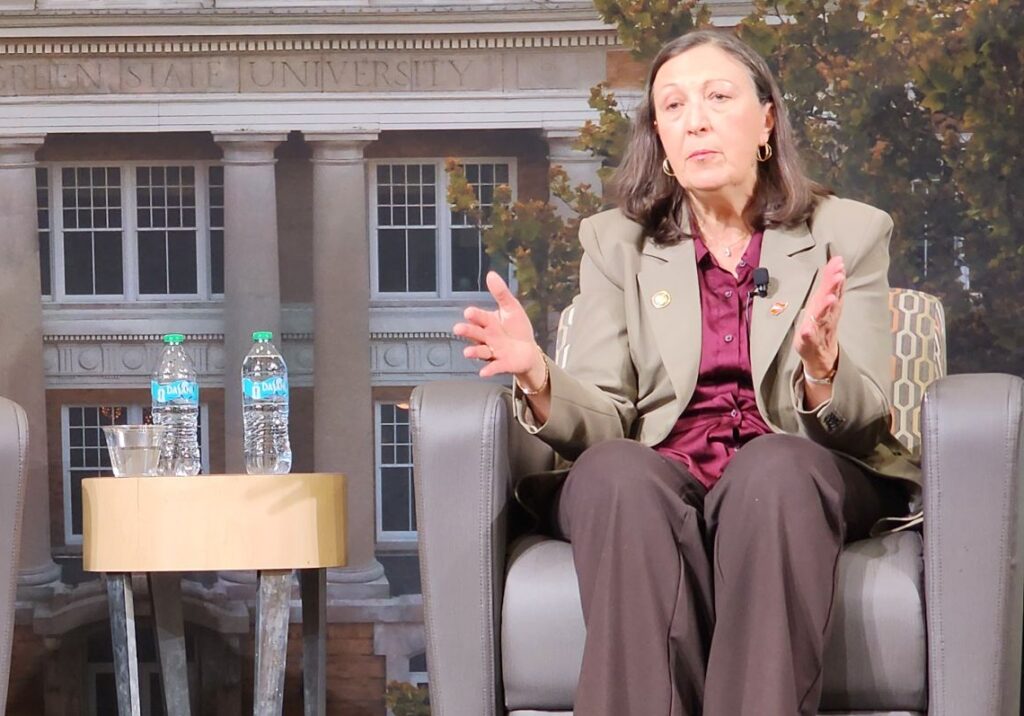
Brunner recalled the period after the 9/11 attacks, when people were nicer and spoke softer to each other. “If we could get back to that,” she said.
The two justices are an example of rivals who rose above the bickering. In 2022, Kennedy and Brunner ran against each other for the chief justice seat. Kennedy recalled Brunner calling to concede – something that used to be commonplace but has fallen from fashion.
Brunner is currently the only Democrat on the seven-member Ohio Supreme Court.
“Before anything else, we are public servants,” she said.
“We’ve been through tough times before. We’re in tough times now,” Brunner said. “You cannot let the hate and the fear change you.”
The Day of Dialogue, which was free and open to the public, is an annual opportunity for BGSU to discuss its responsibility as a public university for the public good.
This year’s event featured discussions with elected officials, government leaders, government affairs professionals, and members of the BGSU community, including students, faculty, staff, alumni and the broader public.
In addition to the Ohio Supreme Court justices, there were three panel discussions on the following topics:
- Teaching the founding documents and civil discourse.
- The role of dissent in American democracy.
- Federalist Paper No. 10 in modern America.
The overarching goal of the Day of Dialogue is for attendees to listen, learn and work toward changing the culture of democratic engagement in the United States. The annual event is presented by the Democracy and Public Policy Network and C. Raymond Marvin Center for Student Leadership and Civic Engagement.