By JULIE CARLE
BG Independent News
The war in Ukraine and strains within the transatlantic alliance have created one of the most uncertain strategic environments since the end of the Cold War, Dr. Stefan Fritsch said Saturday during the fifth talk of the 2026 Great Decision series.
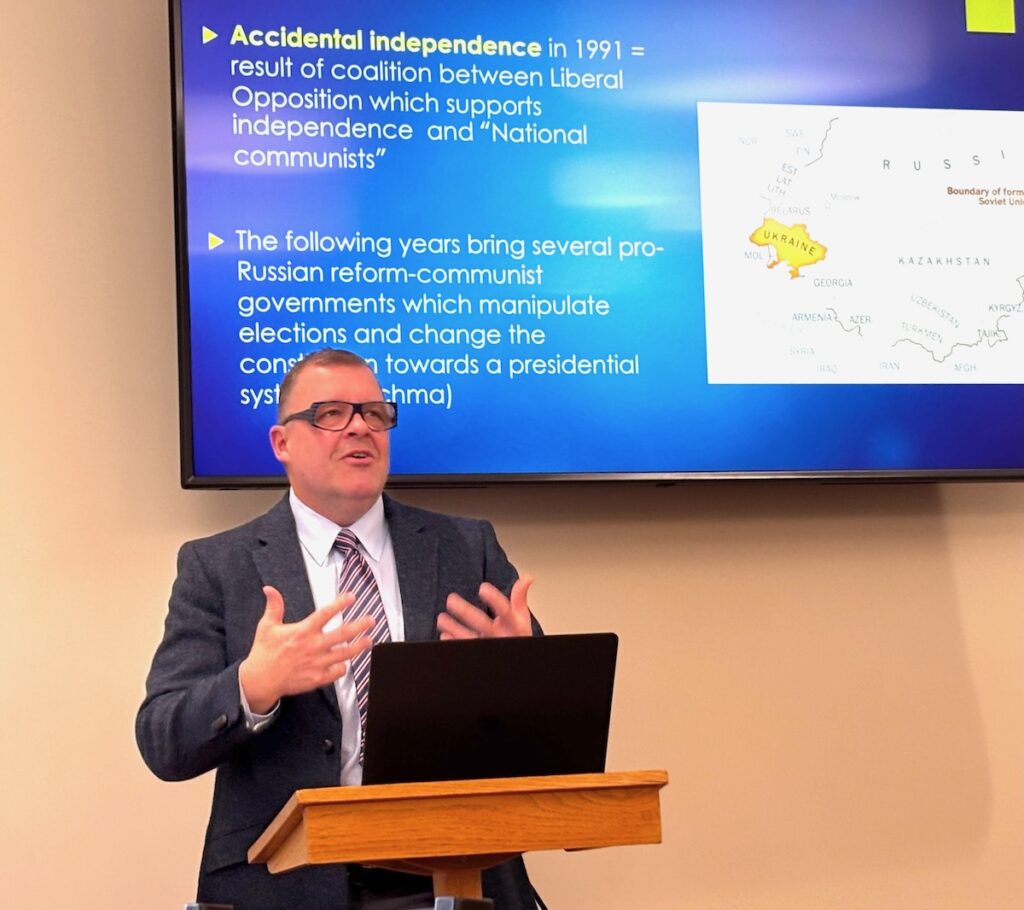
Fritsch, associate professor of international relations at Bowling Green State University, delivered an informative assessment of European security. He traced Ukraine’s complicated post-Soviet trajectory, describing its 1991 independence as “an accidental independence.”
Ukraine’s independence “wasn’t a big revolution,” he said. “There wasn’t a public uprising like in Hungary, Poland and eastern Germany. And there wasn’t a long history of a strong political opposition that would demand system chance.”
Instead, the country’s independence was negotiated between an existing liberal opposition and a subgroup of communists in power who were fine with the independence as long as the nationalistic communists would remain in power. The two groups formed an alliance that Fritsch said resulted in a “fragile political compromise” that led to decades of political instability and a tug-of-war between pro-Western and pro-Russian governments.
Those internal divisions shaped decades of instability and set the stage for today’s Ukraine-Russia conflict, he said.
The Orange Revolution of 2004 came after the elections were so manipulated that the people were outraged and went to the streets in protest. The revolution helped push Ukraine’s system towards a more transparent, democratic system.
In 2013, Ukraine was planning to sign an association agreement with the European Union, indicating its consideration of joining the EU.
Russia’s annexation of Crimea in 2014 was “our Munich with regard to the Ukraine, because the Europeans and the U.S. didn’t do anything about it,” Fritsch said. The muted reaction from Europe and the United States signaled weakness and emboldened Vladimir Putin. It was the first violent change of border in Europe after 1945, signaling to Putin that he could get away with something like that.
NATO and European rearmament
One of the factors in the changing world order of power is the shifting defense dynamics within NATO. Fritsch referenced the alliance’s push toward the 2% Gross Domestic Product (GDP) defense spending benchmark that began at the 2014 Wales summit in response to Crimea. While the initial push for increased defense spending among NATO countries predated President Donald Trump’s first administration, once elected, Trump accelerated the trend, Fritsch said.
With Trump’s second term in office, doubts about the U.S. reliability have pushed European governments toward greater “strategic autonomy,” including expanded military capacity and technological independence.
“The Europeans are trying to figure out, okay, ‘How can we become more independent?’” he said.
War of attrition
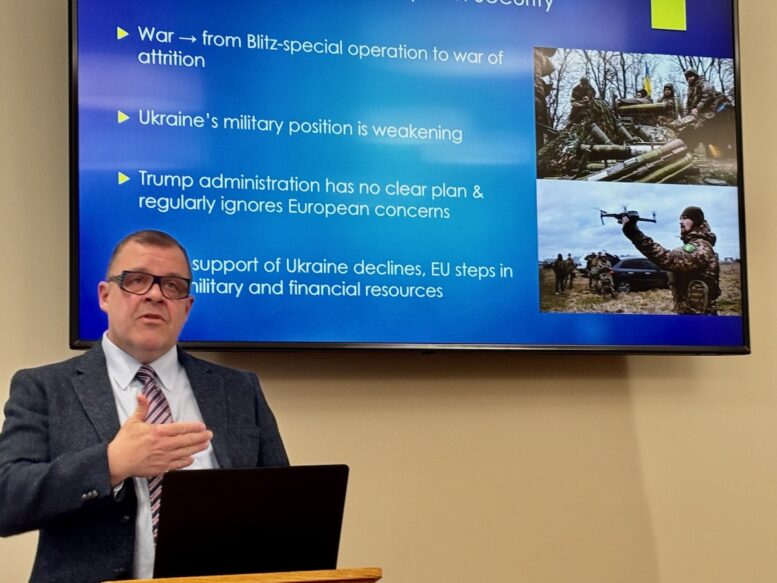
Fritsch called the current Ukraine-Russia war, having just reached the four-year mark, as “a grinding war of attrition“ that may ultimately favor Russia’s larger capacity to absorb losses. Russian forces are facing tactical shortcomings. He noted reports of aging equipment and unconventional recruitment methods as evidence of strain within Russia’s military.
Still, he warned against assuming a Ukrainian victory is inevitable. Instead, he outlined four possible end states for the war, ranging from outright Russian success to a fully victorious and NATO-aligned Ukraine. His preferred outcome, he said, would be a negotiated settlement preserving Ukraine’s independence and Western security guarantees, even if some territory remains under Russian control.
U.S. ‘soft power’ declines
During an extended Q&A, the discussion turned to the global perception of American leadership.
There is concern that domestic polarization and inconsistent foreign policy have weakened U.S. influence abroad.
“I grew up with the U.S. being the good guys,” Fritsch said about growing up in Austria. “I find that that soft power is being weakened considerably,” he said.
Since World War II, the U.S. has had a superpower status, which comes with hubris. Part of that superpower was soft power.
“There are good intentions that come with soft power,” he explained. “It’s not hard power like military power. It’s a more diffuse concept of power that is really hard to measure, but it still shapes people’s perceptions.”
Soft power includes the American way of life: freedoms, entrepreneurialism, “and a sort of moral guiding star.”
The change in strategy has shocked people, Fritsch said. “We have to come to terms with what’s going on in the U.S., because it is just so antithetical to what we all grew up with.”
There was never a question about the U.S. status. Today, that soft status has weakened considerably.
When a superpower lacks a coherent grand strategy, it limits the country’s effectiveness on the world stage. Fritsch said.
“That’s what I worry about in the long run,” he said. “It’s now clearly visible how pivotal the president is.”
Paul Mueller questioned whether U.S. policy might change after the midterm election. “I hope things change,” he said.
European Union and NATO nations are providing U.S. fighter jets, tanks and military equipment to Ukraine, and the U.S. is not saying, “Don’t do that. At the same time, they are saying, “We’ll sell you more, but you have to pay for it,” Mueller said.
“Wars are won by supplies. They are not won by men,” he added. “Russia would not have any chance against Ukraine unless it had the support of China. And China is using this as a test to see how firm the alliances are in the West.”
“I am completely disappointed how one man can change the entire world,” Mueller said. “If the election goes the way I hope in November, I think we’re going to get a backbone in this country and stop this man. That’s just my opinion.” His comments resulted in applause from many in the audience.
For attendee Charlotte Henning, Saturday’s conversation about world security in the face of the current climate was important enough to brave the cold weather to attend the talk. She has attended all of the 2026 topics.
“Each session has been different but interesting and informative,” she said. “It’s important to me because of the way I was raised.”
She credited her high school history teacher (and former BG mayor) Gus Skibbie, for instilling a curiosity about current events. He asked his students to subscribe to both Time and Newsweek magazines to help them discuss what was going on in the country and the world at the time.
“We had to talk about and debate the news all the time, so that set the stage,” she recalled.
Looking forward, Fritsch posed several unresolved questions: whether Europe can sustainably expand its defense capabilities, how Ukraine’s eventual reconstruction would be financed, and whether any workable relationship with Russia is possible after the war.
“I honestly, I don’t know how you get back to some sort of constructive relationship,” he said. “I’m still looking for a grand plan, particularly when it comes to foreign policy. Previous administrations had sort of a vision; now this administration is so crudely transactional that I haven’t figured out a grand strategy yet. A superpower without a grand strategy is a little concerning to me.”
The forum left attendees with a clear message: the conflict in Ukraine is not only reshaping Eastern Europe but also forcing a fundamental reassessment of Western unity and long-term global strategy.
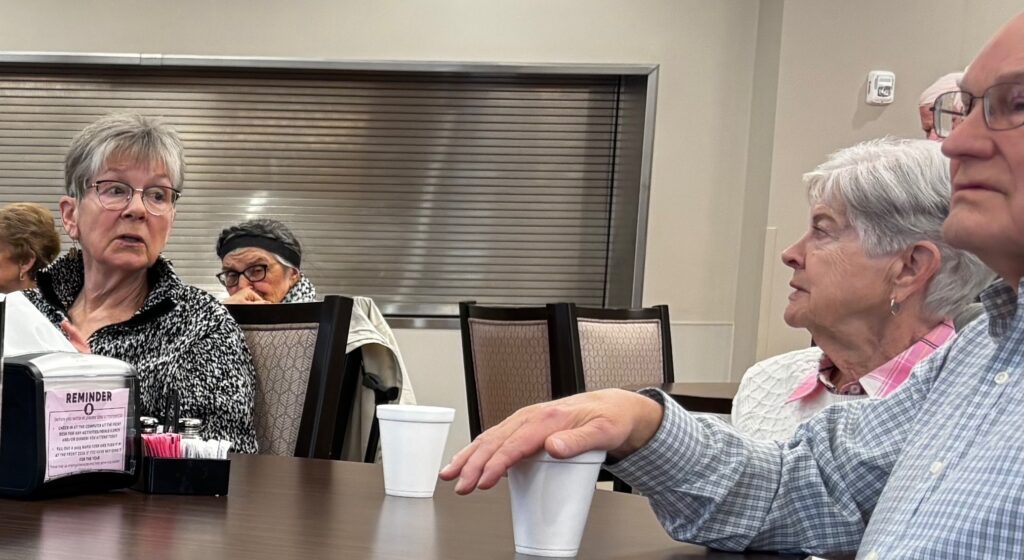
“There are things that I’m concerned about. And to be in a room with people who also seem to be concerned one way or the other, it’s good for me to hear their points and opinions,” said Susan Gavin of Perrysburg, who has attended the Great Decisions lectures to learn more.
The Feb. 14 talk “was enlightening to know all the economic impacts,” she said. “All of the talks have been kind of disheartening because of the reality of the issues, but it also gives me comfort to know that there are professionals and people deeply involved in this who also have unanswered questions, as well as hope for us coming out of this.”