
By JULIE CARLE
BG Independent News
In the small towns of northwest Ohio, history isn’t just found in books or museums—it lives quietly in the buildings, streets, and fading photographs tucked away in family albums. For Donald C. (D.C.) Wells, those fragments of the past have become something more: a calling to bring history back to life.
Though his roots trace back to northern Vermont, Wells has spent most of his life in northwest Ohio, a place he now considers home. Growing up in and around its small towns shaped his perspective early on. He found himself drawn not just to the places he passed every day, but to the stories behind them—the generations who walked those streets, ran those businesses, and built those communities.
That curiosity eventually turned into a creative pursuit.
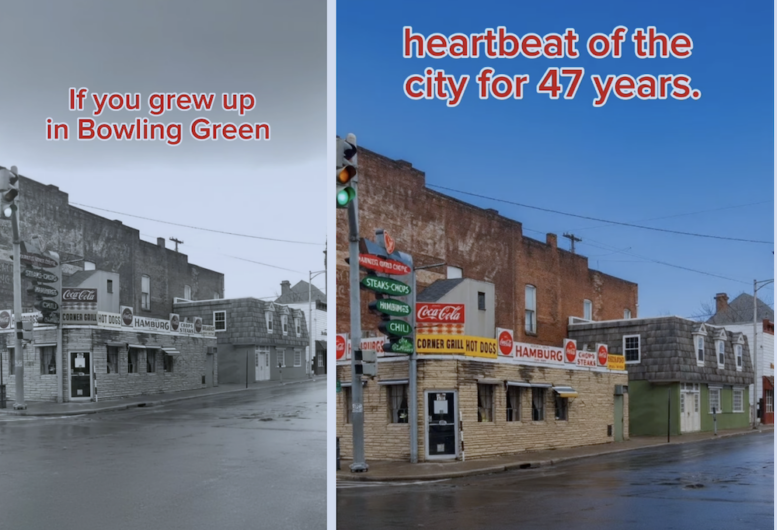
What began as a simple experiment—colorizing an old black-and-white family photo of him and his sister—quickly grew into something much larger. After that first attempt, Wells turned his attention to historic images from Bradner, where he has lived for the past two decades. Seeing familiar streets and buildings frozen in time sparked a deeper question: what did these moments actually look like when they were lived?
From there, his work expanded into restoring and colorizing historic photographs of towns, businesses, and everyday life across the region. When he began sharing his creations online, something unexpected happened. People didn’t just admire the images—they responded.
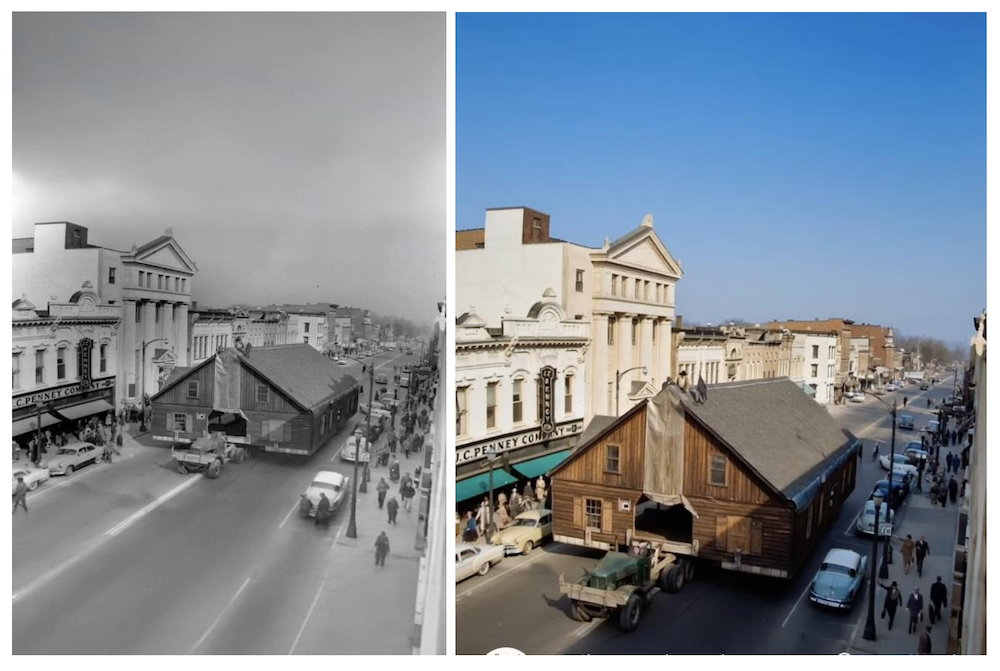
“They started sharing their own memories,” Wells said. “Stories, family connections, even photos. That’s when it became more than just a hobby.”
At the heart of Wells’ work is a deep appreciation for local history—not the grand, headline-making events, but the everyday moments that define a community. A corner store run by someone’s grandparents. A movie theater that once filled up on Saturday nights. Streets where generations grew up and built their lives.
By restoring and reimagining these images, Wells creates a bridge between past and present. For younger generations, his work offers a glimpse into a world that no longer exists and that they will never know firsthand. However, by recreating the rhythms of small-town life decades ago in the long-gone businesses and vanished landmarks, Wells is able to connect the young
For older viewers, it often stirs something more personal.
“A lot of people see these images and remember being there,” he said. “Walking into a store, going to a movie, spending time with family. It brings those moments back in a way that feels real again.”
That emotional connection is what gives his work its meaning.
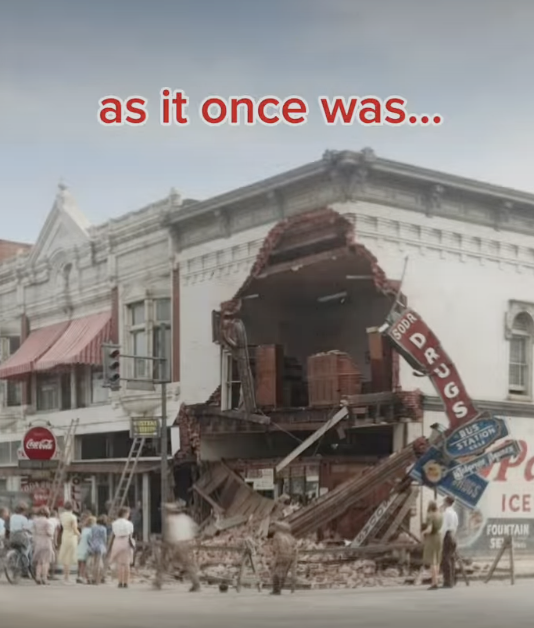
But behind each restored image is a meticulous process. Wells emphasizes that his work goes far beyond simply adding color. He studies every detail in the original photograph—buildings, signage, clothing, vehicles, even clues about the season or time of day. He cross-references old maps, city directories, postcards, and other historical materials to ensure accuracy.
“The goal isn’t to invent history,” he explained. “It’s to enhance what’s already there.”
While modern tools, including AI, play a role in his process, Wells is careful to use them responsibly. For him, technology is a tool—not a storyteller. The integrity of the original photograph always comes first.
“I try to limit the AI from adding its own imagination,” he said. “The buildings, the streets, the details—they stay true to the original image. That’s important.”
Whenever possible, he also seeks out historical color references—old postcards or rare color photographs—to guide his work and make the final result as authentic as possible.
Today, Wells shares his restorations of northwest Ohio communities and beyond, primarily through his Facebook page, Rediscovering History As It Once Was, where his work continues to resonate with a growing audience. But over time, he has come to realize that the images themselves are only part of the story.
“The most important part is the community response,” he said. “People share memories about their parents, grandparents, and places that don’t exist anymore. Those stories add layers you won’t find in books.”
In many ways, Wells’ project has evolved into something deeper than visual restoration. It has become a living archive of shared memory—one that captures not just how places looked, but how they felt to the people who lived there.
As those stories surface in comments and conversations, they create a collective history that might otherwise be lost.
For Wells, that’s the true purpose of his work: not just to preserve the past, but to reconnect people with it. Because sometimes, all it takes is a single photograph—brought back to life—to remind a community where it came from.
