By JAN McLAUGHLIN
BG Independent News
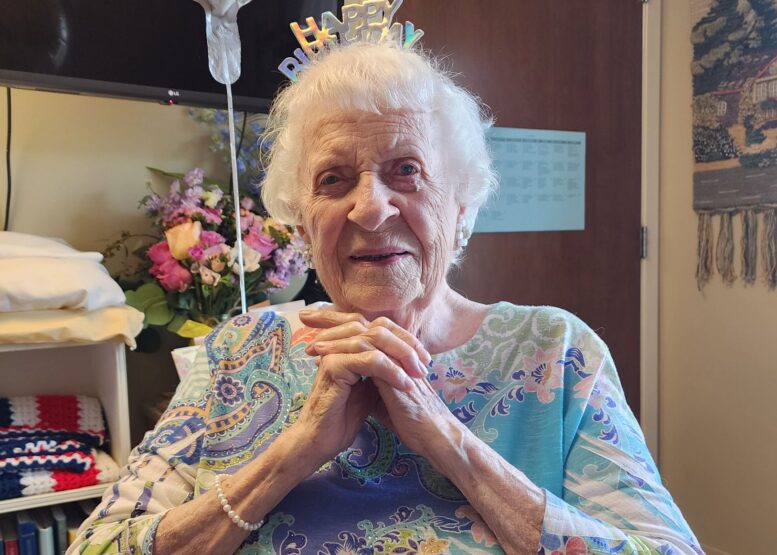
With a birthday tiara on her head and a helium balloon tied to her wheelchair, Geraldine De Meo apologized for not having any interesting stories to share on her 100th birthday.
Then she went on to talk about becoming a nurse during World War II, driving from coast to coast in her first car, losing her brother to polio, and finding her husband at a dance.
“I wish I had something exciting to tell you,” said De Meo, who everyone calls Geri.
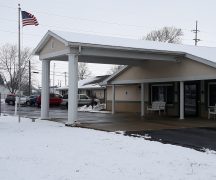
Now a resident at BG Manor in Bowling Green, Geri grew up in Pandora, in Putnam County, Ohio – in a town that seemed bustling at the time. But when her work and her hobbies took her to New York City and Europe, she found that her hometown was really more like a tiny hamlet.
Her father was the postmaster, and her grandfather owned a department store, selling everything from groceries, adult clothing and children’s shoes.
A photo on her dresser shows Geri and her younger brother, Galen, with their flutes when they were 10 and 11 years old.
“He came down with polio,” she said of Galen. “He lived to survive it, but he didn’t live long after that.”
Two weeks after high school graduation, Geri started nursing school at OSU. “That was before you had to say ‘The’ Ohio State University,” she said with a grin.
“The war was on and everybody was doing something,” she said. “I remember looking at the different opportunities for females, and there wasn’t much.”
So she and several other nursing students signed up for the Cadet Nurses Corps, under the U.S. Public Health Service, to help alleviate the nursing shortage during the war. She still remembers taking the Florence Nightingale Pledge with her fellow classmates.
“It was quite exciting,” she said.
“I remember my student days with fondness. It was quite a bit different than Pandora,” Geri recalled. “It’s important you like what you’re doing.”
After graduating, she and some nursing friends moved to New York City. “Wherever I went, nurses could usually find a job.”
When Geri got her first car, she and three other nurses packed up for a road trip from the east to west coast. “We had all kinds of adventures,” she said.
While Geri couldn’t recall the exact model of the car, she was certain it was a Dodge or Plymouth since she was always partial to those.
Like many single women in those days, she often spent her spare time dancing.
“Ballroom dancing was a big thing,” she said. And one day she met her future husband. “ He was a good dancer.”
From childhood to now, Geri has always loved performing music. Her vocal and instrumental skills took her on choir tours across Europe, where she lived with families where they were performing.
“That’s the best way to travel to Europe,” she said. “Americans have not always been received well in Europe, and the average American is asleep at the switch.”
She played flute and piccolo in concert bands, and enjoyed performing in trios with oboes, English horns or bassoons. “I enjoyed the team effort.”
“All of my life I have sung in choirs. I really miss that,” she said. But there came a time when she felt she should withdraw from choir memberships.
“I didn’t think my voice was enough of an asset to selfishly keep my place in choirs,” she said.
Geri’s room has a shelf of books – another longtime love of hers. “I’ve always belonged to book clubs,” with her favorites being novels and historical fiction.
Geri also expanded her palate over the decades, starting in Pandora with Swiss steak being a staple. “I don’t know what they call it nowadays,” but the meal was a family favorite, with sweet potatoes braised in butter and other available vegetables.
“Coming from Ohio, it’s whatever you grow,” she said. “But I discovered if you go other places, they grow other things.”
Geri decided to move back to Ohio from California a couple years ago to be with her son, Peter, who is also a resident at BG Manor. She also has a daughter, Antonia De Meo, who is Deputy Commissioner-General of the United Nations Relief and Works Agency for Palestine Refugees in the Near East.
“Coming back was a culture shock,” Geri said.
She marvels at the progress she has witnessed over the past century – from the first phone installed in her childhood home to computers being everywhere. When her family got a phone, it was used sparingly.
“You had to have your chores done first,” she recalled.
Because of her family’s workplaces, they were among the lucky phone customers who didn’t have to share party lines with neighbors.
“I don’t have any party line experience. Nor do I want any,” Geri said.
She isn’t the only one in her family to have longevity genes.
“I never considered making it to 100,” she said. “But my mother lived to be 103. I really have been fortunate. I try to live a moderate life. I think I kind of show the results of that.”
There are times when Geri still misses working as a nurse.
“I remember thinking I should quit before they said I was too old to be a nurse,” she said.
“My hands don’t work so well anymore,” she said, running a finger over her veins that protrude from her hands.
“And who’s going to hire a nurse with this color hair,” she said, touching her head of white.
But Geri has more pressing matters now. Someone else can handle the nursing, she has social obligations.
As soon as her interview was over, she rolled her wheelchair into the hallway and aimed for a group of people congregating in a nearby room.
“Let me see what’s going on out here,” she said with a smile.