
Written by GEOFF HOWES
BG Historic Preservation Commission
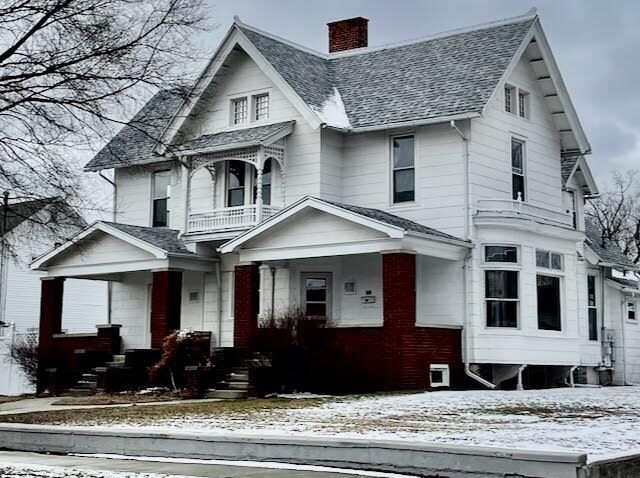
The house at 202 S. Church St., on the southwest corner of Clough Street in Bowling Green, has been home to a remarkable number of people. From 1924 to 2010 it was a duplex rental, and the units changed hands often.
The house was built sometime between 1884 and 1888 as a residence for Wood County Prosecuting Attorney Robert S. Parker and his family. It first shows up on the 1888 Sanborn insurance map and can be seen on the 1888 bird’s-eye-view map of Bowling Green.
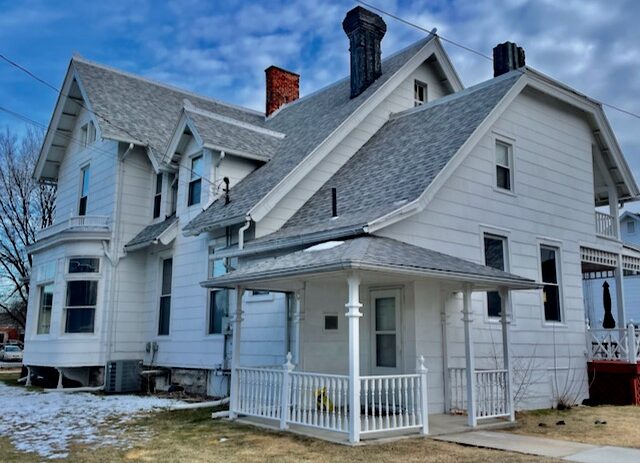
With its simple lines and decorative detailing, this two-story home is an example of late Victorian architecture. The T-shaped cross gable roof has side gables, a longer roof in the back, and a short projecting gable in front, which includes a small balcony with gingerbread trim. The roof peaks are adorned with ridge crests ending in simple but elegant finials.
The two porches, which replaced an original single porch when the house was converted to a duplex in the 1920s, show Craftsman features such as massive brick pillars and low-pitched overhanging gables.
Further additions were made on the south and rear sides, which detract somewhat from the original simple symmetry, but decorative trim harmonizes them with the Victorian style.
The interior retains much of the original décor, primarily in the Eastlake style, characterized by dark woodwork with geometric designs, spindles, and low relief carvings. Two of the three fireplaces feature natural stained wood with ceramic tiles and sculpted mantelpieces framing mirrors. Large bay windows on the north and south ends include stained-glass transom panels. An ornate staircase, pocket doors, and built-in wooden cabinets contribute to the dignified elegance of the rooms.
Robert S. Parker (1855-1933), born in Findlay, taught himself law and passed the bar at age 21. He practiced in Bowling Green and was elected Prosecuting Attorney of Wood County at age 26. At age 42 he was appointed to the Sixth Circuit Court of Ohio. He lived on South Church with his wife Susan and children Edward and Julia. Among other community activities, Susan hosted the Bowling Green Literary Society in her home. Later, suffering ill health, Robert moved to California, recovered, and practiced law there.
The next owner was Marshall R. Gorrill (1854-1918), at various times a teacher, farmer, oilman, and manufacturer. When he was elected Wood County Commissioner in 1904, he and his wife Ida moved to Bowling Green. They eventually returned to their farm on Conneaut, near the road that bears their name. The Gorrills and their three children are interred in Oak Grove Cemetery.
The next owners of 202 South Church were W. I. Woodin, a manager at Froney’s department store on South Main (now Waddington and Juniper); John L. Hill, an undertaker and Methodist Episcopal minister; and John J. Allen, a physician.
In 1923, the undertaker D. W. Young purchased the house from Dr. Allen and converted it into a “two-family home,” which he rented out, often to established people who had moved to BG and needed a place to live while they looked for a house to purchase.
D. W. Young (1856-1947), the son of German immigrants, was born on a farm in Seneca County. At 17, he joined his brother’s embalming business in Green Springs and later started his own mortuary and furniture store in Paulding. He moved to Bowling Green in 1897 and purchased the A. V. Powell mortuary. Young built his own hearses, first horse-drawn and later motorized. In 1915 he designed a new building for his business on South Main, where Lahey Appliance and Coyote Beads are now. Young and his wife Jennie Ella (born Lott, 1860-1949) lived at 306 Haskins Road. He retired in 1941, the year the mortuary moved to 408 West Wooster (now Dunn Funeral Home) to be operated by his son Carl as Young Memorial.
The addresses of Young’s duplex were 202 and 204 South Church. Residents of 202 during the 1920s included Ernest Ketron and D. J. Hutchinson, both regional supervisors for the A&P grocery chain. C. Forrest Shellabarger occupied 204 from 1925 to 1927.
From 1928 to 1934, Merrill C. McEwen (1900-1957) and his wife Marcella (born Kammerer, 1901-1952) lived at 202 South Church. McEwen arrived in Bowling Green in 1921 as a music instructor at the college, eventually becoming professor and chair of music. He had degrees from Columbia and Ohio State and studied at Juilliard. A cellist and violinist, for many years he directed the BGSU Orchestra. Marcella McEwen taught music in the Bowling Green schools and was active in the local music community.
In 1934, the Rev. Gerald H. Coen (1902-1991), pastor at the United Brethren Church, lived in 204 with his wife Bessie (1907-2002). In 1935, Dana M. Halleck (1904-1955) lived in 202 and Thomas and Jenny Jeffrey lived in 204.
From late 1938 to 1939, a pharmacist from Lima, Edward E. Hansaker (1880-1939), lived in 202 with his wife Clara. In 1939 he had just purchased the drug store in the Lincoln Block on North Main at East Wooster (now the Army recruiting office) and remodeled it as a Walgreen agency, when he suffered a stroke and died. The visitation was held in his home, where Clara Hansaker stayed until 1940.
In 1941, Vance E. Harden (1911-2006), assistant manager for Montgomery Ward, and his wife Evelyn (1911-2003) rented unit 202. From 1942 to 1945, William Insull (1891-1967), who came from Scarsdale, New York, to manage the Northeast Public Service Company, lived in 202 with his wife Madge (born Morris, 1899-1990). Although they moved on to Michigan, the Insulls are buried in Oak Grove Cemetery.
In 1945, the owners D. W. and Jennie Ella Young and their daughter Bessie (1885-1952) moved from Haskins Road into number 202. In 1950, Bessie married Leslie F. Robertson (1877-1963), and they lived in number 202 until her death in 1952.
Harriet Hayward (1873-1957) and Alice Roth (1889-1979) lived in number 204 from 1949 through 1952. Hayward was born in Massachusetts and studied at Columbia, MIT, and Oxford in England. She joined the faculty of Bowling Green Normal College in 1915. Hayward organized teacher training in the city schools and supervised the program for 25 years. Upon her retirement in 1941, she was praised for “her influence as a gifted teacher, her ability to impart knowledge, enthusiasm and a conscientious regard for the responsibility of the teaching profession.”
Roth was a supervising teacher at BGSU and the Ridge Street Elementary Training School. Harriet Hayward and Alice Roth lie buried together in Maple Grove Cemetery in Findlay.
Some of the notable people who lived in 202 or 204 South Church in subsequent years are: G. Lee Caldwell (1941-1999), an adviser in Arts and Sciences at BGSU (204, 1969-73); Robert M. Danek (1929-2013), an English instructor at BGSU who went on to teach in New York, Oklahoma, Arkansas, and Saudi Arabia (202, 1971-73); Harvey L. Noyes, who earned a Ph.D. in psychology at BGSU in 1976 (202, 1974-76); Don B. Ralston, a teacher and coach in Gibsonburg (204, 1974-77); Joseph D. Terry, a Wood County Hospital employee and local historian (204, 1989-97); Priscilla K. Coleman, a BGSU professor of Human Development and Family Studies (202, 2003-2006); and Coleman’s son Joseph Bak-Coleman, a noted computational social scientist who earned a Ph.D. from Princeton and has been affiliated with the United Nations, Harvard, the University of Konstanz in Germany, the University of Washington, and Columbia University.
As of 2011, the house was no longer a duplex and was occupied by the owner until it was sold in 2024. It is now owned by Writer’s Residence LLC.
(Written by Geoff Howes of the Bowling Green Historic Preservation Commission. With thanks to the Sentinel-Tribune and the Wood County District Public Library.)
Would you like to nominate a historic building or site for recognition? You can do this through the city website at – https://www.bgohio.org/FormCenter/Planning-13/Historic-BuildingSite-Nomination-Form-83
You can learn more about the Historic Preservation Commission by attending their meetings (the fourth Tuesday of each month at 4 p.m.) or by visiting their webpage at – https://www.bgohio.org/436/Historic-Preservation-CommissionG
