By DAVID DUPONT
BG Independent News
Beth Macy published her first story when she was a journalism student at Bowling Green State University.
Her magazine writing professor, Vickie Hesterman, required all her students to submit their work for publication. If the story made it into print, the student got an “A.”
Macy recalls Hesterman working with her to edit the piece before she submitted it. She was like a “mom and a teacher all in one,” Macy recalled in a recent telephone interview.
Macy got her “A” when the article, prompted by the death of her father, was published in Seventeen. Her father was an alcoholic who was so distant from her that he once questioned whether he was indeed her father.
In the four decades since, Macy, a 1986 BGSU graduate, has continued to make the grade in her field, most recently with book-length works of journalism. Her second book, “Dopesick,” was turned into a Hulu series. “Dopesick” is a deeply reported chronicle of the human devastation wrought by the opioid epidemic.
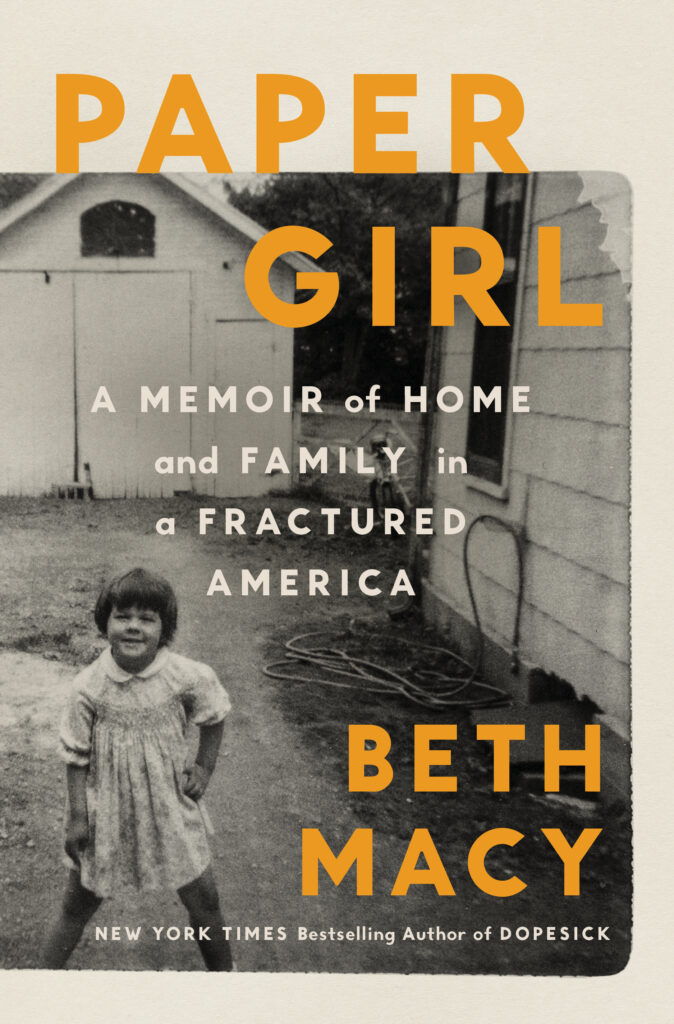
Macy has now published her third book, “Paper Girl: A Memoir of Home and Family in a Fractured America.”
Like that early piece in Seventeen, “Paper Girl” was also connected to a death in her family — her mother’s. On the other hand, Macy said, “I was always really close with my mom.”
Macy was at her mother’s bedside with her older sister, Cookie, in 2020 when the votes for president were being tallied.
When the election was called for Biden, Macy recalls, “my sister just kind of went off and said, ‘it’s fraudulent.’”
That belief is now common currency, promoted by Trump himself, but at the time it was shocking, Macy said.
“I wasn’t quite aware of how deeply different our realities were. It was a real shock,” especially coming at the same time as their mother was dying. “It was so stunning that it made me think: ‘Was there going to be anything left of my family after mom died?’”
So started a journey back to her roots in Urbana, Ohio.
She turned her reporter’s eye on what are the most uncomfortable subjects: the ideological chasm with her own family, as well as the divide in the community she grew up in and, as a “class migrant,” away from.
She placed these in the context of a national crisis, trying to untangle the social and economic forces that have pulled Americans apart and wreaked havoc on their lives.
In the book, she cites an “analysis of rural resentment” by Anthony Flaccavento, who runs the non-profit Rural Urban Bridge Initiative.
The memo asserted “bad trade deals … made the rich richer and smugger” and people” like working and middle class folks in places like Urbana “poorer and angrier.” These led to “the hollowing out of small-town America” as did deregulation of Wall Street under the Clinton and Obama administrations. The elite’s dismissal of “yesterday’s occupations” was further salt in the wounds.
Macy sent this to an ex-boyfriend, who had gone from one of the most liberal people she knew to a believer in hard-right ideology. He dismissed it angrily as wrong-headed condescension.
The ex-boyfriend, she writes in “Paper Girl,” became disillusioned with the Democrats during the Monica Lewinsky scandal, then the bombing of Serbia, which he saw as Bill Clinton’s attempt to distract from the scandal. Then, “he hated that Obama had essentially reneged on a promise to change bankruptcy laws that would have helped struggling homeowners during the 2008 recession while bailing out big banks and carmakers, and Obama’s support for unprecedented mergers in big tech and Pharma. About that, Bill wasn’t wrong.”
Macy had left this troubled milieu in 1982 thanks to the “miracle” of a Pell Grant that paid for her education at BGSU. Her mother knew the truth. When they drove in their Mustang with a bad clutch to campus that young Beth would never return to Urbana to live. “You know, I could never come home enough to please her.”
Now to research her book, she traveled monthly from her home in Roanoke, Virginia, to her Ohio hometown. She reconnected with siblings and old friends.
These visits yielded portraits of a cast of characters, drawn in clear prose.
Her mother casts a shadow over the narrative and analysis. Her siblings, all more than a decade older than she, and their spouses, portrayed with nuance are vivid in their troubled relationships with Macy. The reader meets students who, like Macy, long to improve their lives as well as the teachers who struggle to help them achieve that.
Yet, the bridge to that escape has been drawn up, Macy reports.
The amount of Pell grants has diminished under administrations led by both parties as the costs of higher ed have risen, and state support for all forms of education has cratered.
At the same time, the economic opportunities at home disappeared as long-time, homegrown enterprises were bought out and eventually closed or gutted.
Among those troubled businesses were local newspapers, including her hometown paper The Urbana Daily Citizen. Macy got her start in the business at the Daily Citizen, first delivering the paper, earning her the nickname that is now the title of her book.
Later, she served as an intern there, including covering the “sheep beat” at the county fair.
But Macy writes: “The newspapers they’d once read had become skeletons of their former selves, their content reduced to crime, high school sports, and ads for gun shows and shooting ranges.”
Her siblings and many others in her hometown turned to right-wing media, Fox News and NewsMax. “They no longer believed” the traditional media.
The local schools were failing with more and more parents opting for home schooling, which is barely regulated. Other kids were enrolled in public school don’t bother to show up.
Macy trailed along with a truancy officer, trying to track down students skipping school. That means dealing with disinterested caretakers, recalcitrant students, as well as people who set their dogs on her in places with signs that warn her that she is now in range of their guns.
This is a truancy officer Macy refers to as “the mobile helper of last resort.”
Other helpers include English teachers and band directors — the current one even made sure Macy had a trumpet so she could march with the alumni band during her high school reunion.
Then there are those students who want to succeed, despite the obstacles set in their way. We meet Silas, a transmale, who, despite being homeless because of the chaos of a life with drug addicted parents, strives to go further.
Despite the challenges of his home life, he still served as the marching band’s drum major. Without the option of a Pell Grant to attend a four-year school, he opted to pursue a welding program at a local community college.
Macy and her husband, whom she met at BGSU, live in Roanoke, Virginia. They have two sons — one a gay male, one non-binary.
She had to explain to her brother, Tim, what being non-binary meant. Now he’s a big fan of her son Sasha’s band Palmyra. He had also faithfully traveled to Virginia to see him in musicals, until he unfriended Macy on Facebook because of what she was posting, and missed the date of one. Tim was the only one of her three siblings to attend Macy’s other son’s wedding.
Whenever she asks her sister Terry’s husband how he’s doing, he responds “deplorable,” a barbed reference to Hillary Clinton’s description of Trump supporters.
Her sister Cookie’s third husband sexually abused her daughter. Cookie stayed married to him, and it was covered up by their church.
Macy has grown close to her niece. They traveled to Ireland together.
As these tensions heightened as the 2024 election approached, Macy was advised to and considered carrying a gun.
She asked her publisher to extend her deadline so she could include the election results.
The bullies won, Macy writes. “The consummate showman conned most voters into thinking he cared. I blame Trump and his billionaire enablers, not them.”
Now, people across the spectrum are left with how to bridge the divide in their own circle of friends and families.
With her siblings, she said, “they’re talking to me, but we have to figure out how to love beyond what we can’t understand or agree with.”
With her brother Tim, she said, “We’re not trying to change each other’s minds. We’re just extending grace to each other. If he brings up politics, I just don’t go there anymore.”
One person from Urbana told her that America seemed to be heading toward a society like in “The Hunger Games,” with everyone segregated in their own districts based on their beliefs. That statement, Macy said, comes back to her over and over. Is this really where America is heading? Is this where democracy ends?
Some people don’t feel physically safe interacting with their families, making the relationship impossible.
But for others, she said, “I think it’s worth trying and meeting on the things you do agree on, which is family traditions and food and holidays. Just really trying not to take everything quite so personally. And remembering why it is, we’re all together on this planet, at this moment. We love each other.”