
By JAN McLAUGHLIN
BG Independent News
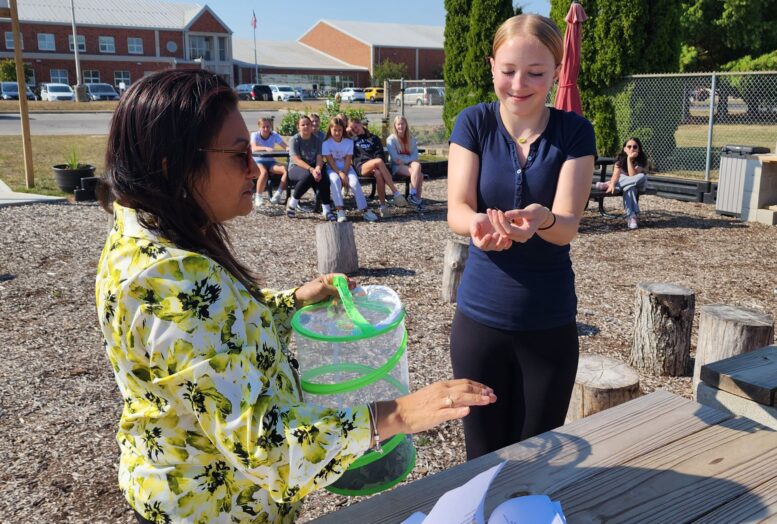
A lesson on language and science at Bowling Green Middle School took flight last week – literally.
Students in Clari Timmins’ Spanish classroom had adopted six caterpillars and watched as they transformed from crawling creatures to chrysalis, then to beautiful monarch butterflies. Last week, the classes released the monarchs to make their 3,000-mile journey to Mexico.
The lesson blended language, Mexican cultural traditions, science and conservation. To make the unit come alive, Timmins brought the caterpillars from her backyard.
“Over the past four years, my family and I have dedicated a corner of our garden to planting milkweed, the host plant that monarch caterpillars need to survive,” Timmins said. “This small act has helped provide a safe space for monarchs, whose populations have been in serious decline due to deforestation, the loss of milkweed, and the increasing frequency of powerful storms.”

On Friday, students from a Spanish 1 class gathered in the Lubrizol outdoor learning lab at the middle school to watch the butterfly that they named Patricia, start her journey south.
“How long is it going to take Patricia to get to central Mexico?” Timmins asked, with students answering that the trip will take a couple months.
Students had closely observed each stage of metamorphosis – learning both the science behind it and the Spanish words for the butterfly’s life cycle: eggs (huevos), caterpillar (oruga), chrysalis (crisálida), and butterfly (mariposa).

They discovered how monarchs depend on milkweed, where females lay their eggs and where the newly hatched caterpillars feed and grow. From there, the caterpillar forms a chrysalis, transforming into an adult butterfly.
While most fragile adult monarchs live just two to six weeks, the fourth and final generation each summer is aptly named “super generation” monarchs. These butterflies live up to nine months, migrating 2,500–3,000 miles to central Mexico to survive the winter, before returning north in the spring.
Timmins also shared the cultural significance of the monarch migration.
“For Mexico, monarch butterflies carry profound cultural meaning. Their arrival coincides with Día de los Muertos (Day of the Dead), a time when families honor their loved ones who have passed away,” Timmins said. “In many communities, the butterflies are believed to represent the returning spirits of those ancestors, bringing comfort and a sense of connection.”
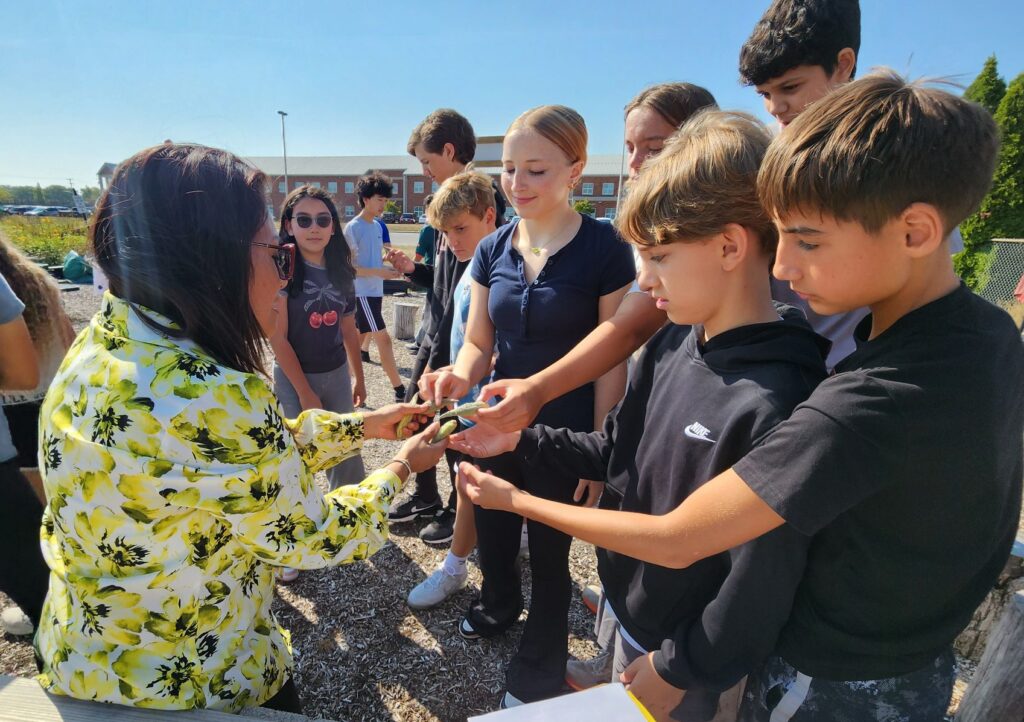
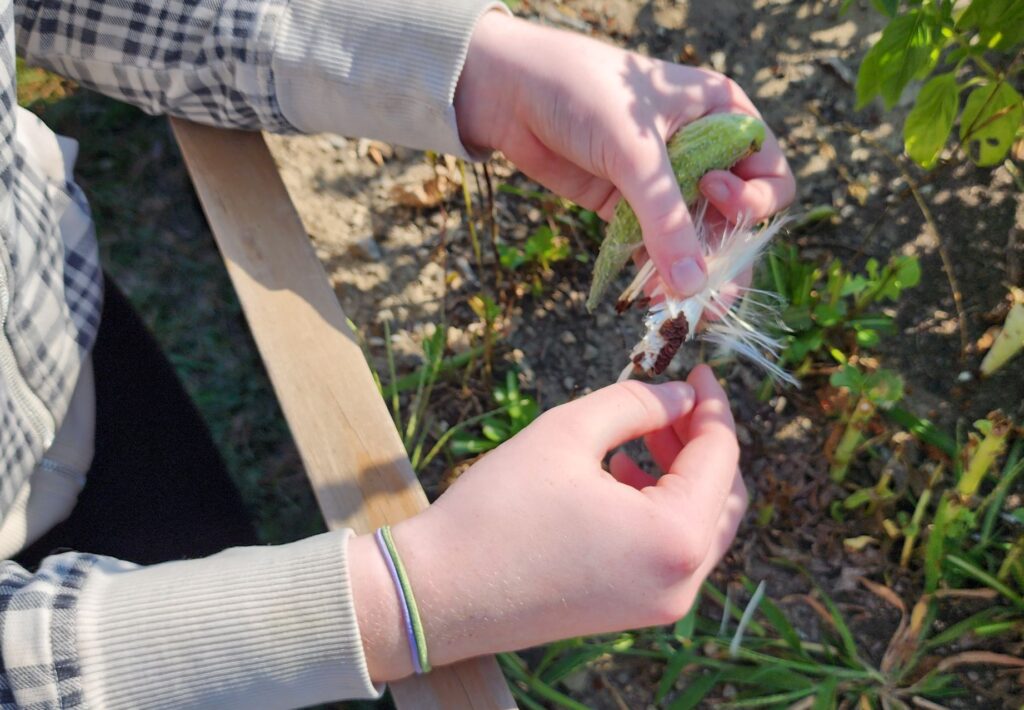
After Patricia flew off to the south, Timmins had one more lesson for the students. She handed out milkweed pods for her students to plant in the outdoor learning lab area, and to take home if they wished.
“Because monarchs pass through Ohio on their migration route, we have a unique opportunity to take part in their conservation. Small actions like planting milkweed can help to ensure that this incredible migration continues,” she said.
Each pod contained up to 200 seeds that the students delicately separated and planted.
The students didn’t seem to mind in the least getting their hands a little dirty.
“We are in the path, so we can participate in it,” eighth grader Chance Flick said of the monarch migration.
Monarchs must time their spring and fall migrations to coincide with optimal habitat conditions, including nectar flowers for butterflies and milkweed for caterpillars. Since milkweed is the only food source for monarch caterpillars, if there’s no milkweed, there are no monarchs. If nectar sources and milkweed goes away, the population declines.
“Through this classroom project, I hope my students will not only witness the wonder of metamorphosis but also understand their role in protecting a species that connects science, nature, and culture across borders. Watching our six caterpillars transform into butterflies will be a powerful reminder that even small actions—like planting a corner of a garden—can make a difference for our shared world,” Timmins said.

According to the World Wildlife Federation, data detailing the abundance of the eastern monarch butterfly colonies wintering in central Mexico’s forests estimate that the species occupied only 2.2 acres during the 2023-2024 winter season – 59% less than the previous year when scientists observed 5.5 acres.
Scientists believe that climatic variations in the monarch’s breeding areas in Canada and the U.S. gave rise to high temperatures and drought, which reduced the abundance of milkweed, the only plant in which the butterflies lay their eggs. Land-use changes in the U.S., combined with the widespread use of herbicides, also contributed to the loss of milkweed and other nectar plants essential to feeding adult monarchs.