By JAN McLAUGHLIN
BG Independent News
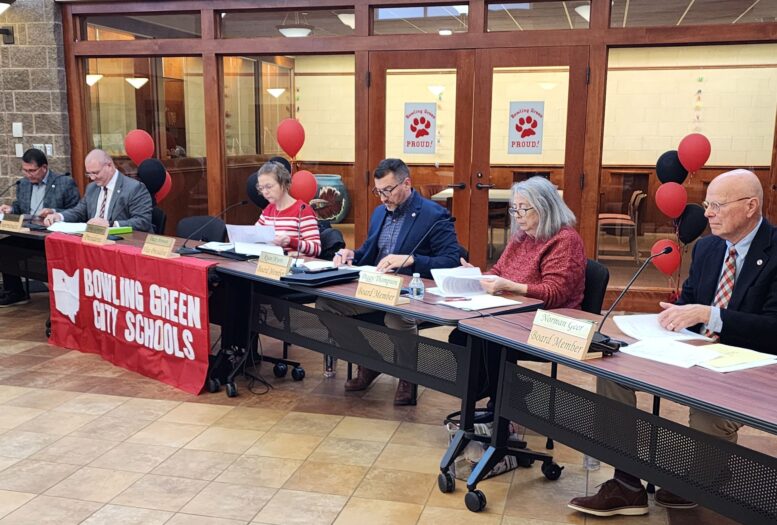
Bowling Green Board of Education voted Tuesday evening to hire a design firm to study the options for the district’s elementary buildings.
DLR Group – the same firm that designed the new high school currently under construction – was selected as the top firm to handle the elementary master planning services.
Superintendent Ted Haselman said the study will likely last 15 to 16 months, and require many meetings with the community, school staff and district administration team.
“We need to determine what our top priorities are,” Haselman said after Tuesday’s board meeting.
By June of 2027, the DLR Group will come back to the board with a recommendation and cost estimates, Haselman predicted. The soonest that voters would see an issue on the ballot for the elementaries would be November 2027 – “at the earliest,” he said.
“They have no clear path,” he said of the board, which is going into the planning with open minds. “But doing nothing is not an option.”
The options could include one new unified elementary, building two new K-5 elementaries, or building two new elementaries – one for K-2 students and another for grades 3-5.
With each of these options, the study will look at construction costs, operations considerations, and the educational advantages of each.
The following items are listed in the architectural pre-bond issue assistance services:
- Assess existing facilities.
- Assist the board in determining the scope of any potential projects.
- Prepare estimates of costs for all the options.
- Provide feasibility studies of potential sites for new buildings.
- Provide necessary graphics to serve as informational tools for a potential bond issue.
- Attend community meetings to present information and provide technical assistance.
The district has struggled to find a solution to its aging elementaries that voters will support. The options are many, including some that may not even be realized yet.
A study of the three elementaries – Conneaut, Crim and Kenwood – done years ago by the Ohio Facilities Construction Commission, came to the conclusion that the Conneaut and Kenwood buildings were not worth the district sinking any more money into. The Crim building, which has gone through extensive renovations, was determined to be salvageable.
The 2023 facility master plan for the entire district made some recommendations for the elementary schools.
Conneaut, Crim and Kenwood elementaries were built in the 1950s and 1960s – and 75 years later, they are not able to accommodate the district’s vision for future-ready learning due to space limitations, according to the report.
The teachers and staff in the buildings work diligently to retrofit existing infrastructure, making space for teachers and staff, and creatively repurposing existing spaces to better support students. The presence of portable classrooms on the Conneaut campus has posed additional challenges to program accessibility and teacher collaboration.
Beyond the outdated infrastructure, technology and systems, the physical layout of the buildings does not accommodate desired teaching and learning, according to the report.
There are opportunities to apply planning and design strategies in the interim to enhance flexibility. Those include acquiring versatile furniture that can create collaborative zones within classrooms, fostering innovative interactions between students and teachers.
The 2023 master plan considered different scenarios for the elementaries that provide opportunities for expanded district resources, equality of resources to all students, and support of the families the district serves. The three options noted were:
- To foster equitable experiences and ensure no student or educator is limited by outdated facilities, consider the replacement of all three school buildings at their current sites to keep neighborhood schools.
- With a new recent addition, Crim Elementary could potentially accommodate district offices, pre-kindergarten students, and serve as an autism center. This transition could yield cost savings by relocating district offices to a district-owned facility, while expanding resources for district families. The replacement of Kenwood and Conneaut, along with the inclusion of students from Crim, would be under consideration.
- Build a single unifying elementary. Although this deviates from the idea of individual neighborhood schools, it ensures equal access to resources. This approach would potentially reduce maintenance costs, but it raises concerns about managing a single elementary with more than 1,000 students. Strategies creating smaller cohorts within a unified school could emulate the neighborhood concept while maintaining efficiency.