By TOM GERROW
BG Independent News
Astronomy often focuses on objects that are vast distances from Earth – stars that are light-years away, galaxies that are tens of thousands of light-years away, quasars at the edge of the known universe. Then, there are astronomers like Dr. Andrew McNeill, who likes to focus on objects that are, relatively speaking, in our own backyard.
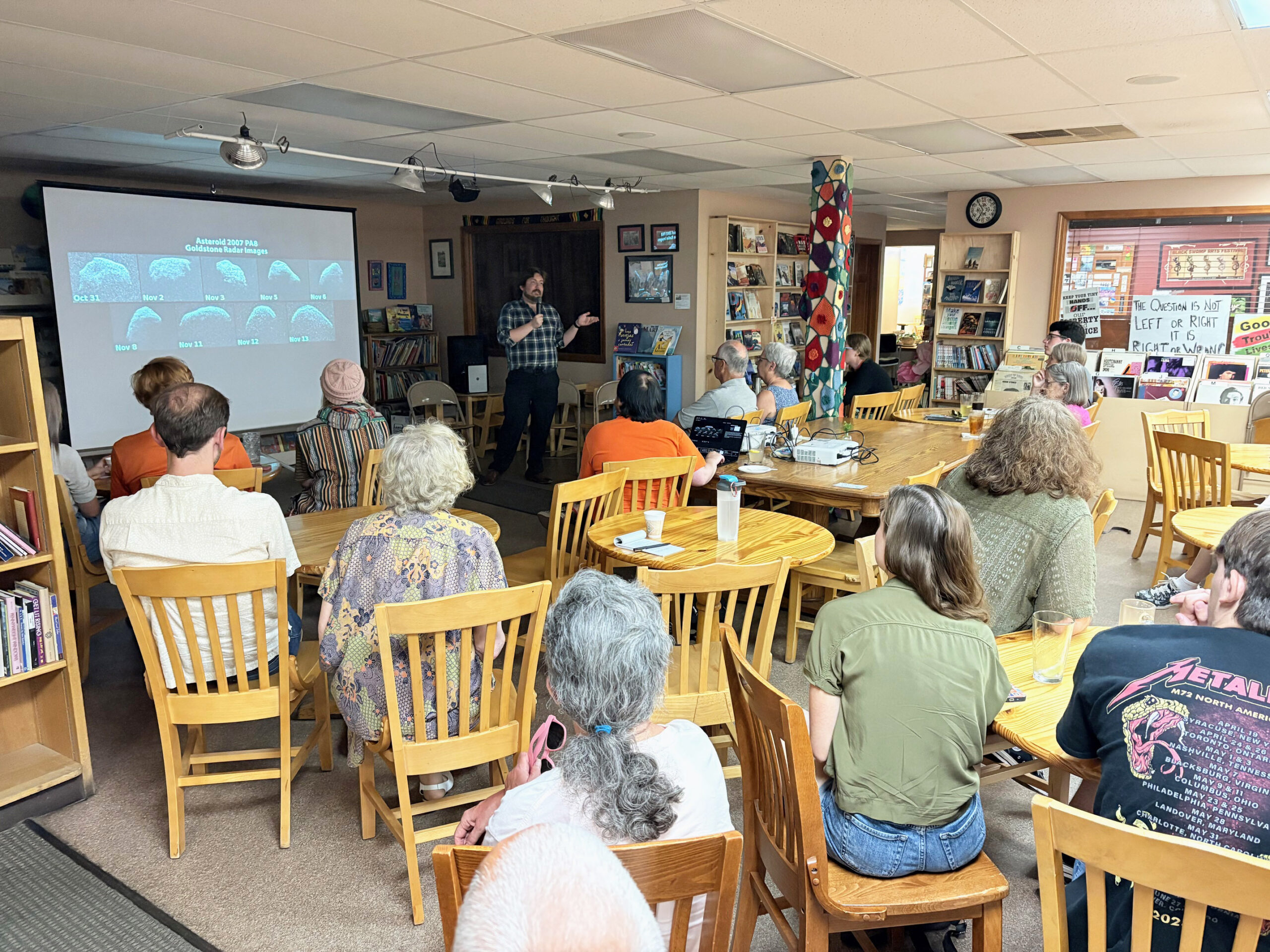
In a BGSU Science Café presentation on Tuesday, Aug. 12, at Grounds for Thought, McNeill discussed “The Shape, Spin and Structure of Small Bodies in the Solar System.” The small bodies in question are asteroids, of which the solar system has quite a few – more than 1.25 million of them, according to McNeill, an assistant professor in the Department of Physics & Astronomy at BGSU and the director of the BGSU Observatory.
Why study these asteroids? First, because they are leftover remnants from the formation of the solar system, they can reveal tantalizing clues about how our solar system evolved. But, McNeill said, another, perhaps better, reason to study these asteroids is “planetary defense.”
Most of the million-plus asteroids inhabit locations in our solar system relatively far from Earth, but some 38,136 are considered near-Earth asteroids. And of these, 2,465 are considered potentially hazardous. “They can get close and pack a punch,” McNeill said.
Astronomers have been searching for potentially hazardous asteroids (PHAs) and determining their orbits for many years, and none of those discovered poses an imminent threat to our planet. Astronomers have developed a risk scale, from 0 to 10, that accounts for the size of the asteroid and the likelihood of a collision with Earth. So far, McNeill said the most dangerous asteroid ever identified is Apophis, which earned a 4 on the scale. Apophis is expected to make a close approach to Earth – but not impact it – in 2027. Observations and calculations have ruled out any collision threat from Apophis for the next 100 years.
Were scientists to discover a threatening asteroid with enough advance warning, McNeill said measures could potentially be taken to “push” the asteroid, altering its orbital trajectory so that it would bypass Earth.
McNeill studies the rotation and shape of asteroids by measuring changes to their brightness over time. With enough observations, he can calculate their spin and structure. Various processes can alter the spin rate of asteroids and, generally, if their spin rate exceeds a certain level, the asteroid breaks up. Some asteroids that McNeill has identified, however, have excessively high spin rates but don’t disintegrate and remain intact.
This is a puzzle McNeill is keen on figuring out. And he may soon get some help.
The Vera C. Rubin Observatory, under construction in Chile but expected to come online this year, will take hundreds of images of the Southern Hemisphere sky, every night for 10 years, for a survey called the Legacy Survey of Space and Time (LSST). These observations will create a massive data stream and, among other things, will catalog a vast number of objects in the solar system. McNeill has been selected as one of the data brokers for these observations, which means he will be one of the first to get the data – as soon as the next day after the observations are made.
Another planned future NASA mission, the NEO Surveyor, aims to use sensitive infrared detectors to catalog 90 percent of PHAs. As a space-based telescope, it will be able to perform observations around the clock, unlike ground-based telescopes which are limited to night-time hours and favorable weather conditions.
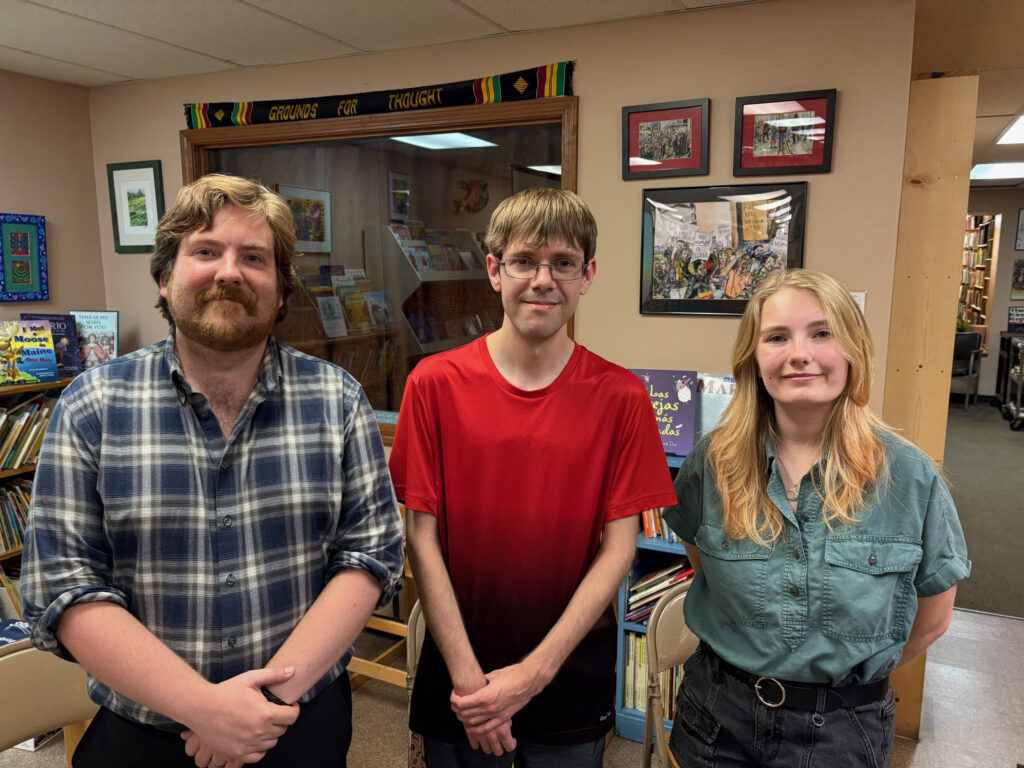
About 35 people attended McNeill’s 30-minute presentation, which was followed by a lively question-and-answer session that included BGSU graduate student KJ Stevens and undergraduate Katie Douglas as panel members who helped answer many of the questions from the audience.