
By DAVID DUPONT
BG Independent News
The Black Swamp Players will open their 57th season next September with a production of “Heroes of the Fourth Turning.”
Not heard of Will Arbery play set on a college campus?
That’s by design.
In his recent talk to the Exchange Club, the Players’ president Heath Diehl said that the troupe wants to focus on newer plays that have not been performed in the area.
“We want to do shows that tell stories that actually speak to our community here in 2025, not who we were in 1947,” he said. “We want to speak to who we are now.”
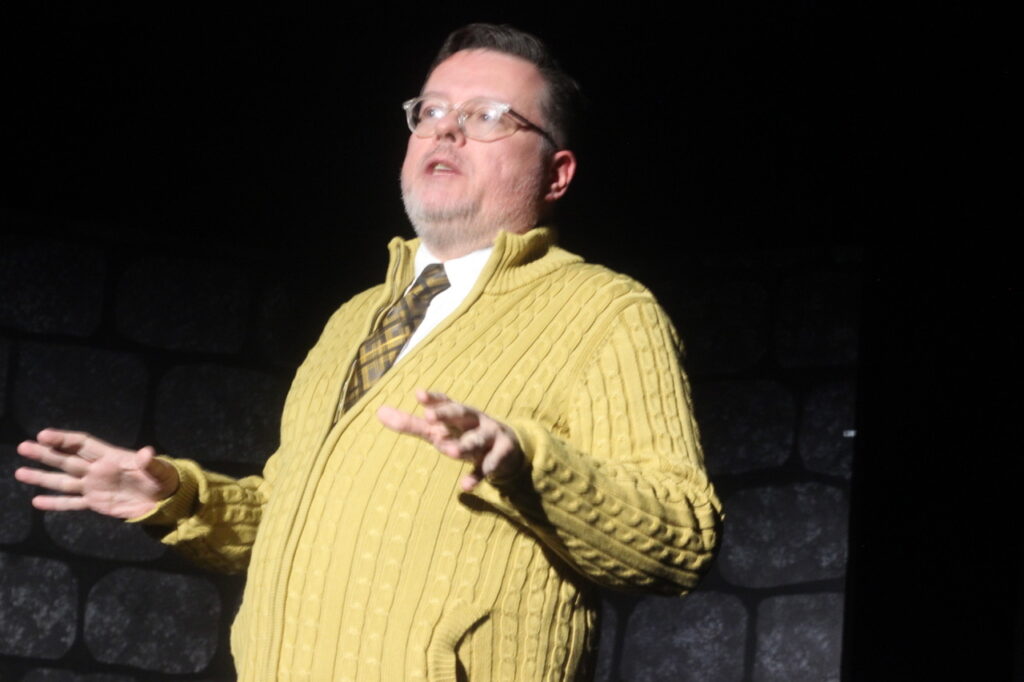
The opening show, which was nominated for a Pulitzer Prize, has been praised for its insightful and measured approach to conservative beliefs.
Directed by regional theater veteran Fran Martone, “Heroes of the Fourth Turning,” finds graduates of a tiny Catholic college returning to campus to pay tribute to their mentor who has been inducted as the new college president.
Their conversation swings wildly addressing questions of “what is it mean to be Catholic? … What does it mean to be conservative in these times in this place?” Diehl said: “That’s pretty hard hitting drama. There’s not a lot of comedy in it.”
That’s emblematic of the season. “These are issues that people are talking about right now,” he said. “We focus a lot on contemporary theater, because that’s what we like.”
Productions for the upcoming season will be:
- “Heroes of the Fourth Turning,” Sept. 26 through Oct. 6.
- “The Thin Place” written by Lucas Hnath and directed by Diehl, Nov. 7-16.
- “Book of Days” by Lanford Wilson and directed Jeffrey J. Albright, Feb. 20 to March 1.
- “The Revolutionists” by Lauren Gunderson and directed by Barbara Barkan, April 24 through May 3.
- “The Appliance Department” by Bella Poynton and directed by Story Moosa June 12-24.
Shows run Fridays and Saturdays at 7:30 p.m. with Sunday matinees at 1:30.
Diehl will direct “The Thin Place.”
“That’s our ghost story for the season,” he said. “It is about mentalists and mediums, and it’s also a play about belief. Why do we believe? What we believe when we think that there might be life after death, this other place that we go to, that people here can speak to the other side. Why do we believe that?”
“The Book of Days,” which made its debut at The Purple Rose in Chelsea, Michigan, was presented at BGSU in 2014. (It starred Mariah Burks who recently returned to the area as member of the Broadway touring company of “Clue.”)
“Essentially, it’s a murder mystery about small town America,” Diehl said. “But one of the interesting things about it at least for me is you’ve got this big cast and most of them serve as a kind of Greek chorus that really get us thinking about what does it mean to live in small town America and how to means navigate small town America. And there’s a murder mystery.”
The fourth play of the season, “The Revolutionist,” he said, “is about three women who are real and one woman who is fictionalized, all of who live during the French Revolution. One is a writer, one is an assassin, one is the Queen Marie Antoinette, and then the last one, the fictionalized one, is a revolutionist from the Caribbean.
And it’s a story that is funny, but it’s also very timely because it asks us to think about who is a revolutionist. What does it mean to be a revolutionist, and also what roles does a revolution play in progress?”
The last show is the winner of the Players’ playwriting competition.
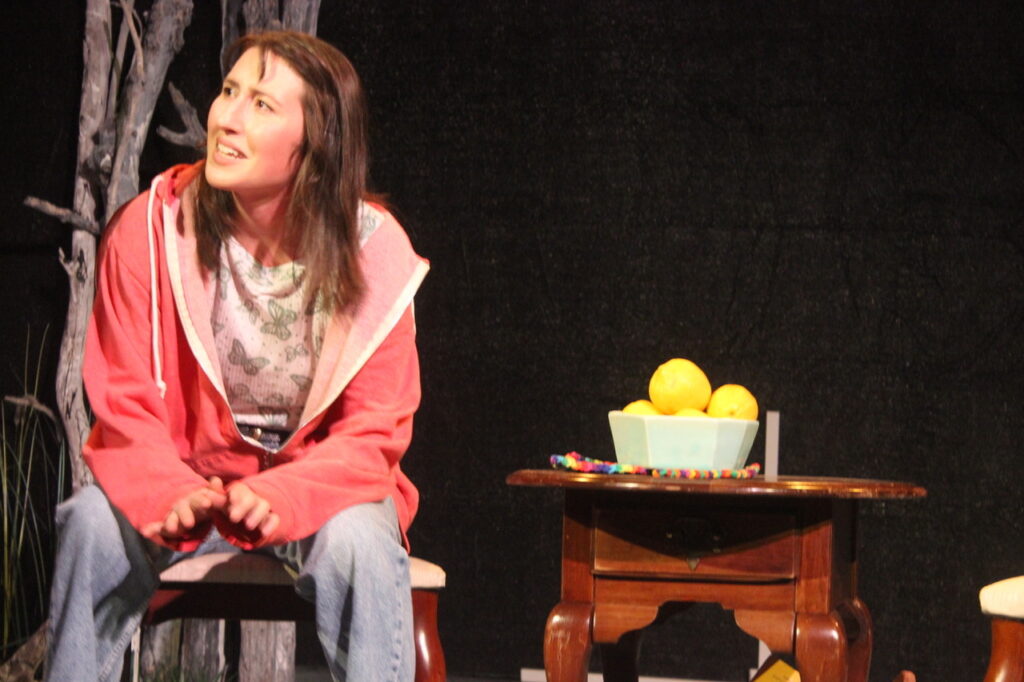
“The Appliance Department,” Diehl said, “takes place in an appliance department of a big box store in the near future, and it’s about AI, specifically. It’s a story about these humanoid robot kind of things that are bought by humans and used for various purposes. The big questions that the play asks is: What does mean to be human?
No one, what’s the line between human and other? But also, what are ethical uses of this kind of technology.”
In choosing plays, the troupe’s selection committee has to also consider the resources available to the troupe and the venue.
The plays tend to feature female-centric casts “because we primarily get a lot of women to audition and not a lot of men.”
They also look for plays that have a range of ages, from performers in their twenties on up.
“We like to have some flexibility in casting, not just in terms of age, but in terms of racial and ethnic background, in terms of ability,” he said.
That’s true of directors. This season features fixtures of the area theater scene Martone, Albright and Barkan as well as a BGSU graduate student Moosa.
The change in approach, Diehl said, helps to expand the pool of talent.
And because of the constraints of the theater at 115 E. Oak St. those casts tend to be small. They cannot accommodate dozens of actors, and that’s especially true of musicals. “We know that we will probably never do another musical in our space,” Diehl said. “And that’s partly because our space does not have the acoustics for it, but also musicals are wildly expensive.”
Ironically, though, it was the master of Black Swamp Players musicals, Bob Hastings, who is responsible for pulling Diehl into the troupe’s orbit.
Seven years ago, right after the Players celebrated their 50th anniversary, the board announced that was the final act.
Diehl was not involved, but he read an impassioned letter to the editor penned by Hastings written with hyperbole fitting the author. “It’s a crime,” Hastings said of the end of the Black Swamp Players.
Hastings had been involved for 36 years, most prominently as director of the annual musicals.
“I loved this guy before even meeting him,” Diehl said. “I have to reach out to him because if somebody’s going to do something, we’ve got to do it now.”
Through Hastings, he met Lane Hakel, then president, and joined the board.
Then the troupe was hit with another challenge. The First United Methodist Church, where the Players had staged works for 20 years, said it wanted to use the Fellowship Hall more for its own programming. Being homeless, though, was part of the DNA of the troupe. In the years right after their founding in 1968, they staged productions in court rooms, parlors, church halls, parks. “We were nomadic for many, many years, we performed in any space that would allow us to be there, for any audience that would listen to us,” Diehl said.
Before the Methodist church they rented a space in the Woodland Mall.
After years of dreaming of a home of its own, the troupe bought the space on East Oak Street, the former Plan, Do, and Talk Day Care, that was formerly a Baptist Church.
With funding from donors and the state, the space has been renewed as a “black box theater,” a flexible space that allows for a variety of configurations.
Not only did the Players survive, but thrived.
“People thought we were done with Season 50,” he said. “Now, in fact, we are stronger than ever.”