
By JAN McLAUGHLIN
BG Independent News
With rapid climate changes and renewable energy advancements, the City of Bowling Green is once being again asked to reconsider its rooftop solar policy.
In the past, it’s primarily been residents with rooftop solar systems who have asked the city to revisit the policy. But now they are supported by the city’s newly adopted Climate Action and Resiliency Improvement Plan, and by the BG Save Our Neighborhoods Group Climate Action Team
The rooftop solar issue became a flashpoint in 2021 when the Board of Public Utilities began charging a fee for homeowners with rooftop solar that tied into the grid. City officials called it a reasonable “fee” while rooftop solar users said it was an unfair “penalty.”
Joe DeMare has said the city “blew it” more than a decade ago when it invested in coal power, then erred again four years ago when it decided to “penalize” rooftop solar systems – tarnishing the “green” image of Bowling Green.
Brian O’Connell, director of the city’s public utilities, has explained that the fee is necessary to make sure other electric customers in the city aren’t paying for those who choose to install rooftop solar panels.
The electric rates in the city are based on customers buying their energy from the city. A smaller portion of the rates is based on fixed electric system costs for such items as meters, poles, wire, transformers, switches and linemen – items needed for all homes including those with rooftop solar, O’Connell said.
“Those fixed costs don’t change just because someone decides to put rooftop solar on their home,” he said.
The city reimburses rooftop solar systems for the extra energy they produce and send to the city’s grid to be shared with other users. But without that fee being charged to homes with their own solar power, “the other customers are subsidizing their energy sales,” O’Connell said.
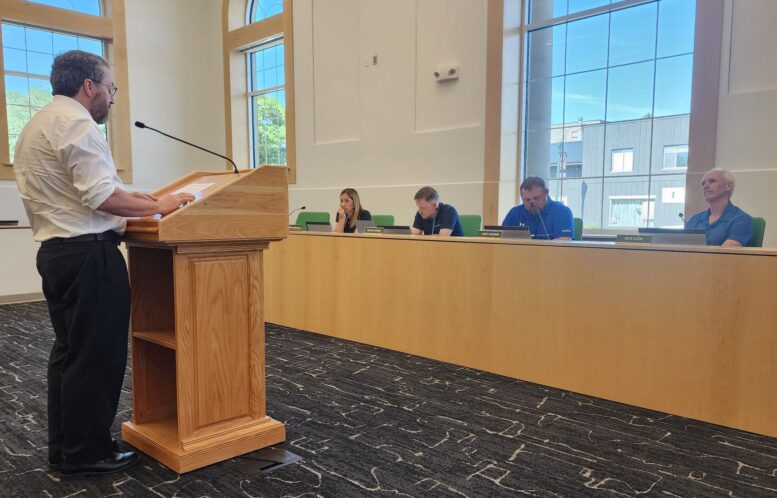
But on Monday, five citizens spoke at the Board of Public Utilities meeting in an effort to convince the city to change the policy, which they said discourages residents from installing rooftop solar systems.
Rose Drain, from BG SONG, presented information she gathered from other Ohio communities about solar policies. Dayton’s sustainability office offers guidance to residents and businesses on transitioning to solar energy, she said. That city has no surcharge for solar panel users, Drain added.
Cities like Dayton, Cleveland, Columbus, Cincinnati and Akron are using funding from the Inflation Reduction Act for a “Solar for All” program to install solar panels on qualifying homes. None of those cities operate their own utilities like Bowling Green.
The city of Westerville, which like Bowling Green operates a municipally-owned utilities system, has a rebate program to encourage commercial installation of rooftop solar, Drain said. The rebate program has been in place for five years, and only one business has participated.
Westerville has about 100 residential solar installations, and has no solar surcharge, she said.
The village of Yellow Springs, which also operates its utility system, also has no surcharge for solar, Drain said.
A representative of Ohio Solar Neighbors United told Drain that Bowling Green is the only city in Ohio known to that organization to have an electric fee for solar owners.
“Most electricity providers welcome the diversity of energy supply from rooftop solar, especially since these small systems attach to the distribution side of the grid,” Drain said.
Kathleen Dennis submitted a statement noting that Bowling Green’s Climate Action and Resiliency Improvement Plan outlines the impact climate change has had on the community.
“It also provides necessary resiliency strategies to help us understand the impact,” Dennis wrote.
Solar power can support the city during extreme weather emergencies by providing shelter for a portion of the public, recharging of cell phones, preventing food spoilage, running of furnaces or air conditioning, recharging vehicles, and powering gas pumps.
“The world must push for extensive reductions in the burning of fossil fuels if we are to maintain reasonable global temperatures,” Dennis stated. “We have an obligation to our children and grandchildren to initiate change that will leave them with a livable planet.”
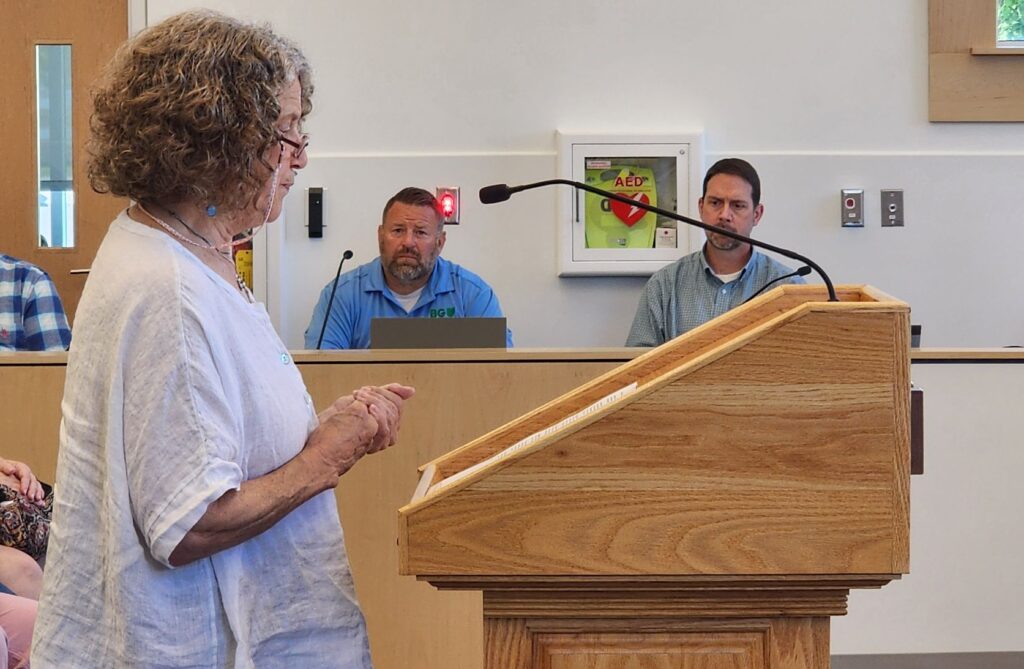
Jacqui Nathan voiced her support for improving the long-term energy resiliency in Bowling Green. She talked about the changes that have occurred in energy markets over the past decade, such as growth of community solar projects, virtual power plants, sustainable energy utilities, and the use of brownfields or other unused plots to construct community solar arrays.
Joe DeMare said much has changed since Bowling Green adopted its rooftop solar fee four years ago. Electricity markets have shifted toward renewables, pricing and technology for solar power has continued to improve, while the global environment has declined.
“We believe that these changes warrant taking a fresh look at BG’s solar policy and, for the good of the community, adapting to the situation by creating a new policy,” DeMare said.
DeMare said the current policy is keeping residents from installing solar, with there currently being nine residential rooftop systems in the city.
“There certainly has not been a boom in solar installations here as there has been in other parts of the country,” DeMare said. “The addition of the electric facilities charge has discouraged new installations because with the surcharge it’s impossible for homeowners to make back the money they invest in their systems.”
Jim Evans pointed out the progress made in other states using electricity generated by wind, solar, hydroelectric and nuclear power. In comparison to national averages, Ohio relies more heavily on coal and natural gas, he said.
Evans told the Board of Public Utilities that he disagrees with the statement that the city should not be promoting resident use of renewable energy.
“I ask instead, what message should the city of Bowling Green be sending to the local community?” he asked.
But after the meeting, O’Connell said the comments from residents did not change his mind about the appropriateness of the monthly fee.
“My philosophy is to follow the needs of a public utility,” he said. “We’ve tried to base our charges and fees off our costs.”
With the current fee of $4 per kilowatt hour, the average rooftop solar residence pays anywhere from $12 to $20 for the monthly fee. Despite those fees, O’Connell said two more homes in the city have added rooftop solar in the last three years.
“We’re here to provide power in a fair way – not try to make it burdensome,” he said.
O’Connell said it would take a cost of service analysis to convince him that changes are needed in the solar policy.