From BGSU DOCTOR OF MUSICAL ARTS IN CONTEMPORARY MUSIC PROGRAM
Bowling Green State University’s Doctor of Musical Arts Cohort will present their first composer portrait concert, performing the music of Russian composer Sofia Gubaidulina Thursday, Sept. 18 at 8 p.m. in Bryan Recital Hall in the Moore Musical Arts Center.
This concert which is the first projected in the series reinforces BGSU’s long-standing identity as a leading school for contemporary music studies and performances.
Gubaidulina will be the first of many composer portrait concerts presented by BGSU’s doctoral cohort, with future portrait concerts already in the works.
Ryan Ebright, the coordinator for the doctoral degree in contemporary music at BGSU, developed the idea of a composer portrait concert series at BGSU. The idea comes from a conversation Ebright had with Melissa Smey, the director of Miller Theater at Columbia University, during his time writing about a newly commissioned chamber opera. Ebright’s new role as the DMA coordinator at BGSU, inspired him to further develop this idea.
“One of my goals for the program is for the DMA cohort to develop a stronger identity as an ensemble or performance troupe,” Ebright says, “and I thought that a DMA-led Composer Portrait series might be an effective and fun way to begin meeting this goal.”
Although conceived by Ebright, the composer portrait concert is organized, performed, and managed by DMA students at BGSU’s College of Musical Arts. This sort of hands-on, practical experience in planning a concert of new music is a part of Ebright’s vision for the doctoral program, as the next generation of contemporary music specialists.
“The program is designed to foster excellence in performance, scholarship, and teaching, and to give our students professional skills and tools that can be adapted to different contexts,” Ebright says. “I want the program to foster students’ curiosity, their ability to collaborate, and their initiative, so they can take an idea—no matter how audacious or outlandish—and realize it.”
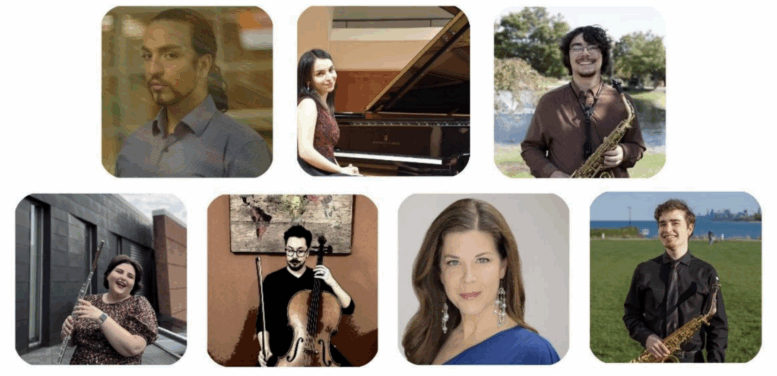
Stephen Eckert, a fourth-year DMA student and pianist from Canada, is responsible for organizing the first portrait concert. They took the initiative in curating a diverse, interesting, and practical program for the instrumentation of the doctoral cohort.

(photo provided)
Gubaidulina was born in the USSR on Oct. 24 1931 in Chistopol. As a young composer in Moscow, Gubaidulina benefited greatly from contact with her peers and from the relatively open cultural atmosphere in the later Khrushchev years.
Even at this early period, the titles and character of her pieces made strikingly clear Gubaidulina’s fascination with religion, something which caused her trouble with the Soviet authorities, especially when her music was performed abroad. In 1992, with the collapse of the USSR, she moved to a small village outside Hamburg, Germany, where she lived until her death on March 13 of this year.
The concert program showcases a wide breadth of styles from Gubaidulina’s repertory.
The program will include:
- Duo Sonata for baritone saxophones (1977). Performed by saxophonists Jake Loitz and Sam Valancy.
- Cello Preludes no. 3, 5 and 7 (1974). Performed by cellist Anthony Marchese.
- “Klang des Waldes” (1978). Performed by flutist Shannon Lotti and pianist Stephen Eckert.
- “Vivente-Non vivente” (1970). Features electronic playback.
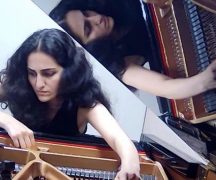
- Chaconne (1962). Performed by pianist Niayesh Javaheri.
- “Aus den Visionen der Hildegard von Bingen” (1994). Performed by vocalist Katherine Pracht.
“The Duo Sonata and Cello Preludes recall her most signature sound — dramatic yet restrained, with contrapuntal lines adorned by timbral effects,” Eckert says. “‘Klang des Waldes’ is a strange work in her oeuvre. It is a short post-romantic study of natural sounds including long soaring melodic lines and short bird-like interjections. ‘Vivente-Non Vivente’ is an exploration of early keyboard electronic music that is lesser known, and her only electronic work. Lastly, the Chaconne features her most dramatic and furious early style, and ‘Aus den Visionen der Hildegard von Bingen,’ written over 30 years later, reveals the exact opposite; an extremely restrained, concise, and delicate work for solo vocalist.”