
By JAN McLAUGHLIN
BG Independent News
After 30 years of observing peregrine falcons, Chad and Chris Saladin still find the raptors fascinating. Clocked at dive speeds topping out at 242 mph, peregrine falcons are the fastest predators in the sky.
“You never know what you’re going to see,” Chad Saladin said.
The Saladins, who live in Lorain, have been observing and studying peregrine falcons in Northeast Ohio since the 1990s. They had heard about the pair roosting at the Wood County Courthouse, but until this summer, the couple had not traveled to Bowling Green to view the falcons in the clock tower.
For the past 15 years, the courthouse has had successful nests – plus has a live nest cam that can be viewed on YouTube as well as inside the courthouse on a monitor.
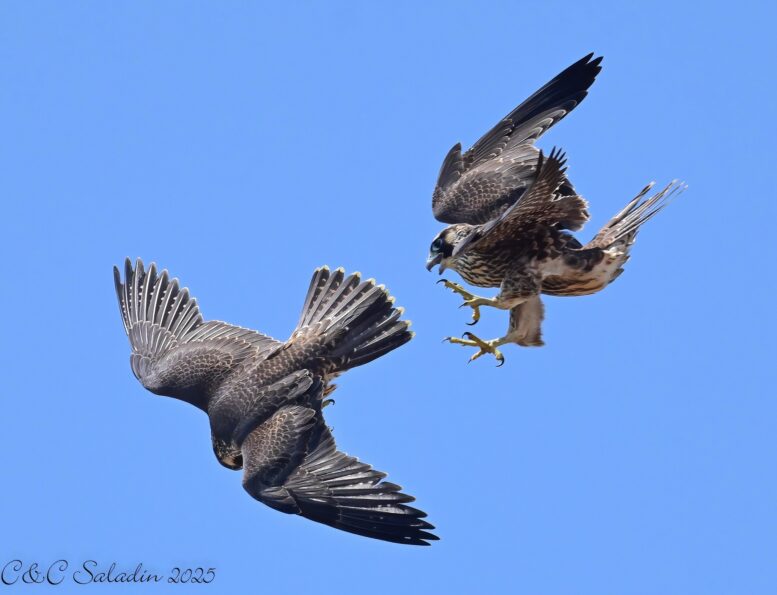
When the Saladins arrived earlier this summer, they found two adults with four fledglings – three males and one female – in their early flights.
“They are getting ready to leave,” Chad said of the fledgings, leaving their parents as empty nesters in the clock tower.
Photos of falcons taken by the Saladins fill their Facebook page, including the shots captured of the Bowling Green parents and fledglings. https://www.facebook.com/media/set?vanity=ChadandChrisOhioPeregrinePage&set=a.1690581251657052

Hooked on peregrines
The Saladins remember the first peregrine falcon pair they spotted at Rocky River Reservation in North Olmstead, Ohio. Their aerodynamics and acrobatics in the sky were incredible.
“They were doing such cool stuff. We were hooked,” Chad said. “That was back when they were endangered.”
The couple got involved in helping to band peregrine falcons in Ohio, to track the number of the endangered raptors at a time when there were just 12 known peregrines in the state.
Though Chris is a fan of many bird species, Chad is pretty much focused on falcons. The elite raptors primarily feast on birds they ambush out of the sky.
“They are a top predator,” Chad said.
Peregrine falcons feed primarily on other birds, such as songbirds, shorebirds and ducks in the wild, and starlings and pigeons in urban areas. Flying high above their intended prey, peregrines will “stoop” or dive and strike in mid-air, killing the prey with a sharp blow.
Peregrine falcons live mostly along mountain ranges, river valleys, and coastlines. Historically, they were most common in parts of the Appalachian Mountains and nearby valleys from New England south to Georgia, the upper Mississippi River Valley, and the Rocky Mountains. Peregrines also inhabit the Pacific Coast from Mexico north to Alaska and in the Arctic tundra.

Their menu is varied. “Just about anything that flies,” Chad said. They are capable of carrying their own weight in prey. For larger meals, peregrine falcons are known to strike birds out of the sky, then go down to earth to retrieve it.
Chris pointed out the diamond swoop shape falcons go into when diving for prey.
“They are virtually a flying bullet,” she said.
Peregrines are designed for speed and swiftly dispatching their victims, the Saladins described. The power is centered in their chests. Once they capture their targets, falcons have a notch in their bills perfect for biting the back of their preys’ heads and severing their spines.
Unlike other raptors that tend to be skittish and fly away when their young are being banded, peregrine falcons go into protective parent mode, Chad said. When the Saladins previously worked to band falcons, the parents were so defensive of their youth that banders had to wear hard hats, goggles, and be armed with shields.
“They are so feisty and fearless,” Chad said. “They are ready to attack.”
Birds-eye views
About seven years into watching peregrine falcons in the Lorain-Cleveland area, following their migrations along the East Coast, and viewing them in their natural habitats in the Smoky Mountains, the Saladins decided it was time to pick up some camera lenses so they could show others what they see.
The couple’s Facebook page is dedicated to wild peregrine falcons that they have monitored, photographed, and studied in hopes of helping to protect and conserve the species.
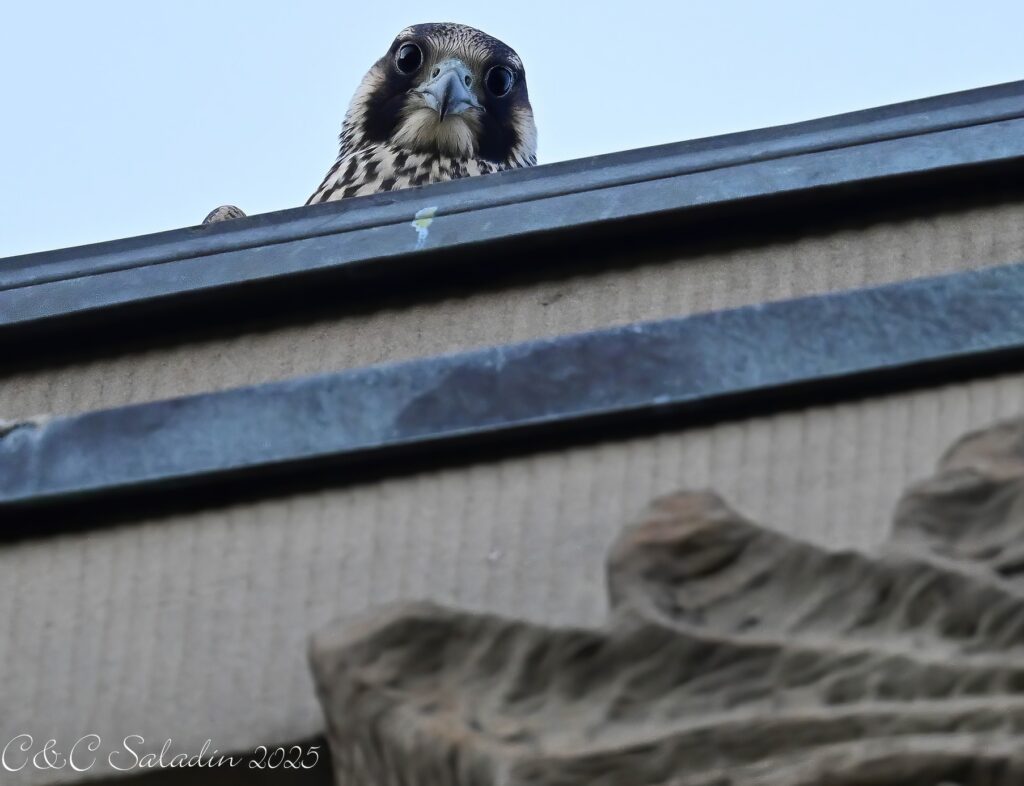
The Saladins’ photos – taken with 600 mm Nikon lenses – show falcon siblings fake fighting while in flight, adult falcons grasping captured prey as they return to their roost, and looking curiously at their photographers.
It’s hard to fathom that the couple never had any training in wildlife photography – or any photography at all.
“We just started by winging it,” Chad said. “We probably should have taken a photography class, which we never did.”

The Saladins have discovered that once peregrine falcons know the photographers are only observing, the birds are much more accepting of the couple’s presence than most raptors. “They are so tolerant,” Chad said.
And the Saladins’ patience tends to pay off.
“We get a lot of pictures because we know them so well. We’ve learned a lot as we go,” Chris said. “They give clues,” and the couple knows how to read them.
“I don’t think there’s anyone in Ohio more crazy about falcons than we are,” Chad added.
Over the years, the Saladins have encountered other falcon fanatics who give up photographing the fastest diving raptors, which can also reach speeds of 75-80 mph in level flight.
“If you photograph the fastest bird on earth, it’s pretty easy to photograph anything else,” Chris said.

Falcons under threat again?
In 1970, peregrine falcons and some other raptors were placed on the endangered species list. The population decline was found to be due to egg shell thinning caused by persistent pollutants such as DDT. Environmental regulations reducing DDT gave falcons a chance to repopulate.
The raptors were removed from the endangered species list, and banding in Ohio was discontinued in 2014.
But the Saladins and other falcon followers are seeing some troubling signs that the raptors may again be at risk. The loss of four adult females and no new falcons being born in their usual observation grounds near Lorain, led the Saladins this summer to the Wood County Courthouse for peregrine viewing.
“This has been a strange year for the peregrines, and with the multiple losses of resident females and accompanying nest failures, we didn’t get our ‘fix’ at our typically reliable sites to the east,” Chris said.
The previous adults who roosted in the clock tower had been banded. The Saladins were able to determine that the adult male now at the courthouse was not banded, and the adult female named “Erika” was hatched and banded in 2021 at the NIPSCO Baily Plant/Bethlehem Steel Burns Harbor site in Indiana.
But many empty nests are not being filled this year by replacement adults. It appears that the surplus “floaters” are dwindling, and many regular roosting sites are going unfilled.
While some have suggested raptors may be experiencing pesticide contamination again, others are wondering if bird flu might be to blame. It’s instinctual for falcons to seek weak, easy-to-capture prey. But that is putting them at risk of consuming prey suffering from a deadly infectious disease.
Meanwhile, the Saladins intend to continue keeping a watchful eye on peregrine falcons, hoping to share their amazing acrobatics with others, and helping to protect them for generations to come.
