By JULIE CARLE
BG Independent News
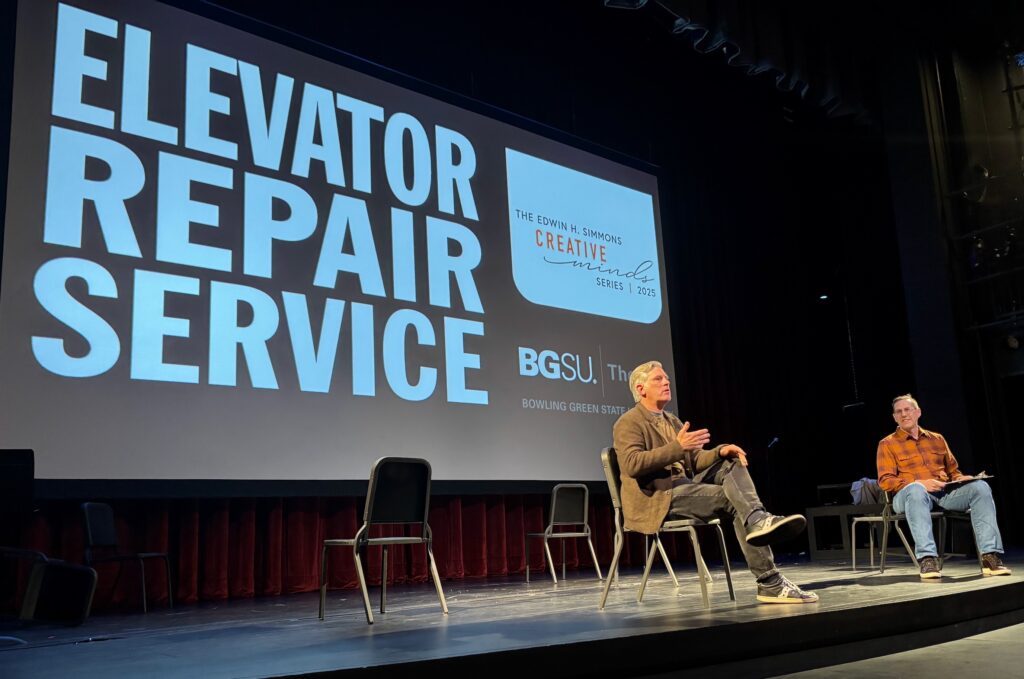
Experimental theater was front and center during the 2025 Creative Minds at Bowling Green State University.
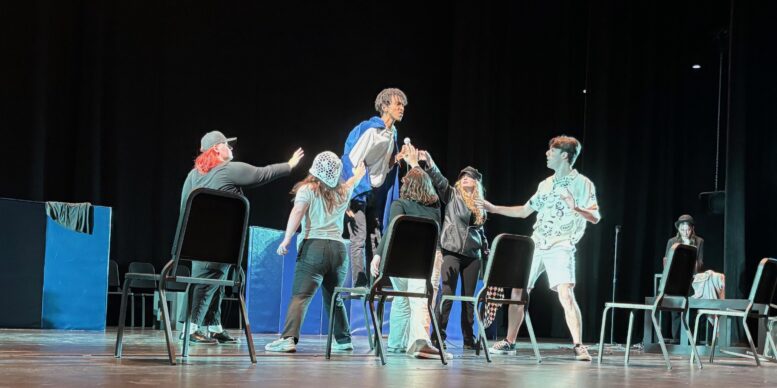
Over a four-and-a-half-day span, 25 BGSU students took selections from George Saunders’ 2005 novella, “The Brief and Frightening Reign of Phil,” and turned them into three 15-minute original, fascinating and chaotic scenes.
Five members of the Elevator Repair Service (ERS), a New York-based experimental theater company, helped guide the theater and film students through the creative process.
“I can’t stress enough what an amazing accomplishment that you just watched,” ERS Founder and Artistic Director John Collins said at the conclusion of the three original pieces.
The students and ERS ensemble members started by forming three separate theater companies. With texts they had never seen before, some sound effects and music, they came together and created theater in just three and a half days.
“It’s a tremendous testament to their creativity, their ability to work together as an ensemble and their talent. That was awesome,” he said.
The stories they created from Saunders’ novella followed the tensions between two countries — Inner Horner, a tiny country that has room for only seven citizens within its borders, and Outer Horner, which is larger with more resources and citizens who feel they are favored by God.
The ERS experience is meant “to help students think about ways of creating that are new and unusual, and backwards and upside down in some ways to help them see the world of theater a little bit the way we do,” Collins said.
The experimental theater group started in 1991 with a small group of people who got together “to make work with what we had,” he said.
“We had no money, no place to work, but just each other and a bunch of found junk,” he said. “It was all about making performance out of what you had around you and the most important available resource you have are the people you’re working with.”
ERS’s goal was to make work that was about joy. To find that joy required the performers “to follow every unexpected impulse, to throw out the plan as soon as some amazing accidental discovery happened, or something went wrong in a wonderful way,” Collins explained.
The same philosophies carry over today, more than 30 years in the making. The group moved from “found text” to great literature, but they continue to “let that process be the author of the work,” Collins said.
The main difference between ERS’s work and the Creative Minds residency was the time frame. The traditional rehearsal process can take up to two to three years to make a new piece, while the BGSU process was four and a half days – start to finish.
“Even though these guys only had a few days to do something, it really does represent the spirit of what we do. It comes from this ensemble aesthetic,” Collins said.
When the students applied to be part of the program, which overlapped with the University’s Fall Break, they were asked to identify what role they wanted, Chambers said. Their options were performer, director, designer or stage manager.
“However, they quickly found out that they were going to be doing all those things,” he said with a laugh. “They were engaged with the making of these things in a variety of different ways. That’s integral to what you do. Practice is the mode of discovery.”
Chambers praised the process. “The mundane has gravity. Life is beautiful and messy. Human bodies are fascinating and strange. I really like the last one: embracing the capacity of failure.”
Collins and the ERS ensemble embrace the concept of failure or when the plans go awry. “We began to see that as a way of growing something new that we hadn’t seen before. Our process is more like agriculture than architecture,” he said.
“Theater is such a wonderfully imperfect medium, and on some level, that’s what we love about it,” Collins said. “There’s just something wonderful and human about awkward imperfection, and there’s just no better place for that than the stage because you can feel the realness and the immediacy and the intimacy of that in a theater in a way you can’t anywhere else.”
The soul of the live performance connects the actors with the audience. When something goes wrong on stage the audience witnesses a person in real time doing something real and truthful. That doesn’t happen in movies.
“You’re really adept at leading the audience towards focus,” Chambers said to Collins. He creates tension between rigor, precision, and discipline that embraces chaos, as evidenced in the three vignettes performed.
“What we try to do as a company is create performances that are experiences that have their own life, their own set of rules,” Collins said. He always enjoyed watching theater that he didn’t necessarily understand, but that had life and an internal logic. “Nothing bores me more than knowing what was coming next.”
Their works have chaos and energy that generates something that is unique to the stage. He called it an act of faith in the process and faith in the audience who will know the finished product will be worth it.
“It’s okay to look at theater the same way you look at visual art,” he said. “What I want my audiences to understand is that this is your experience and you can see it and enjoy it any way you choose to. There’s not a right or a wrong to it. There’s not a correct interpretation.”
“This was a great opportunity to get to do this kind of creative process that we don’t really get to do much,” said Christopher Jones, a doctoral theater student who was part of the BGSU ensemble. “It was great to get immersed in it.”
The group was given text and sound effects and told to watch a short video. “We sat on the floor in one of the rehearsal rooms and really analyzed the crap out of this text that we were getting to try to make sense of it,” Jones said.
After they had tired of working on the text, they started to physically play with the items they had discussed.
“Once we had come up with four or five good scenes or good moments, we picked an order and a forum,” he said. Though they had only half a day to fine-tune everything, Jones said the quick turnaround “made it fun and it motivated everyone knowing we had to make a decision right now, not tomorrow. It was great.”