By JAN McLAUGHLIN
BG Independent News
People interested in housing options in Bowling Green took a stroll of sorts around different neighborhoods earlier this month.
They found themselves in developments focused on being neighborly, being non-traditional, and offering options.
The visual tours were the results of a project connecting the BG Save Our Neighborhoods Group and the BGSU School of the Built Environment. Architecture students in Professor Lindsey Brusoe’s design studio class were challenged to envision a new future for the former Sentinel-Tribune property on East Poe Road, using concepts of shared or cooperative living experiences that prioritize community well-being.
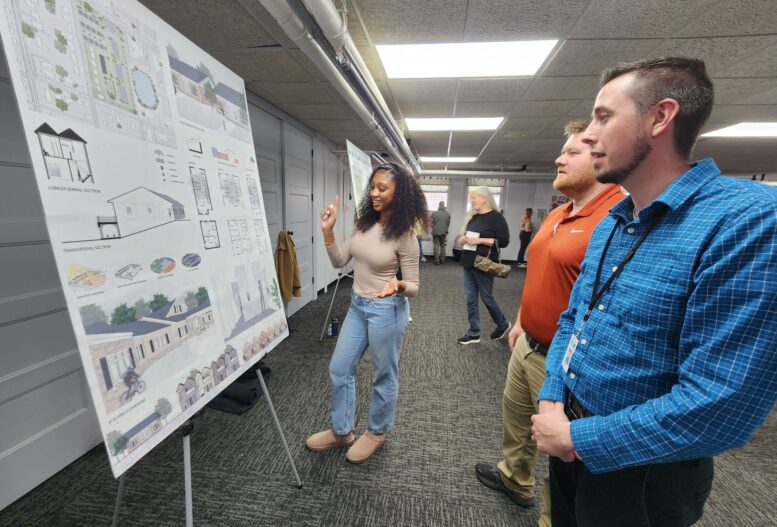
Earlier this month, the students showed off their concepts in the basement of First Presbyterian Church, where community members could view all the possibilities.
Each design had several types of homes. Some included space for commercial uses. All offered opportunities to cultivate “community,” with landscaped walkways, green spaces and gathering areas.
None of the designs came with price tags. The goal was to create neighborhoods with moderately priced housing. But as the students explained, they were the architects, not the number crunchers.
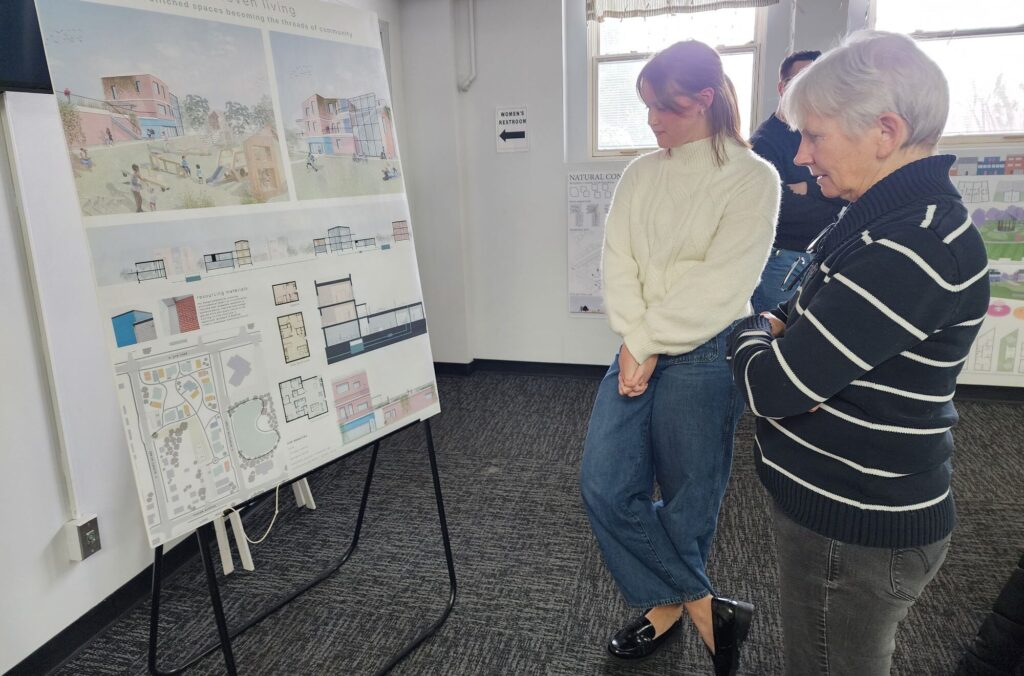
Alaina Andrews, from Temperance, Michigan, showed her final design that created spaces geared to students through senior citizens.
“I wanted to have a space for everybody,” she said, of the 62 units ranging from studio apartments to multi-bedroom apartments. Andrews described her development as intended for “interwoven living, becoming the threads of community.”
Her design included features like a cafe, rooftop seating, a playground, pickleball and basketball courts.
Samuel Speweik, of Waterville, created a neighborhood using organic shapes that would encourage a sense of togetherness.
“You wouldn’t be able to live here without knowing your neighbors,” Speweik said.
The design called for gardens, courtyards in the center of homes, and the use of sustainable materials.
“This is missing middle housing – in between large skyscrapers and single family homes,” Speweik said. “That’s what we all desire – well designed homes that are affordable.”
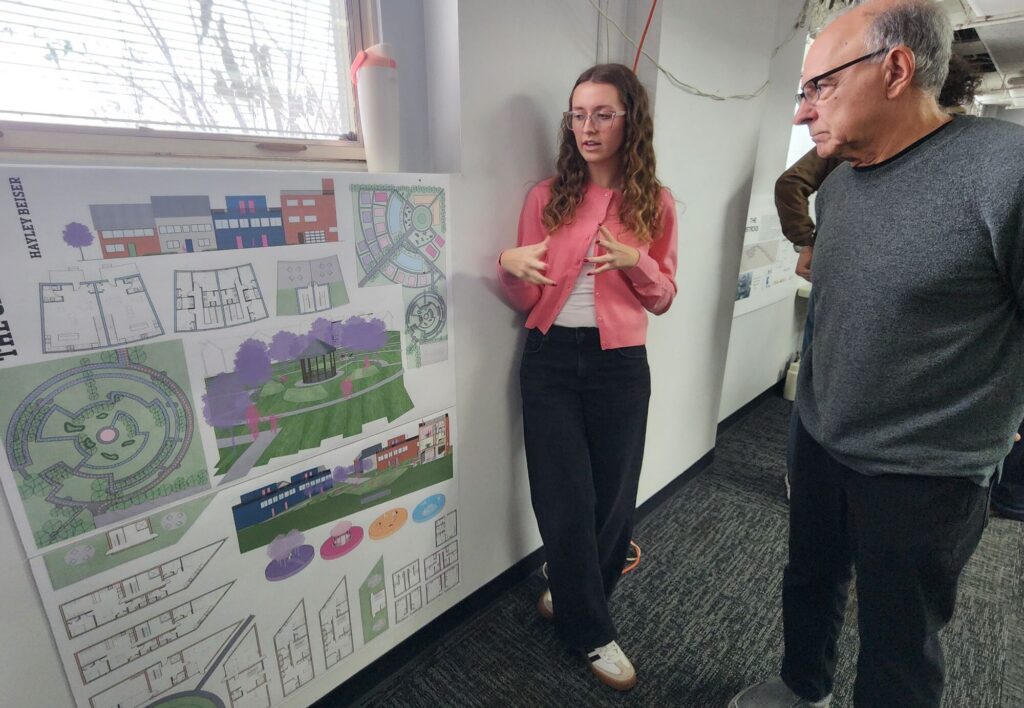
Hayley Beiser’s concept was designed with intergenerational residents in mind. To provide some services right in the neighborhood, she included a yoga studio, a cafe and a general store.
Some of the budding architects designed neighborhoods to combat the “loneliness epidemic.” Rebekah Barnett, of Wooster, created large interactive spaces in the middle of homes for multi-generational families. She included a food pantry and laundromat, and studio apartments that were connected with shared spaces.
Some of the drawings played on the connection to BGSU Falcons, with Gavin Dicke, of Rockford, placing housing units in the pattern of a spreading wing with shared balconies.
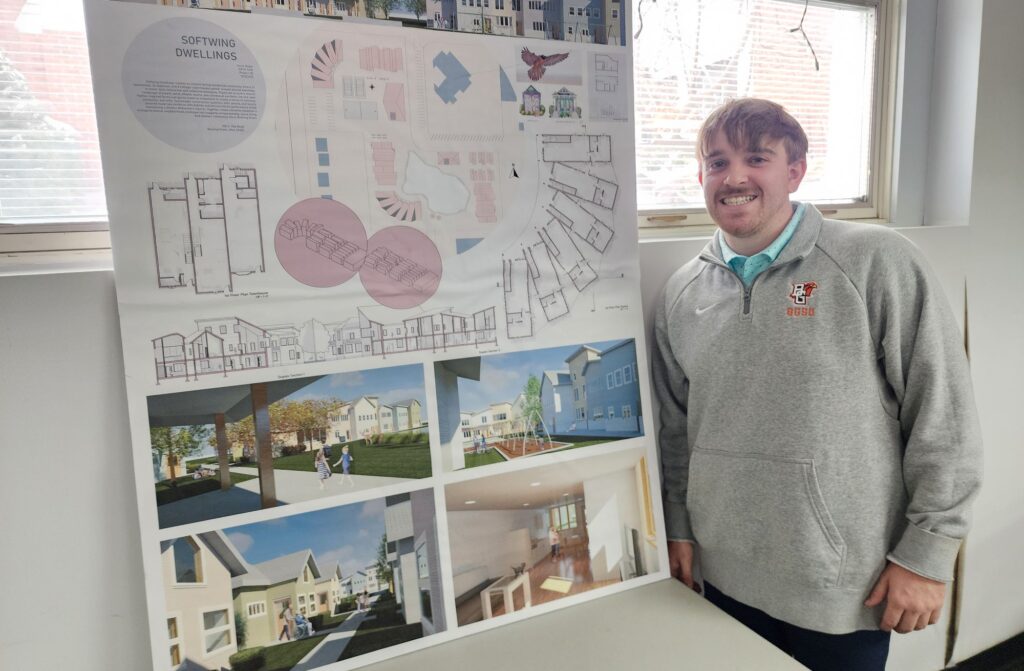
“So neighbors can meet neighbors,” Dicke said.
His design included a concert area and pavilion, plus the use of solar panels. Dicke said this project gave the student architects the chance to create something that could become reality.
“I’m really excited about this. It’s a very practical project,” he said.
Hallie Kamphaus, from Leipsic, was inspired by nest structures for her project. That nest design appears throughout her neighborhood, where she inserted a community market, gardens and pop-up shops.
“I had a really fun time with this,” she said.
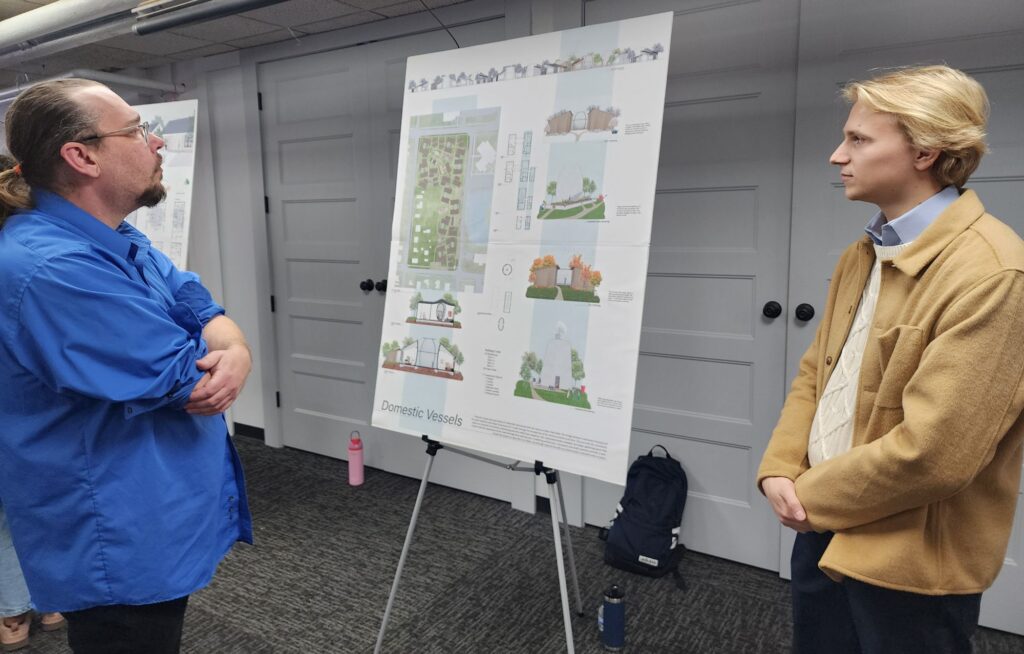
Evan Thompson, from Oregon, also created a place where residents were encouraged to interact. “Sprinkled throughout the development” were outdoor patios, fire pits and gardens.
Amira Welch, from Columbus, introduced her design as “more practical” than some of her classmates’. With a focus on sustainability, she reused the brick on the Sentinel-Tribune building, installed solar panels and vegetation shading.
The project began as a way for BG SONG to explore housing options for Bowling Green, and involve the creative thinking of budding architects, said Kathleen Dennis.
“We wanted to start the dialogue. What can we do with new development?” Dennis said.
In addition to community members interested in housing, several city officials attended the open house to view the proposals. They saw possibilities.
“I’ve been very impressed,” said Matt Snow, community development administrator for the city, noting that the plans did not show “standard squares on paper.”
While some designs were more practical and some more imaginative, there were good ideas, said Chase Fletcher, the city’s senior planner.
“There are definitely designs that will work,” Fletcher said.
City Council President Mark Hollenbaugh agreed some plans were quite idealistic – but all had components that could be incorporated. But with any development, cost will be key, he said.
“To be successful here it has to be affordable,” Hollenbaugh said.
Rose Drain, of BG SONG, said she was pleased with the efforts of the students, and the interest from the community.
“We didn’t know what to expect,” she said. “The energy here is tangible – and hopefully catching.”