By JULIE CARLE
BG Independent News
Loss of farmland, tight margins and extreme drought are among the challenges facing northwest Ohio farmers.
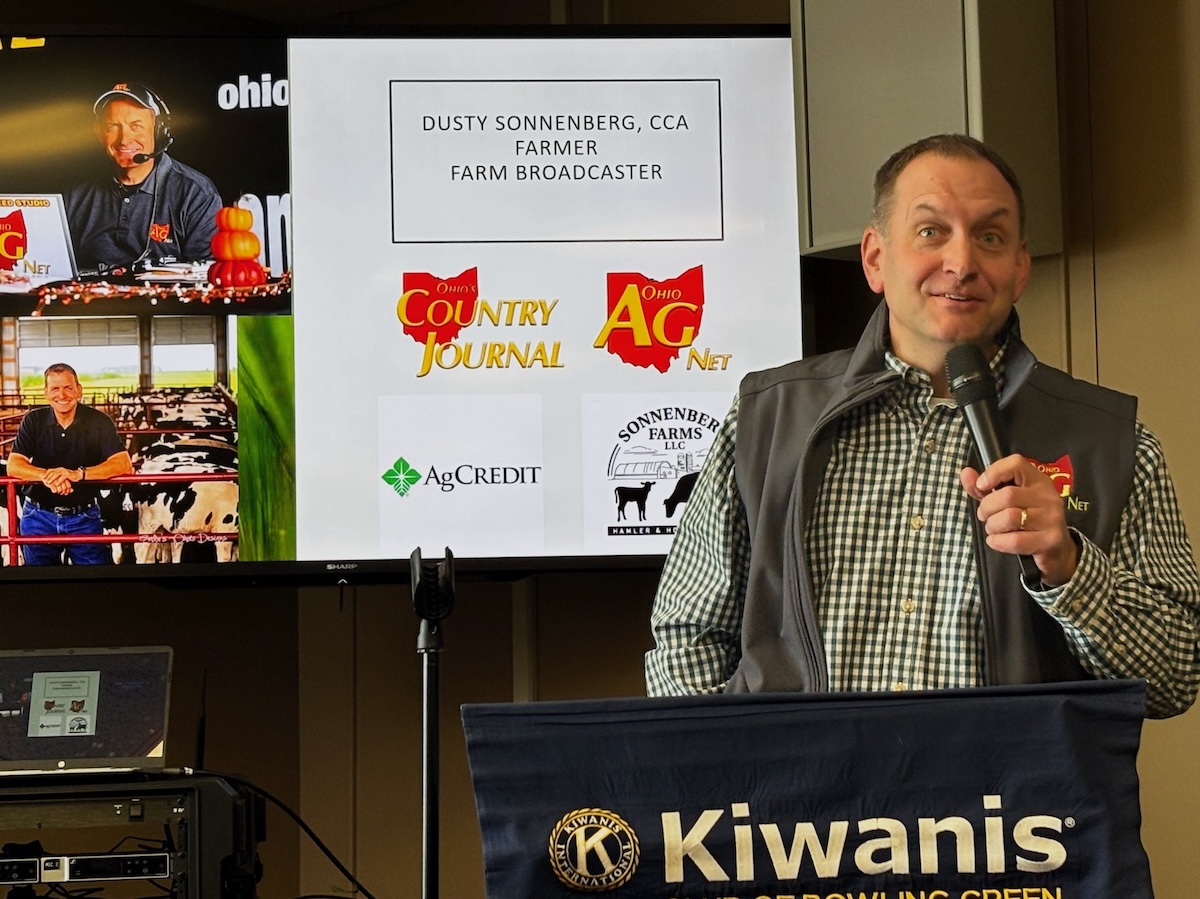
During the Bowling Green Kiwanis Club meeting on Thursday, Henry County farmer and Ohio AgNet broadcaster Dusty Sonnenberg discussed the challenges and technological advancements that are likely to shape the future of agriculture.
Northwest Ohio farmers, especially those within a section that includes most of Wood, Henry, Putnam, Paulding and Mercer counties, and lesser amounts in Hancock, Allen, Auglaize, Ottawa and Lucas counties, are in an extreme drought condition.
With current precipitation levels at 7-8 inches below normal, the long-term implications could be concerning. The lack of subsoil moisture is not likely to hurt the planting season.
“There will probably be moisture to get the crop started, but as we get into late June, July and August, that’s when we rely on that subsoil moisture for those plants to be able to use when it gets dry,” he explained. “This is something that at least locally we’ll be talking about quite a bit: What is that subsoil moisture and what do the drought conditions look like?”
Stressed farm economy
Another major stressor for farmers is the “largest gap in 25 years between the high cost of inputs and the prices farmers receive for their crops,” he said. The result: very thin profit margins.
The prices that farmers receive is similar to prices a year ago, but the cost of inputs such as seeds and fertilizer are much higher. The current difference in what farmers receive for their crops versus what it costs to produce the crop is the most it’s been in the last 25 years, Sonnenberg said. “We’re producing a lot more bushels, but we’re doing it on a lot thinner margins. The technology we have in the seed that’s out there now has allowed us to produce more bushels per acre on less acres and with less inputs”
Agriculture and water quality
“Water quality issues will continue to be something we talk about in this part of the state, as well as across the country,” Sonnenberg said.
The 2014 massive issue of algal blooms in Lake Erie, which disrupted access to clean water for hundreds of thousands of people, primarily in the Lucas County area, highlighted agriculture as a major contributor.
Ever since 2014, “when everything got brought to the forefront, agriculture has stepped up to do its part,” he said.
The H2Ohio program, which was started by Gov. Mike DeWine is making great strides in reducing agricultural runoff into aquifers and Lake Erie.
Currently in Ohio, there are more than two million acres enrolled in conservation practices and production techniques that help improve water quality as well as the use of nutrients and management of soils and soil health.
In Wood, Henry and Putnam counties, more than 50% of farmers and farm acrers are enrolled in the practices.
“It’s really neat to see farmers, especially in northwest Ohio, taking ownership and embracing the opportunity to do their part to help improve the quality of water,” he said. For the past several years, the algal bloom on the lake has been significantly less than the forecast.
More frequent flooding events in the spring may be contributing to more nutrients washing out of the fields through the ditches, rivers and into the lake, Sonnenberg said. The flash flood events are often followed by drought events.
“How do we manage those types of changing weather events?” he asked. “That’s a question that we’re working on.”
Loss of acreage and farmers
In the most recent agricultural census (2022), Wood County had over 250,000 acres of farmland. The county is first in Ohio in soybean production, eighth in the state in overall crop production and 24th in livestock production, contributing over $203 million to the state economy.
Each year in Ohio, more than 100,000 acres of farmland go out of production.
Sonnenberg doubted that statistic when he first heard it, thinking, “That’s an awful big number.” But then he thought about Ohio’s 88 counties and figured that number was realistic if each county lost about 1,000 acres a year to changes in land use for various reasons.
The more concerning thought was that if the average farmland loss was consolidated to Wood County, it would take only two and a half years for the county‘s most productive soils to be taken out of agriculture.
“Farmland use and general land use is a conversation that agriculture and all of us need to have,” Sonnenberg said. “It is something that we as Ohioans need to think very seriously about.”
The number of farmers in Wood County is decreasing, while the average age of farmers is increasing. Of the 2,039 farmers in Wood County, there are about 200 that are under 35 years old; 1,007 who are 35 to 64, and 832 (more than 40%) who are 65 and older or at retirement age.
Though many farmers don’t actually retire, “there is going to be a transition nationwide of millions of acres in the next decade from one generation to the next,” he said. “We’ve seen what housing values have done; farmland values have gone up just as rapidly. So how do we best facilitate that transition of ownership of those acres, especially in light of land use, to make sure those acres can remain in agriculture?”
Solar development, data centers and residential development compete against agricultural uses of the land.
The increased values create opportunities for “those generations that are removed from the farm to be able to cash in on some pretty big checks if they don’t have a direct connection back to that land,” he added. “We rely on that land and whoever’s operating it to provide the feed, fuel and fiber that we use every day.”
Advances and strengths in agriculture
Sonnenberg admitted there are many challenges in agriculture, but there also are plenty of reasons for hope.
The evolution of farm equipment and practices has enabled farmers to increase yields and efficiencies.
Advanced technology is already making a difference in farming practices. creating many advantages in agriculture. Planters that can plant 48 to 64 rows at a time help farmers plant hundreds of acres a day instead of a handful of acres. Modern-day combines are equipped with GPS and technology that impacts farmers’ efficiencies.
The technology of autonomous tractors is already in prototypes and will be available in the not-too-distant future. Drones are being utilized for the precise application of pesticides.
“These are some of the new things that are coming down the line that are really exciting that are going to take us to that place we need to be going in the future,” he said. “I believe in the future of agriculture with a faith born not of words but of deeds,” he said, quoting the FFA Creed. “There are a lot of folks that we stand on their shoulders for what they did in generations past, and it’s our task to be those that are building the foundation for the ones that are coming in the future.”
The future success of agriculture depends on strong leadership, collaboration among commodity groups, and adapting to a changing demographic landscape where the non-farming population is the vast majority. Ohio farmers have been at the forefront of many agricultural commodity groups, including the national president and vice president of the National Pork Board, the immediate past chair of the United Soybean Board, the president of the American Soybean Association and the president of the National Corn Growers Association.
“It’s great to see a state like Ohio, whether we are an urban state or a rural state, providing leadership locally but also at the national level,” he said.