
By JAN McLAUGHLIN
BG Independent News
Sticker shock for rising health insurance costs is making some people sick with worry.
If Congress fails to take action on health care costs this year, the tax credits that have helped many Americans pay for Affordable Care Act health insurance plans for four years will disappear.
On average, that will more than double what subsidized enrollees currently pay for premiums, according to an analysis by the health care research nonprofit Kaiser Family Foundation. Among those affected will be people who are self-employed, work at small businesses, and have part-time jobs.
The rising costs and shrinking benefits – combined with confusing information – has some local residents worried about which health insurance to select, or if they will be able to afford any plan at all.

Debbie Dalke feels uncertain as she switches from employer-provided health care to Medicare. She and her husband worry about her mother-in-law, who has dementia and is on Medicaid.
“I’ve been on employer-provided health care for most of my life,” Dalke said.
She worries that some people with automatic renewal plans will be stuck with huge cost increases. “They’re going to be hit with sticker shock.”
“Some healthy people will decide they are going to go without it,” Dalke said. In many cases, people already delay care until it becomes an emergency. “A lot of people don’t go unless they absolutely have to.”
“If insurance gets too expensive, healthy people stop buying it. This leaves insurance companies with sicker enrollees and smaller profits. To cut their losses, some will further increase the cost of insurance, so even fewer people buy it, and so on,” Dalke said. “This downward spiral impacts the quality of healthcare for everyone.”

Katie McKibben worries about a family member who has substance abuse issues, and the looming cuts to coverage.
Meanwhile, the complexity of the insurance programs make it difficult for most people to navigate their options. The ads that run on TV are deceptive, McKibben said. The plans are littered with misinformation that muddies the issue – such as the fact that “Medicare Advantage” is not really Medicare and often has few advantages for consumers. And some of the renewed plans neglect to clearly explain that patients now are required to get prior authorizations for some standard care.
McKibben and her sister helped their elderly mom decide what plan was best for her. “You have to have a navigator,” McKibben said. “They are preying on the elderly.” She also worries about the next generation’s access to health care. “I have concern for the world my two granddaughters will be growing up in.”

Kathleen Frey, who has concerns about the loss of local hospital care, had to travel to Fulton County for a high-risk pregnancy delivery after the closure of the obstetrics department at her local hospital in Napoleon, where her first four children were born.
“It’s heartbreaking,” Frey said.
One of her children has a rare congenital disease that requires a day at the hospital each month. Frey worries she will have to travel to another county for that care if the Henry County Hospital goes the way of some other rural hospitals across the nation.
“I’m already panicking,” she said.
Closure of rural hospitals will lead to greater mother and infant mortality, Frey predicted.
“It amounts to abuse against women and children,” she said.
Frey’s husband, a firefighter and paramedic, has seen longer response times as rural hospitals close.
“This is impacting lives in so many ways,” she said. “I’m afraid they aren’t connecting the dots.”

Laura Wicks, co-owner of Grounds for Thought in Bowling Green with her husband Kelly, watches as the challenges mount for small business owners wanting to provide health insurance for employees.
“The cost has always been more than we can afford,” Wicks said. Their business employs between 18 and 21 people – with the costs in the past being quoted at between $700 and $1,200 per person.
Worsening the issue is the lack of clarity available on health insurance options, Wicks said.
“I don’t think people see the real effects of this,” she said.

Monica Gonzalez, 34, who works at Grounds for Thought, struggles to afford private purchased health insurance as the prices explode.
“I wish the leaders would listen to the people they are leading,” Gonzalez said.
The tax credits and subsidies are the only way many people can afford any health insurance, she said.
Gonzalez’ insurance premium is currently $133 with a $300 tax credit. Her plan has no dental or vision coverage, plus a big deductible.
“It’s basically covering the bare bones,” she said.
The rising costs could create a large ripple effect, according to the Associated Press. Over time, as many younger, healthier people inevitably forgo more expensive coverage, insurance companies are expected to further increase costs for members of the covered population to account for them being older and sicker.
If more Americans are uninsured and can’t pay out of pocket for emergency health care, some of their health costs will also fall on hospitals and the government. With some smaller rural hospitals already operating on shoestring budgets, the more vulnerable sites are predicted to close – requiring people to travel further for care.
The number of people who rely on Affordable Care Act health insurance has increased markedly since before the pandemic. More than 24 million people were enrolled in the marketplace plans in 2025, up from about 11 million in 2020, according to the Kaiser Family Foundation.
If the “One Big Beautiful Bill Act” increases the federal deficit, across-the-board spending cuts will be triggered in federal programs, including Medicare.
The OBBBA specifies new work requirements for Medicaid recipients. Arkansas did this a few years ago, but it didn’t increase employment because about 95% of those required to work were already working.
However, 25% of the recipients still lost their Medicaid because they were unaware of the policy or were confused about how to report their status. Dalke worries that many Wood County residents on Medicaid could lose their insurance because they can’t navigate the bureaucracy.
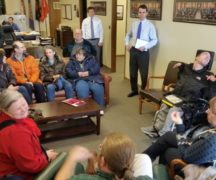
The ramifications and confusion surrounding health insurance plan changes prompted Dalke and McKibben to ask for an appointment to talk with their congressman, Bob Latta, R-Bowling Green.
“Latta wouldn’t meet with us, so we met with a staff person,” McKibben said.
Dalke and McKibben asked David Wirt, district director at the congressman’s Bowling Green office, to share their concerns with Latta, so he could respond to them. That meeting was on Sept. 30, and the women are still awaiting a response from Latta.
“I don’t really understand why the House continues to be in recess, while presumably conducting district work, but Mr Latta doesn’t have time to respond to us,” McKibben said earlier this month.
Democrats demanded that Affordable Care Act subsidies passed in 2021 be extended, but Republicans refused.
Neither McKibben nor Dalke found any comfort in the deal made to end the federal government shutdown. Senate Republicans only agreed to hold a vote on extending the health care tax credit.
“The Republicans did not promise to vote for it,” Dalke said. “I am also concerned that this vote might come too late for the people to receive the credit when they pay their insurance premium in January.”