
By JAN McLAUGHLIN
BG Independent News
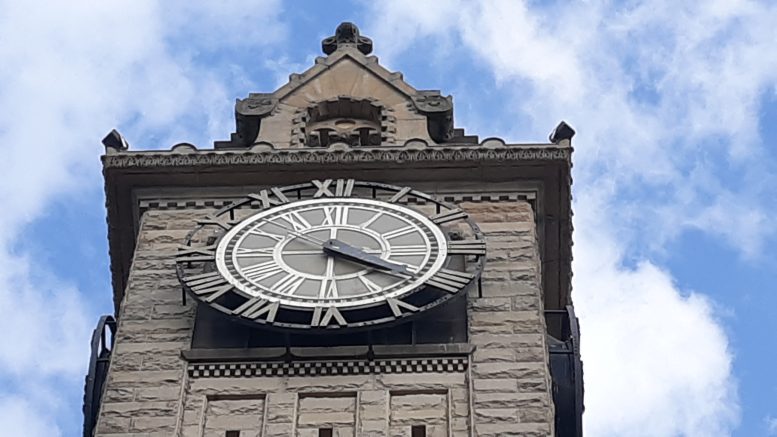
Like clockwork, when the courthouse clock in Bowling Green goes quiet, people of the community worry.
In the past decade, time has taken a toll on the clock with the pins or gears breaking in frigid winter weather. But this time, as weeks of below freezing temperatures have lingered in the city, the towering clock in the courthouse was intentionally frozen in time.
Alex Aspacher, director of communications for the county, said discussions were held with courthouse maintenance staff last week in order to prevent damage to the towering clock. It was decided the best way to prevent problems with the severe cold and condensation was to turn off the clock motor. Aspacher expects the clock will be back in business as soon as the weather cooperates.
But neighbors of the 125-year-old clock powered by a 75-year-old motor apparently don’t like their noisy neighbor going quiet. Comments on social media expressed concerns for the treasured timepiece.
This wasn’t the first time.
In early February 2019, the massive clock stopped working in the frigid cold. It turned out that a single pin in the shaft connecting the clock motor to the clock hands had broken.
By the end of February, it was back in business.
But getting the historic clock up and running is far more difficult than pushing a few buttons. Once repairing the pin, courthouse maintenance staff had to climb the steps into the 195-foot clockhouse tower to set the clock to the correct time.
“It’s all original equipment,” Wes Sattler, of the county maintenance department, said in 2019 of the giant clock towering over the city. Sattler said the courthouse crew has become adept at clock repairs over the years.
There were more time troubles in November of 2019, when the clock conked out again. It proved to be a tougher fix, and time stood still at 4:19 for weeks.
Local residents with mechanical minds offered to try to get the clock back on track. The county commissioners were approached by several tinkerers sure they could fix the problem. One was an 88-year-old man who said he had been up in the clock tower when he was 10 years old.
Ultimately coming to the rescue was an airman assigned to the 180th Fighter Wing, who designed and built a gear to replace the broken part. After seeing an article about the clock, Staff Sgt. Alex Wynn, a machinist assigned to the 180th Fighter Wing, reached out to offer his services.
Unlike earlier in 2019, this fix was a little more difficult since it involved a stripped gear – and replacements were no longer available. Wynn, who repaired and built different parts for aircraft and ground equipment, was successful in getting the clock ticking again.
Residents of Bowling Green have come to rely on the big old clock – and when that constant timekeeper stops functioning, it can be, well, disorienting.
Back in January of 2018, neighbors of the clock voiced their displeasure with the towering timepiece being tweaked with. After several years of the Wood County Courthouse tower clock running behind – or actually ahead of the times, the courthouse crew set about fiddling with the mechanism to get the clock to chime on time.
But once the clock was right on time, neighbors appeared to find it discombobulating.
It turned out some of the neighbors seemed to appreciate the advanced notice the courthouse clock had been giving them for decades.
“I’m kind of disoriented because the clock tower in the county courthouse is chiming exactly on the hour. I’ll get used to it,” Geoff Howes, a courthouse neighbor wrote on Facebook. “We’ve lived three blocks from the courthouse for 30 years and if I’m not mistaken, this is the first time it’s been on the hour. It changes every spring and fall, when we go on and off daylight savings time. Sometimes it’s three minutes early, sometimes two, sometimes five or six. Most recently it was four minutes off.”
Some Bowling Green residents had grown to rely on the early chimes, which acted as a giant snooze alarm of sorts.
One resident asked if this meant that Bowling Green Standard Time had been abolished.
Since the clock was running four minutes ahead, the courthouse crew was asked to turn off the clock motor for four minutes, then start it up again. That did the trick – at least for the chimes.
Those relying on the clock hands to tell the time were still a few minutes behind … or ahead.
The chime mechanism operates independently of the hands, which aren’t as easy to adjust. Moving the hands ideally occurs when the clock’s big hand is pointing straight down, so it’s easier to reach. A worker with a radio on the ground then has to talk through the worker in the clock tower.
The clock, perched in the 195-foot tall courthouse tower, has a storied history.
The clock had been guaranteed to vary no more than 10 seconds a month. But a few months after it was installed, a Bowling Green newspaper reported the clock “goes when it pleases and makes its own time.”
Even the majestic courthouse clock was bound to lose track of time when pigeons roost on its hands, when blizzard winds whip in its face, and when it works round the clock for more than a century.
When constructed, the clock hands were the second largest in the U.S., exceeded only by the clock hands on the San Francisco Chronicle newspaper building. Stories vary, however, with some stating that the Wood County clock hands were 16 feet in diameter and some stating they were 17 feet. Either way, the San Francisco hands had them beat by half a foot.
The original hands of the clock reportedly were made of basswood – not of wrought iron as spelled out in the contract. The present ones are aluminum.
The original basswood hands are now at the Wood County Museum. Many years ago the clock would be slowed by pigeons roosting on the hands. The clock used to be operated by a weight system, like a grandfather clock, but is now operated by a small motor.
The hands on the clock were reportedly frozen during the blizzard of 1978. More recently, one of the clock hands was wrestled by high winds and bent backward.
Each of the four faces of the clock has 12 electric light bulbs, one for each hour. To replace a burned-out bulb, a steeplejack has to climb 195 steps to the tower and then walk outside on a narrow ledge. The steps to the tower consist of three floors of steep stairs, followed by three steel ladders.
A little shanty just below the faces of the clock houses the mechanism. A huge arm with a sledgehammer on the end strikes the bell – which weighs 2,000 pounds.
The clock tower is frequently the home to a pair of nesting Peregrine Falcons, who often hatch a new batch of babies each spring. The clock’s loud chiming – nor the lack of perfection in keeping time – apparently does not disturb them.