By JULIE CARLE
BG Independent News
For the first time in 50 years, the threat of nuclear proliferation is real.
“We are moving basically in an era now where there are no agreements or commitments to rein in the nuclear arms race,” Dr. Stefan Fritsch, an associate professor of political science at Bowling Green State University, said Saturday during the second 2026 Great Decisions talk at the Wood County Senior Center.
All but one of the arms control treaties and agreements, which were put in place after the Cold War have expired. The New START treaty that was signed in 2010 is set to expire Feb. 4.
“That’s the last of the nuclear agreements between Russia and the U.S. that were still active. Everything else has expired,” Fritsch said. “We are moving basically in an era now where there are no agreements or commitments to reign in the nuclear arms race. And that’s a first in 50 years.”
The post-WWII international, rules-based system was led by the United States, acting as a “liberal hegemon,” defined by Fritsch as “a country that has just significantly more power and resources than anybody else in the system.” (Read more about the reference to “liberal” in Jan. 24 Great Decisions talk by Dr. Amilcar Challu.)
These countries provide stability and global public goods, such as the U.S. Navy that keeps the international seas open. The U.S. pays for the Navy to do that but everybody else profits from the open seas, he explained.
Security guarantees to allies are another example of public good created during the rules-based system.
“The nuclear umbrella that the United States expanded to its allies in Europe and countries like Japan and Australia,” is another example of public good, he said. “That means other countries could count on the U.S. being there should they get attacked by somebody else.”
The security guarantees limited nuclear proliferation for decades.
Recent shifts in U.S. foreign policy have created “a rupture in trust and profound insecurity among allies,” he said.
Historical background (post WWII)
The U.S. became focused on how to organize world politics and the global system as World War II ended. Policy makers knew they “couldn’t go back to the old way of doing politics … where we’re all adjusting for power and influence without some commonly agreed upon rules of how would politics should be vanished,” Fritsch said.
Leaders decided to finish President Woodrow Wilson’s post-World War I plan and introduced a rules-based, multilaterally organized global system. It hadn’t worked out because the U.S. wasn’t fully ready to commit to the plan and take over a leadership role until after 1945. They worked on formulating and designing and bringing others on board to create the rules-based system.
The strategies of collective security and containment strategy originated after the war when it became obvious that the Soviet Union was likely to become a competitor on the global stage.
For awhile, the U.S. “had a monopoly on nuclear powers, but the Soviet Union was catching up rapidly. During the Cold War, there was a balance of terror because of nuclear power and nuclear arms.
“We eventually had mutually assured destruction, which means that if anybody ever pushes the trigger and sets of a nuclear exchange, it would be suicidal,” he said.
That strategy of nuclear deterrence proved to create “a rather surprisingly stable system,” Fritsch said.
The buildup of nuclear arms continued through the 1960s and ‘70s and peaked in the mid-1980s. The Soviet Union amassed more nuclear arms than the U.S., but the Soviet’s over-investment in nuclear capabilities became their downfall, he said.
Post Cold War, and after the Cuban Missile Crisis, the global sentiment was the need “to rein this in,” which is when the two superpowers decided to work together to manage nuclear arms. The U.S. and Russia agreed to get rid of certain types of nuclear arms through various treaties and agreements. However, there was still enough to destroy the planet multiple times over,” he said.
Things started to change after 9/11, the following wars in Afghanistan and Iraq, and the economic crisis, which together created small fissures in the system.
Foreign policy and the push toward democracy in Russia “didn’t pan out,” Fritsch said. NATO was developed to be a “polite nudging” for countries to do more for themselves. During President Barack Obama’s terms, he told Europeans “nicely” that they needed to build up their own defenses.
When Donald Trump was elected for the first time in 2016, his administration was “very blunt and very outspoken” telling countries they needed to increase their military and security spending.
“That was the first wake-up call for Europeans,” he said. “After 50-60 years of a relationship that was very stable, that came as a little bit of a shock.”
President Joe Biden continued many of the policies Trump initiated, but “packaged nicer and a little less forceful of a message.”
But the last year, in Trump’s second term, “has been a little more turbulent… because everbody is scrambling,” Fritsch said.
‘Now it’s different’
With the tenor of maintaining the old transatlantic model of providing security now gone, “The constant questioning of the U.S. commitment to NATO in Article 5 and if we can still trust the nuclear security guarantees has created a lot of nervousness and insecurity in Europe,” he said.
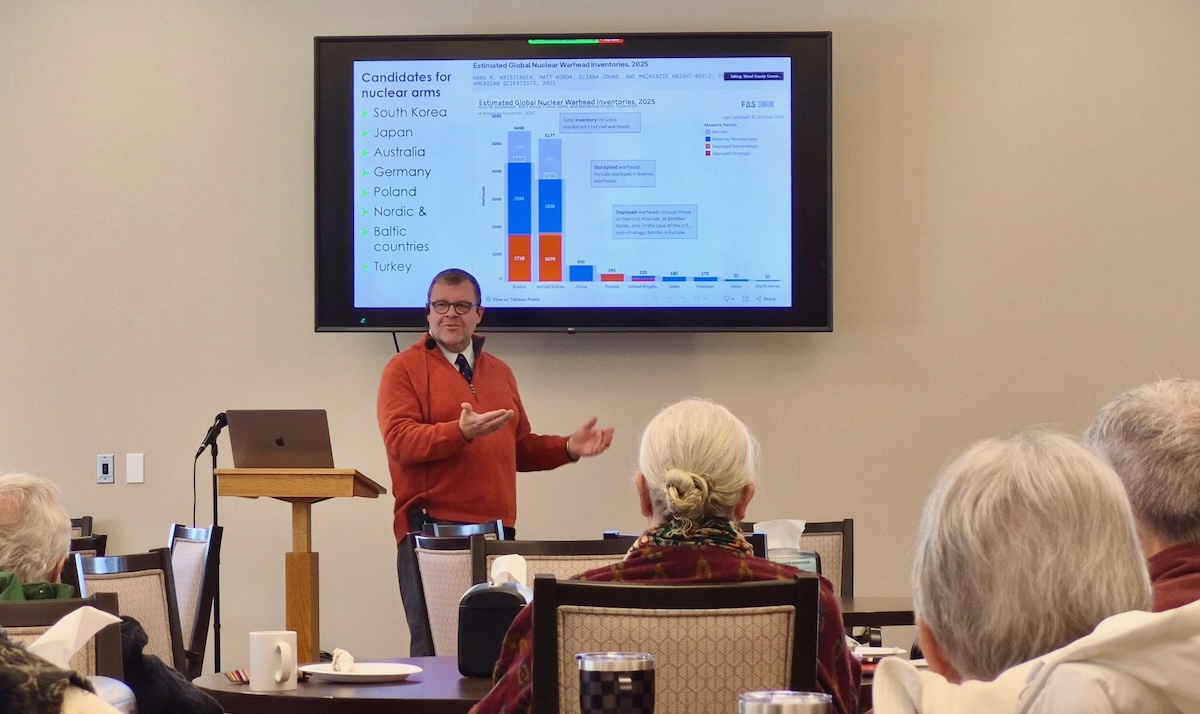
“The talk has started,” he said. The insecurity has revived conversations in several allied nations—including Germany, Poland, South Korea and Japan—about the necessity of developing their own nuclear weapons.
A new unregulated environment has emerged, increasing the risk of a renewed arms race.
“That’s the perverse logic of nuclear deterrence, that the more nuclear arms you have, the more stable the relationship becomes,” Fritsch said “Now it’s really sort of a fundamental break, I think, in that trust relationship.”
Doomsday Clock ticks closer to midnight
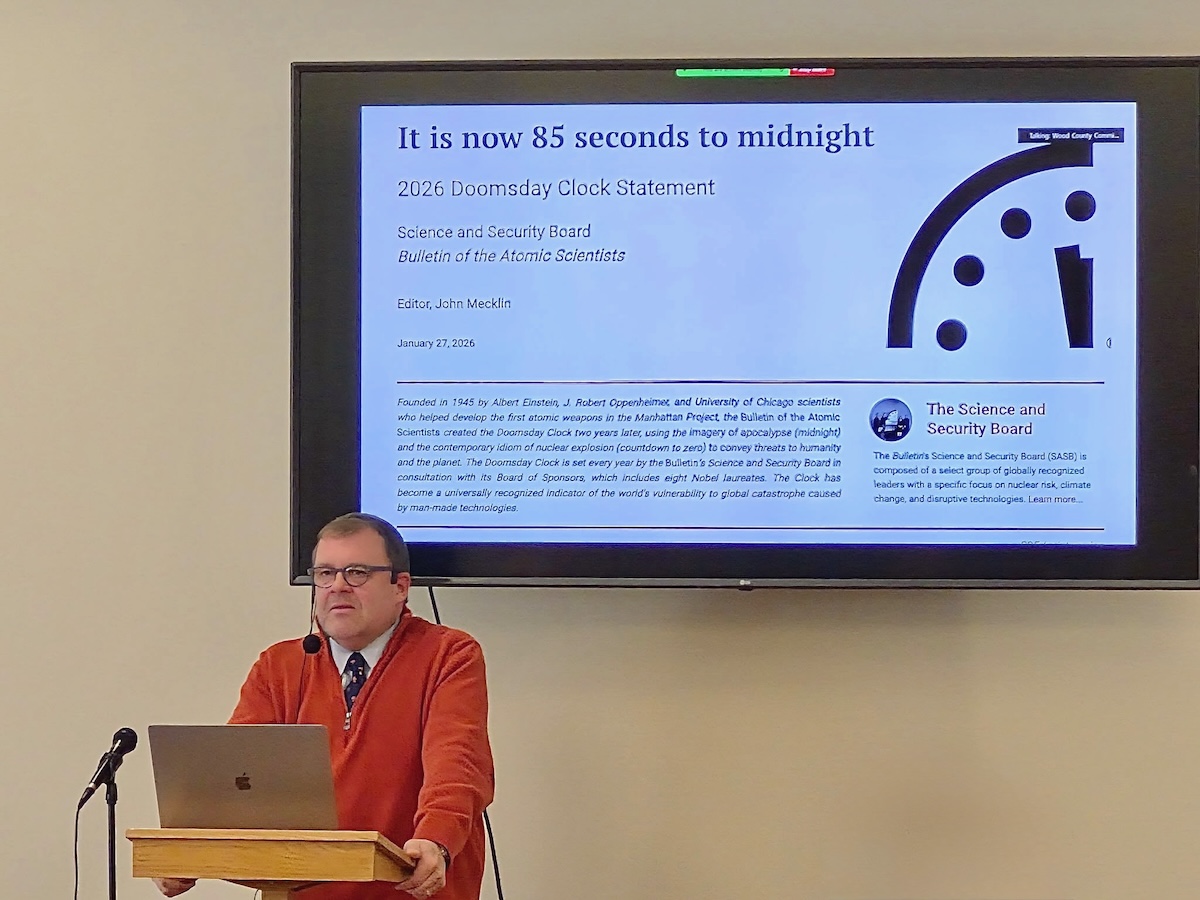
All of this has led to the Doomsday Clock ticking closer to global catastrophe.
At just 85 seconds to midnight, the most recent update of the symbolic clock by the Bulletin of Atomic Scientists forewarns of dangers such as climate change, misuse of biotechnology, the threat of artificial intelligence and mostly at this time, the risks of nuclear war.
“I think a lot of politicians and statesmen around the world are developing this sort of nonchalant relationship with conflict because none of them has experienced war,” Fritsch said. “If the Europeans think about defending themselves right now, good luck, because it’s impossible. It will also take more time to scale up military capabilities. We are at the beginning of the beginning.”
The next Great Decisions talk is Feb. 7 at 9:30 a.m. at the Wood County Senior Center. Dr. Douglas James Forsyth,associate professor in the BGSU Department of History, will address “Trump tariffs and the future of the world economy.” The talk is free and open to the public but registration is required by calling the programs department at 419-353-5661 or 1-800-367-4935 or emailing programs@wccoa.net.