
Written by Geoff Howes
Bowling Green Historic Preservation Commission
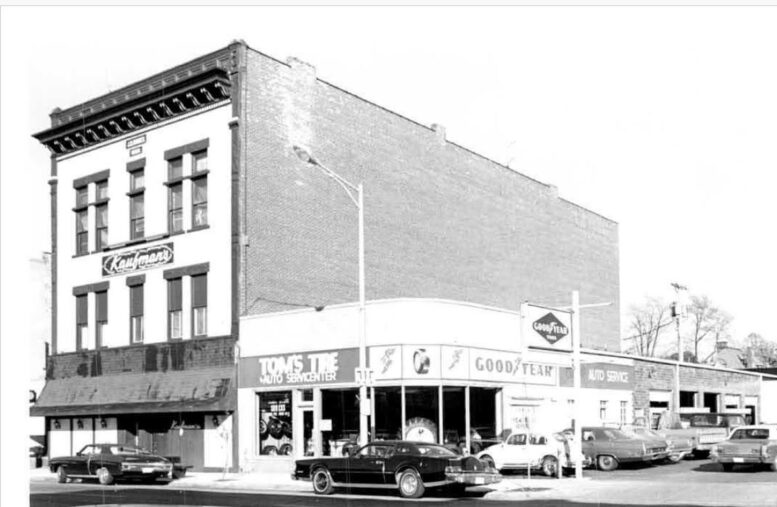
The Bowling Green Historic Preservation Commission’s Historic Building of the Month for December 2025 is the three-story Hankey Block, later called the Case Block, at 163 S. Main St., and now Beckett’s Burger Bar. The large, fading sign on the south wall reminds us that for many decades it was Kaufman’s Restaurant.
Built in 1892 and finished in 1893, the Hankey Block has housed fraternal organizations, clothing stores, an architect, insurance agencies, law firms, hardware stores, a sewing-machine store, a beauty parlor, a car dealership, physicians, the gas company, a series of restaurants, a piano sales company, and apartments as well.
In July 1892, the community column “Tea Table Chat” in the Wood County Sentinel reported that work had started on the new Hankey Block. In August, it noted that D. Fries was doing the brickwork, Chapman & Line the stonework, and S. R. Brown the carpentry. In September, the columnist enthused: “The front of the new Hankey block on South Main will be a beauty. The brick work is of the light pressed variety, the same as in Mr. Hankey’s house.” In October, he predicted that the new block, with “its handsome cream-colored pressed brick and cut stone front, is going to be one of the finest buildings in the city.”
Mr. Hankey was John R. Hankey (1843-1902), a leading citizen in Bowling Green during the oil-boom era whose name—with the date 1892—crowns the façade. He was born on a farm in Wayne County, Ohio, in 1843. At 15, he went to Wooster to work in a clothing store. After serving for three years during the Civil War, he spent ten years as a traveling clothing salesman.
In 1874, partnering with a tailor, George J. White, he opened a clothing store in Bowling Green, where the courtyard of the vacant bank at 130 South Main Street is now. Just two years later, he built the three-story Exchange Bank building that still stands at the northwest corner of North Main Street and West Wooster Street.
In 1877 he brought his wife Emma T. (Van Houten) Hankey (1846-1917) and their three sons to Bowling Green. In 1890, he built the mansion at 408 West Wooster that is now the Dunn Funeral Home—the house with the cream-colored brick mentioned above.
Some thought his extravagant buildings were reckless investments for a newcomer, but Hankey proved them wrong by expanding his interests into lumber, natural gas, glass, oil, banking, and real estate. He continued building as well, notably the Hankey-Taber Opera House in 1889, in partnership with Ira C. Taber. This massive theater (featured as Historic Building of the Month in January 2023) stood just south of the Hankey block until it burned down in 1926.
“Tea-Table Chat” called the new building the “K. P. block” to distinguish it from the older Hankey Block on North Main. “K. P.” refers to the fraternal organization Knights of Pythias, who took over the high-ceilinged third floor as their “Castle Hall” in early 1893. According to the Sentinel, the room with its elegant furnishings was “said to be the finest of any hall of that order in Ohio.”
The Knights of Pythias, founded in 1864, was the first fraternal order chartered by the U. S. Congress. The women’s auxiliary, the Pythian Sisters, shared the Castle Hall. The K. of P. stayed in Hankey’s building for 64 years, until 1957.
The first retailer to occupy the street level was the clothier Sam Riess, who previously had a store at 104 South Main Street (now Easystreet), and one before that in the Sentinel block on East Wooster Street.
Samuel and Fanny Riess and their children were the first Jewish family known to live in Bowling Green. Fanny emigrated from Budapest and Sam from northern Germany. They married in 1871 and settled in Bowling Green in 1882.
For their daughter Jennie’s February 1883 wedding to Julius Less, a Detroit businessman, her parents first planned to use their house on Clay Street, but it proved too small. “It being impossible to secure other suitable quarters,” the Daily Sentinel wrote, “the large double-room in the new Hankey Block, to which Mr. Riess will soon move his place of business, was pressed into service …”.
The Sentinel’s account of the celebration begins: “Never in the history of Bowling Green has a wedding taken place upon so grand a scale …” 150 guests attended, including “many prominent Jewish citizens” from out of town. Rabbi Scribner of Toledo officiated. After a honeymoon in New York, the couple moved into an apartment on the second floor of the Hankey block, and Julius Less ran the shoe department in his new father-in-law’s store.
Sam Riess’s “Double Mammoth Store” sold clothes and shoes, along with carpets and other dry goods, from 1893 to 1902, when Riess relocated to North Baltimore.
In 1901, Hankey sold the building to Myron L. Case (1863-1923), a banker and entrepreneur (Note: the Case house still stands at 132 North Maple Street, which was built in 1890 and is part of the Boom Town & North Maple Historic District). Late in 1902, G. W. Loomis (1852-1923) moved his hardware, implement, and buggy store into the two rooms of what was now the Case Block.
In the 1890s, one of the second-floor offices (which “Tea Table Chat” said were “equal to any this side of Chicago”) was occupied by the architect Homer C. Brown, who designed Bowling Green’s Central School, which stood where the Senior Center is now. Another tenant was the Wood County Insurance Agency. The attorney Ira C. Taber (1860-1941), Hankey’s partner in the opera house next door, also moved into the new Hankey Block, later joined in by his partner C. R. Painter.
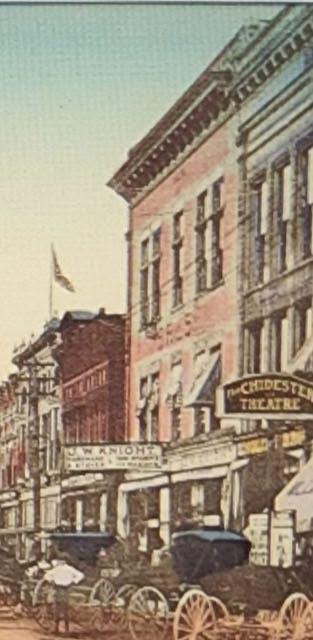
Dr. J. C. Snyder, a surgeon and gynecologist, had his practice there in the 1890s. In 1905, G. W. Loomis sold his hardware store to J. W. Knight, who ran it until 1909, when it was purchased by the storekeeper and farmer Robert Place (1852-1928). That same year, Place sold the store to Frederick H. Prieur (1858-1950), a merchant and horse breeder originally from Montreal, Canada. Prieur’s hardware occupied the first floor until 1925, when he moved to his new building across the street at 144 South Main (now For Keeps), which still bears his name.
At midnight on Saturday, Feb. 16, 1918, Edward E. Keep, age 67, stepped away from a poker game in his apartment in the Case Block after hearing a noise at the door. He was gunned down by a single shot from a .38 and died the next afternoon. The murder was not solved until 1924, when three men who had intended to rob the card game were convicted and sent to prison.
In 1926, after Fred Prieur moved out, the Schott brothers set up their “Workingmen’s” clothing store in the south room at 163 S. Main St. Arthur M. Schott had co-owned the Army and Navy Goods Store across the street at 192 S. Main St., and he planned to “cater especially to those who toil with their hands.”
Now the street level of the Case Block was divided in two. The first occupant of the north room was Ritz Millinery and Beauty Parlor, operated by Delphine Collins from 1926 to 1927. In 1927, the number 161 S. Main St. was added for the north side. The Singer Sewing Machine Company was the first business at this address, from 1927 to 1929. Also listed from 1927 to 1929 was the millinery shop of Mrs. H. E. Campbell. She was the local representative of the White Sewing Machine company and the Starr and Waltham piano companies as well. She may have shared space in the Singer shop or had a shop on the second floor.
161 S. Main St. was now also the address of the second and third floors, accessible through the outside entrance to the stairway between the north and south rooms. Later, this door was 161 1⁄2 and the number 159 was assigned to the side door off the alley. Other upstairs tenants included E. E. Coriell, in his office as the Grand Keeper of Records and Seals of the Knights of Pythias. Coriell was county auditor in the 1920s and a member of the BGSU Board of Trustees in the 1930s. In the 1950s, the K. of P. shared their space with the IOOF and the Royal Neighbors of America, a women’s insurance society.
From 1930 to 1932, Bolles Motor Sales, a Studebaker dealership, occupied 163 S. Main St. In 1931, the Ohio Fuel Gas Company moved into number 161. Its name changed to Columbia Gas of Ohio in 1964, and in 1971 it moved into a newly built office at 521 N. Main St. (now Middleton Law Offices).
Edward J. Unkart (1888-1957) was well known in town when, in March 1935, he opened his “new, modern restaurant at 163 South Main (K. of P. Bldg.)” Unkart had owned a “card room” across the street at 186 S. Main St., a gaming establishment that served food and drink. He had been a Wood County deputy and unsuccessfully ran for sheriff in 1918 and 1926. Coincidentally, he was one of the officers called to the scene of the Keep murder in 1918. He was active in the local Democratic Party, served as chairman of the Board of Elections, and was a member and unofficial captain of the original Bowling Green Fire Department.
From this point on, 163 S. Main St. would stay in the restaurant business. In 1951, the Sentinel-Tribune reported that Stanley Kaufman of Custar had purchased the restaurant from E. J. Unkart and planned to remodel it. Kaufman’s Restaurant became a downtown institution, Bowling Green’s place for fine dining.
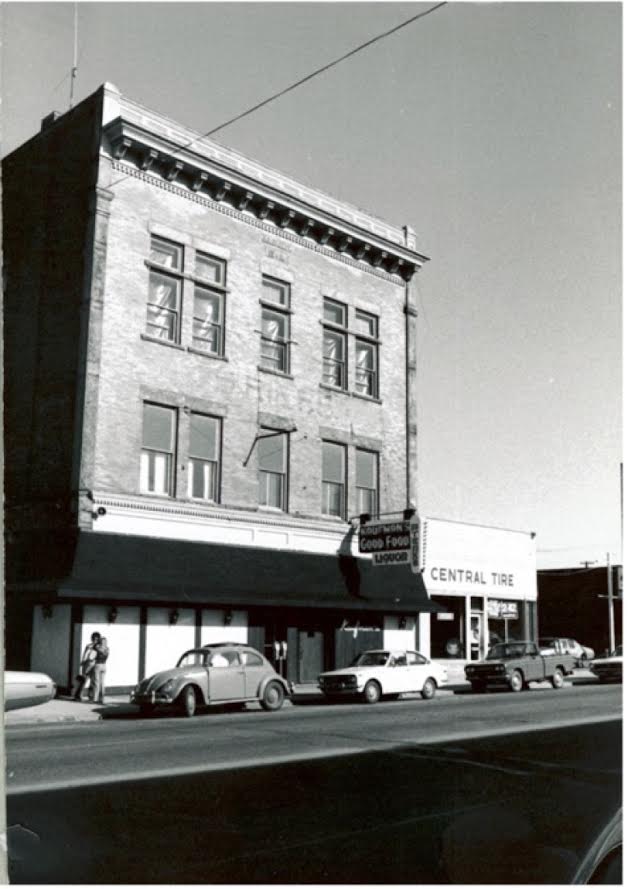
In 1971, Stanley Kaufman took over the space left by the gas company and added a barroom behind it. These became the Bismarck Dining Room and the Barbarossa Lounge. Continuing the German theme, the Bavarian Lounge, the Rhine Room, and the Riesling Room were added on the second floor, for a total of six dining rooms by 1980. The old K. of P. hall on the third floor was now used for offices and storage.
Kaufman’s was known for its catering and for accommodating community groups with meeting spaces and banquets. Many still remember the Tuesday night family-style chicken dinners. For university departments, it was the place to take job candidates and visiting scholars. In 1993, the Bismarck Room became the city’s first non-smoking dining area.
In 1997, Jim Ferrell, the owner of SamB’s restaurant on North Main, bought Kaufman’s, making it Kaufman’s Steak House and updating it by having the walls of the main dining room hand-painted with murals and adapting the menu to current tastes and trends. In 2002, Ferrell closed Kaufman’s and moved SamB’s to 163 S. Main St., where it would remain for 20 years. He then opened Beckett’s restaurant at the former SamB’s site.
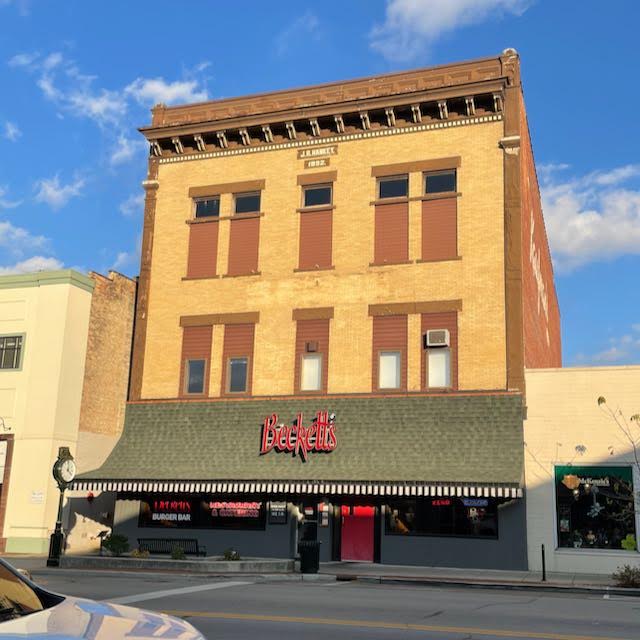
In 2007, George Strata took over operations at Beckett’s, renting the building from Ferrell. In 2022, Strata purchased 163 S. Main St. and moved Beckett’s into the bigger space, while Ferrell returned SamB’s to its previous home at 146 N. Main St. Strata had worked at Kaufman’s while a student at BGSU. “It’s a full circle,” he said, “… I have a lot of good memories of being in that building.”
(Written by Geoff Howes of the Bowling Green Historic Preservation Commission, with thanks to Heather Sayler, the Sentinel-Tribune, and the Wood County District Public Library.)
Would you like to nominate a historic building or site for recognition? You can do this through the City website at – https://www.bgohio.org/FormCenter/Planning-13/Historic-BuildingSite-Nomination-Form-83
You can learn more about the Historic Preservation Commission by attending their meetings (the fourth Tuesday of each month at 4 p.m.) or by visiting their webpage at – https://www.bgohio.org/436/Historic-Preservation-Commission.
