
By JAN McLAUGHLIN
BG Independent News
As Americans watch ICE agents sweep into cities in Democratic states, some wonder who will be next. If ICE were to show up in this region, what rights do immigrants have? And what role can bystanders play legally?
To answer those questions, a “Build the Nest” training was hosted last week by LaConexion of Wood County, a non-profit community-based organization bringing unity, voice and representation to the immigrant community in the Northwest Ohio region.
The training was led by Mechelle Zarou, an attorney serving immigrant and refugee families in Northwest Ohio, and Brittany Ford from Welcome Toledo-Lucas County.
“We are building a nest of protection for immigrants across the state,” Ford explained.
Making immigrants and citizens aware of their rights has become rather complicated in the past year since the federal government is ignoring some long-standing constitutional human rights.
“We really have no pathway to legal immigration to the U.S.,” Ford said. There is no refugee or asylum system anymore – “unless you’re a white Afrikaner.”
“When we created these materials, we were in a very different world,” Zarou said.
The brutality seen in Minneapolis the last few weeks has shaken up faith in the rights people previously relied upon, she said.
“Everyone has rights,” Zarou said. “We’re holding them (ICE) accountable for following the law.”
Here are some tips offered for those who may encounter ICE:
- If you are stopped on a street or in a public place, you have rights under the 5th Amendment to remain silent. Arrests cannot legally be made without warrants, unless ICE agents have reason to believe you have committed a crime – other than just being brown. In Ohio, while people are required to give police their name, address and date of birth – there is no requirement to answer questions about citizenship.
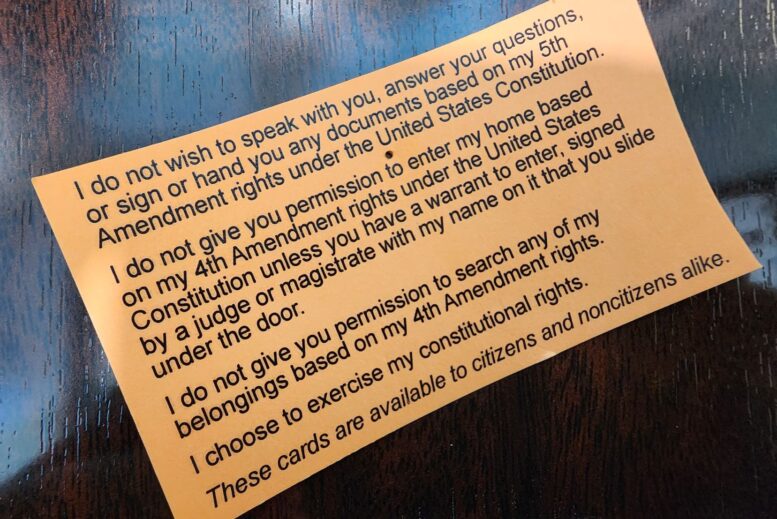
- Carry the small “Know Your Rights” wallet-sized card with you. It states your rights as a human being. They are available with English writing on one side, and 18 different languages on the other.
- Use your 4th Amendment rights to not give authorities permission to enter your home – unless they have a warrant signed by a judge or magistrate with your name on it. ICE has been using battering rams to violate that Constitutional right, Zarou said. “They should be held to comply with the law just like we are,” she said.
- Ask to speak to an attorney. Since ICE is likely to confiscate your phone, have a phone number memorized for a legal aid attorney.
- If you speak a language other than English, you have the right to an interpreter, as part of the U.S. Civil Rights Act of 1964. “Which hasn’t been rescinded yet,” Ford said.
- Don’t sign anything without your attorney present. No matter how much pressure is exerted, do not sign paperwork that may be seen as a waiver of rights or an agreement to deportation. “There’s a lot of tricks being played,” Zarou said.
- Do not lie to immigration enforcement since that could be used as reason for deportation. “Under no circumstances should anyone give false information,” Zarou said.
- Detained immigrants have the right to ask to be released on bond.
- In preparation for encounters with ICE, immigrants should collect and copy important documents. Zarou – who hopes this still holds true in America – does not recommend carrying your passport in public.
- Make plans for temporary guardians for your children if it becomes necessary.
Ford and Zarou also talked about how local residents can be effective bystanders, offering support and documenting incidents legally.
Confrontations with ICE agents are often “highly charged situations,” so it’s important that bystanders not interfere, Zarou said. However, citizens are in no way required to help ICE enforce immigration laws.
“You can be a good bystander in a lot of different ways,” she said. For example:
- Bystanders can lawfully videotape ICE officers. That has put some citizens at risk in some communities. So if videotaping is too scary, use your phone to record audio.
- As soon as the incident is over, write down everything you witnessed right away, while it’s still fresh in your memory. “Eyewitness testimony still means something,” Zarou said.
- If you witness someone being detained by ICE, you can advise that person to remain silent.
- You can volunteer to deliver groceries to immigrant families who fear leaving their homes, or offer help with their children if the adults are detained.
- “Safe spaces,” like churches should have some spaces labeled as “private” where ICE agents cannot legally enter.
During the meeting, Pastor Jeff Schooley asked if Bowling Green City Council could establish some local rules for ICE agents – such as not allowing facial masks, requiring body-cameras and limiting how local police assist ICE.
While some communities have taken such actions, the federal government is ignoring local ordinances, Ford and Zarou said. And declarations of “sanctuary city” status have made some communities targets for the federal government.
Ford also shared data about immigrants in Ohio. In 2023, there were approximately 550,000 living in the state – about 4.7% of the population. Many of them filled positions as physicians, professors, and STEM professions. Asians made up the largest percentage of immigrants, at 42%.
Ohio’s population grew from 2023-2024 – only due to immigrants, Ford said.
In 2024, immigrants paid total taxes of $7 billion in Ohio. “We need immigrants,” Ford said.
