From BROWN BAG FOOD PROJECT BOARD MEMBERS
Hunger is a serious issue in Bowling Green, with thousands of our neighbors regularly experiencing food insecurity. A recent publication by Wood County Hospital (2025) noted that just over 18,000 people in Wood County do not know where their next meal is coming from. If you’ve ever been hungry, you already know there is no benefit to not having enough food to eat.
Research in this area, for example, shows that children who are hungry perform far worse in school, get into more trouble, and have higher levels of stress and anxiety than children who are not hungry (Frongillo et al. 2025). Hunger strains family relationships, promotes parent-child conflict, and can contribute to abuse (Krishnamurthy et al. 2024).
Not just an issue for the township, food insecurity is also tied to victimization on college campuses (e.g., Daigle et al. 2022). With about one in every eight people in Wood County reporting food insecurity, there is a severe amount of hunger in our neighborhoods and our college campus.
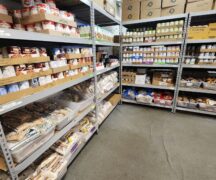
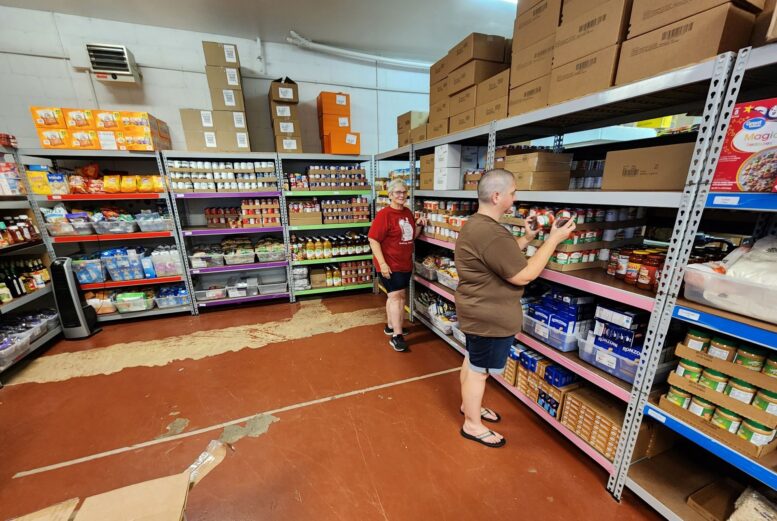
Here in Bowling Green, Brown Bag Food Project, located on Sand Ridge Road, serves hundreds of families each month. Founded by Amy and Peg Holland and staffed entirely by volunteers, BBFP provides nutritious and free food every Monday, Wednesday, and Friday year-round, plus special holiday distributions.
Recent conversations with some local officials suggested that crime in Bowling Green has decreased because of BBFP food distributions. Wondering if that was true, we set out to see.
Food distribution and crime in Bowling Green, Ohio
To understand the link between food and crime, we used publicly available crime data from the Bowling Green Police Department (BGPD) and food distribution data from BBFP from 2021 (or about when the COVID-19 restrictions were lifted in Ohio), to August of 2025.
The brown line below represents monthly food distribution from BBFP to families, while the blue line tracks larceny trends reported by BGPD. The dashed lines for each show the overall trend over that same time.
As shown by the brown line below, the need for food in our community has increased substantially since 2021. For example, BBFP served roughly 200 families a month in 2021. By 2024, that number increased to over 300 families a month. By the end of 2026, BBFP will likely be serving between 380 and 420 families a month.
As shown by the blue line, larceny reported by BGPD has tended to decrease since 2021. Overall, this mirrors broader trends in crime across the United States since COVID-19.
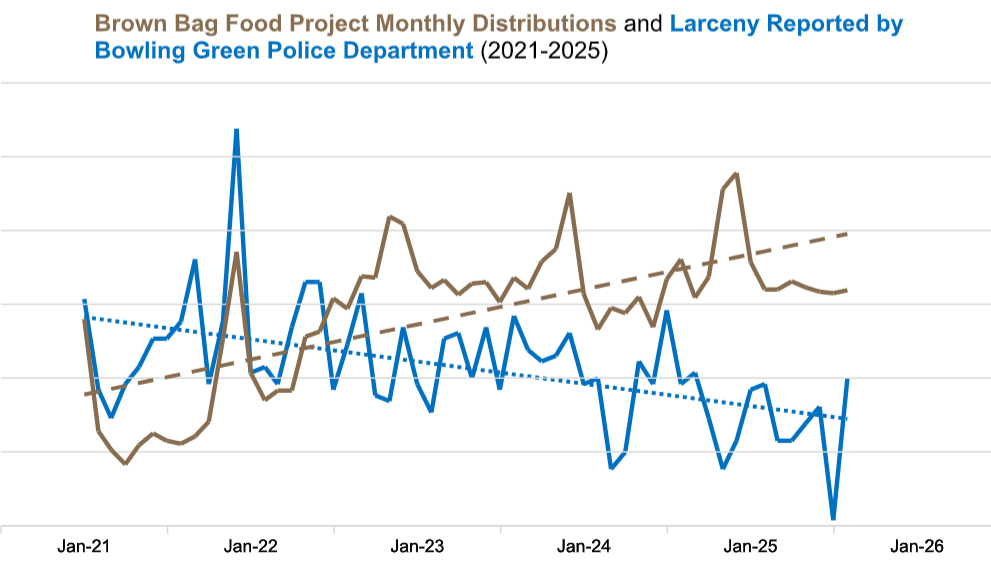
What is truly remarkable is how closely food distributions overlap with larceny from 2021 through much of 2022. It is quite rare to see two seemingly unrelated events follow such a similar pattern over that length of time.
But even more interestingly, around 2023, the relationship reverses, and food distributions continue to increase while larceny decreases. This echoes what some members of local law enforcement have already recognized – food pantry distributions seem to decrease crime in Bowling Green.
Brown Bag Food Project and crime in Bowling Green
One key question that is raised is how much of an effect does BBFP distributions have on crime? To answer that question, we looked at trends over time, wondering what crime would have looked like if BBFP had limited distributions to only 100 families, the navy line below; 200 families, the red line below, and not the 300+ families per month they actually serve, the green line below.
As shown in the figure below, decreases in crime in Bowling Green are strongly linked to BBFP distributions. In fact, the analysis suggests that had BBFP not expanded to serving more than 200 families a month, larceny in BG may not have fallen at all.
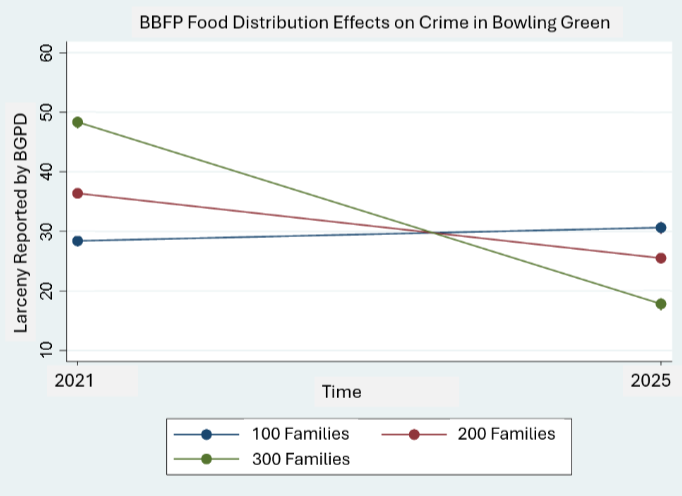
A skeptical mind might point out that it is possible the relationship described above is coincidental. Like all analyses, that is entirely possible. But one key part of this analysis is indisputable – BBFP is serving more and more families year after year.
Thus, even on the chance that this analysis is simply wrong, the outcome is still that hungry members of our community, including a great deal of children, are getting fed by a 100% volunteer workforce. Even for the most skeptical among us, that has got to be a cause worth supporting. And now is a great time to support BBFP.
A call to action
BBFP needs to expand to meet the continual and growing need for food in our community. Click here to donate and help BBFP raise money to expand and serve more people.