
(Written by Marnie Pratt, Wood County District Public Library)
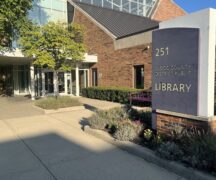
While the current Wood County District Public Library is not quite as old as many of the previously featured Historic Buildings of the Month, it represents a critical piece of community history and stands as a reminder of what can be accomplished when citizens and public officials work together to respond to community needs.
The library is celebrating its 150th birthday this year, but that is actually a celebration of Bowling Green, not the current building. The city’s first known library was founded by the Bowling Green Library Association (BGLA) in 1875. It operated in several locations, often determined by who was serving as librarian at the time. When the BGLA dissolved in 1888, there remained a strong movement of people hoping to re-establish a public library in the city. Some like the Y.M.C.A. were successful for a time, others less so.
Finally in 1914, the women of the Shakespeare Round Table organization, who had been fundraising for the cause for several years, opened a library in the back rooms of the Exchange Bank on the northwest corner of Wooster and Main. It was operated entirely through volunteer hours provided by the organization’s members. The venture was a success, so much so that it quickly outgrew the space, and by 1919, it was relocated to the second floor of the McKenzie/Kabig building on the southwest corner of Main and Court.
In 1928, the construction of a new high school on West Wooster presented the women of the Shakespeare Round Table and the city’s Board of Education with a new opportunity. In August, the two groups met to discuss the idea of merging libraries in the new building, believing the joint venture would provide the community with a stronger and more stably funded library. The resulting Bowling Green School District Library served both students and the wider community, and it was the city’s first truly free and tax-supported public library.
By the 1950s, the city’s population was increasing more rapidly than officials had anticipated, causing both the library and the high school to need more space. The vacant building left by the Church Street School when Conneaut Elementary was constructed in 1954 seemed the perfect solution, but unfortunately, this home would also prove insufficient within a relatively short time. Not only would the library continue to grow, but the building’s upper floors were determined structurally unable to support the weight of the library’s many materials. Thus began a decade-long process of physical and financial strategizing for a new building.
Construction of the library’s current location finally began in 1973, and it opened to the public on Aug. 7, 1974. This was the first time the library occupied a space that was constructed specifically for it, and in fact, when former director Marian Parker retired in 1987, she stated that the “building was built with everything in mind.” Considering it has also served the library significantly longer than any of its other locations, it seems the careful planning paid off. The building was remodeled in 2003, but overall, it has served the community for 51 years this fall.
The building was designed by the architecture firm Munger, Munger & Associates, while Hoyt Galvin, who was nationally known for his work with libraries, served as building consultant. When it first opened, the library was just over 35,000 square feet (48,000 after the remodel), but it looked quite different than today. For example, there was a large outdoor courtyard in the front of the building instead of the enclosed atrium. This still offered a space for people to sit and was even sometimes used for events; however, it wasn’t quite the year-round community space the atrium is today. The library’s departments were also in different places. The children’s area was originally on the second floor, and adult collections, magazines and audio-visual materials were all on the first floor. Even the program rooms and administration offices were on opposite floors from where they are now. The library currently has pictures on display throughout the building of what it looked like when the building first opened.
The library’s dedication and open house held on Oct. 13, 1974, was attended by around 500 people, and the Sentinel-Tribune reported how the event’s speakers highlighted the library’s dedication to service and innovation. These remain essential to the library today. Librarians of 1875 likely could never have foreseen things like bookmobiles, computers, eBooks, 3D printing, or even 1,000 Books before Kindergarten. With an ear to the needs of the community, the library has provided such services and looks forward to delivering even more throughout the next 150 years.
Would you like to nominate a historic building or site for recognition? You can do this through the City website at https://www.bgohio.org/FormCenter/Planning-13/Historic-BuildingSite-Nomination-Form-83.
You can learn more about the Historic Preservation Commission by attending their meetings (the fourth Tuesday of each month at 4 p.m.) or by visiting their webpage at https://www.bgohio.org/436/Historic-Preservation-Commission.