By JULIE CARLE
BG Independent News
It’s official. The Wood County Park District has started its annual butterfly and wildflower monitoring program.
A handful of local citizen scientists and at least one or more professional scientists are helping the park district’s staff track butterflies and wildflowers in some of the district’s 21 parks from April through October.
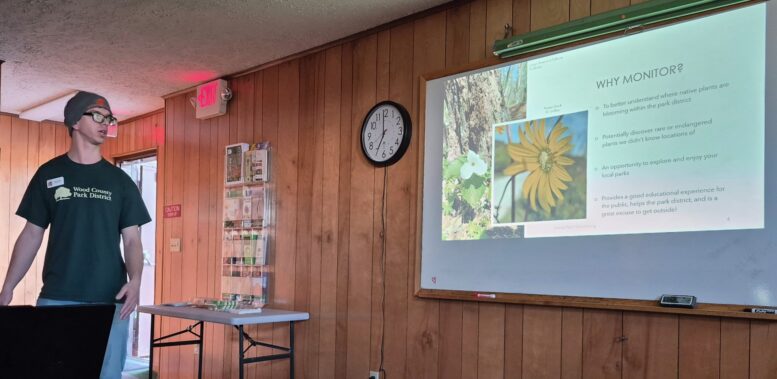
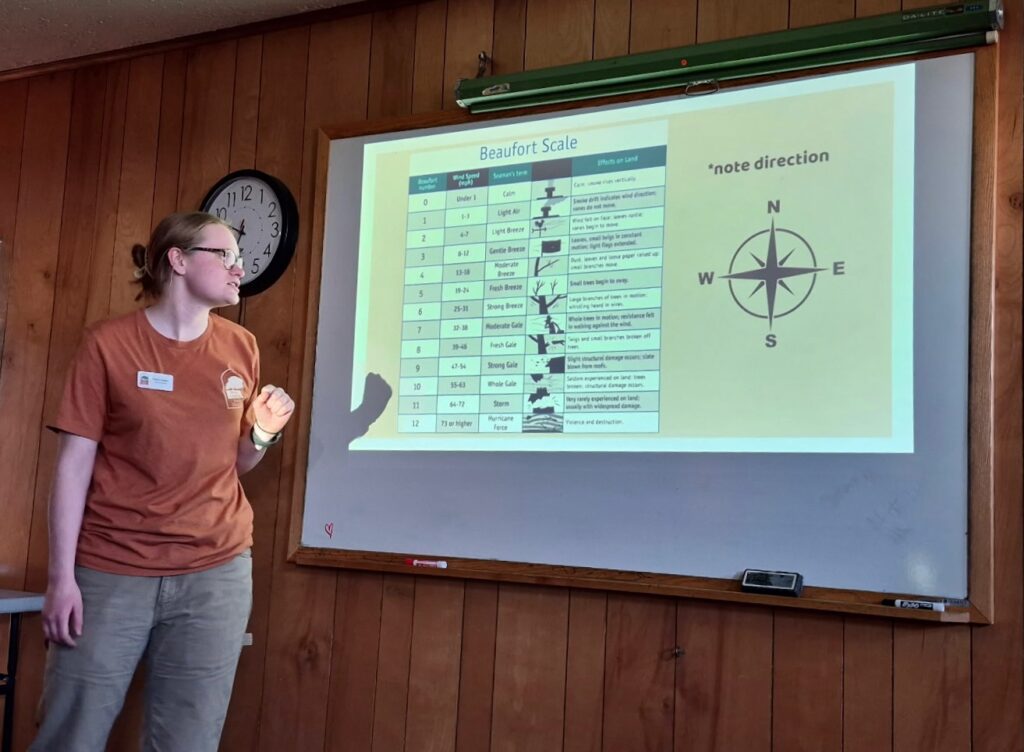
During a recent orientation session, Program Naturalist Valerie Deehr and Restoration Specialist David Linsky talked about vital effort to track often-fleeting appearances of butterfly populations and native plants’ blossoms across several county parks.
What might sound like a leisurely walk in the park is, in fact, a growing body of citizen science helping researchers understand environmental change.
“I didn’t even know butterfly monitoring was happening,” said Deehr. “Now it’s one of the most important things we do.”
Counting wings, tracking change
The butterfly monitoring program is part of a statewide effort coordinated through the Ohio Lepidopterists, with data ultimately archived at the Cleveland Museum of Natural History. Locally collected observations feed into a much larger picture — one that scientists say is showing troubling trends.
“Wildlife populations have dropped dramatically,” Deehr explained. “We’re trying to understand what’s happening — how habitat changes, invasive species, and climate shifts are affecting butterflies.”
Volunteers walk designated “transects” — mapped routes through parks — once a week from April through October. Each outing lasts about an hour. Along the way, they count and identify butterflies within a set distance, recording species and numbers.
The data reveals patterns over time: which species are thriving, which are declining, and when they appear during the season.
That timing — known as flight period — is especially important.
“As temperatures change, we’re seeing butterflies emerge earlier or stay later,” she said. “That tells us a lot about climate impacts.”
Deb Horlak of Bowling Green attended the orientation session when she saw the call for people to track butterfly populations. Though she is not a scientist by trade, Horlak was looking for volunteer opportunities and thought looking for butterflies might be a good fit.
“In the past, I’ve raised butterflies, when I lived in California,” she said. She lived on a three-acre ranchette that had a greenhouse and plenty of milkweed. “It was a really fun thing to learn all about butterflies.”
Horlak, a dental hygienist who used to work for Dr. Jack Whittaker, moved back to Bowling Green when she retired to be near her children. “This seemed like a good opportunity,” she said. Her designated area is the Black Swamp Preserve, but she is not familiar with many of the Wood County parks. “This gives me a chance to go check them all out.”
Common species — and a few bright spots
Last year, volunteers recorded 51 species across five parks, including Cedar Creeks Preserve, Beaver Creek Preserve, and Bradner Preserve.
The most commonly spotted butterfly was the cabbage white butterfly— an invasive species that has become widespread in the region and is known as an agricultural pest.
“It’s everywhere,” Deehr reported.
Last year’s monitoring had some encouraging signs, too. Deehr said. Monarch butterflies — whose populations have been impacted by habitat loss — ranked among the top five most observed last year.
“That’s really good to see,” she noted. “They’ve been in the top five for a few years now.”
Other frequently recorded species included pearl crescents, clouded sulfurs, and eastern tailed blues — small flashes of orange, yellow, and blue that dot summer landscapes.
At Bradner Preserve alone, volunteers counted more than 1,400 individual butterflies.
Plants tell the other half of the story
While butterflies draw attention, plants are equally critical to the ecosystem — and to the monitoring effort, said Linsky, who oversees plant monitoring and tracking how habitats evolve.
Efforts like reseeding prairie areas — including a challenging site at Cedar Creeks that he said, “still wants to be a farm field” — are closely watched.
Plant data also helps explain butterfly trends. Native plants provide food and habitat, while invasive species can disrupt entire ecosystems.
“Invasives are non-native and harmful,” Linsky explained. “They outcompete native species and affect everything around them.”
Understanding that relationship is key to restoration work — and to the long-term health of the parks.
A role for volunteers
The program relies heavily on community members willing to commit to weekly visits during the growing season. Some work solo; others pair up.
“It’s nice to have a partner,” said Ranaye McLaughlin, who has helped monitor butterflies at Cedar Creeks Preserve near her home for nearly 10 years. “It’s easier because there are more sets of eyes to watch where the butterflies are flitting off to.”
With partners or additional volunteers, flexibility is built in. If one person misses a week, another can step in. For some, the work becomes part of a routine — or even a passion.
Andrew Penniman, a retired biology professor, has brought his zoology expertise to the volunteer role for the past two years. While he studied spiders in his career at a small Georgia college, he said, “I’m a biology professor who refuses to quit.”
Tracking butterflies and woody plants was new to Penniman, “but there was a need within the park district for somebody to do that,” he said.
He is the only one surveying the wooded areas “to get an idea of species distribution,” he added. Most of his time is spent in the parks in southern Wood County near his Bloomdale area home.
While monitoring woody plants, Penniman discovered Shagbark in greater numbers at Cricket Frog Cove compared to a few at Bradner Preserve. “It may have to do with the soils or the historical land use and whether people encouraged hickories to grow or now,” he said.
Expanding the effort
In 2026, the district plans to add another monitoring site, continuing to grow the program’s reach.
More data means better insight and better decisions about land management, restoration, and conservation, Linsky said.
For the volunteers, though, the reward is often simpler: An hour outdoors, exploring the local parks. A quiet trail where they might spot a rare butterfly or flower, and the chance to contribute to a cause greater than themselves.