By HEIDI GASSER
BGSU Student Journalist
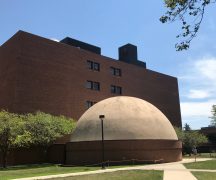
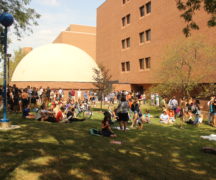
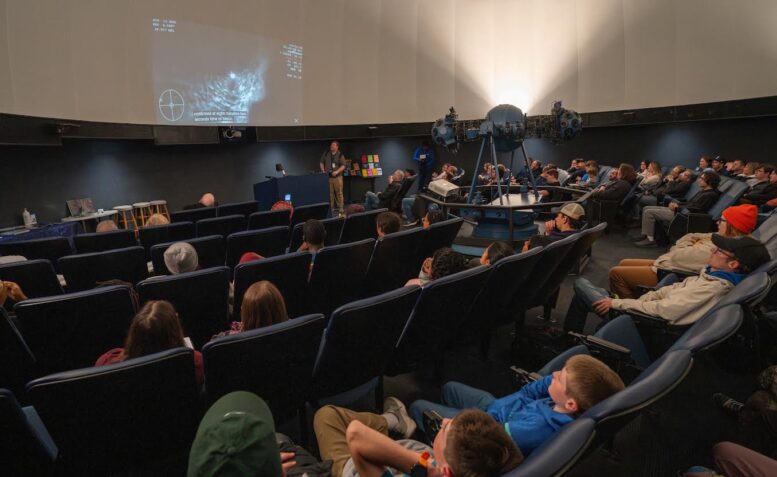
More than 90 space enthusiasts packed Bowling Green State University’s planetarium to witness the launch of Artemis II, a 10-day NASA mission that will fly a crew around the moon for the first time in more than 50 years.
Planetarium Director and Teaching Professor Kate Dellenbusch said the Artemis mission breaks boundaries and prepares the United States for more space missions to come.
“The Artemis lV Mission is supposed to be landing on the [moon’s] surface [in the future]. The difference between where [the Artemis project] is headed, hopefully, and how Apollo worked, is that this mission is about developing the framework to have a more permanent settlement, a base, on the Moon,” Dellenbusch said. “It’s laying the foundation to maybe go to Mars in the future.”
Artemis II is manned by four astronauts and is part of a project designed to “explore the Moon for scientific discovery, economic benefits, and build the foundation for a crewed mission to Mars” (NASA.gov).
The mission will break records, with astronauts traveling thousands of miles past where previous space travelers have visited.
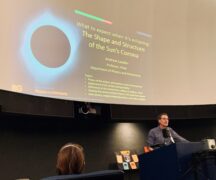
“One of the things that they are bragging about is that, because they are in this orbit, their distance from the Earth will be farther than anyone has ever gone before,” said Glenn Tiede, a BGSU professor of physics and astronomy. “They are more than 4,000 miles farther than any of the Apollo astronauts ever got.”
Among the dozens gathered to witness the launch was Joshua Fondren, a self-proclaimed “space guy” who said he is looking forward to what comes next.
“I was absolutely excited, thriving with joy at the launch. I was glad it wasn’t scrubbed and happy to see the first crewed Artemis mission pushing [the campaign] forward. I hope this leads to more crewed missions going forward,” Fondren said. “It’s been ages since the last humans went to the moon. I am all for that Star Trek, Star Fleet future of humans in space, and setting up a permanent presence to better understand the universe.”
“Scrubbed,” or failed launch attempts, are not uncommon among rocket launches. During Artemis I preparations, practice launches were scrubbed several times before a successful take off in November 2022. Artemis II was originally scheduled to be launched back in February, but underwent various “wet dress rehearsals,” to refine mechanic safety.
Tiede said NASA has been taking safety seriously by designing the Artemis campaign in tiers to build on one another, each preparing for increasingly complex missions.
“Artemis I was the mission that just happened two years ago. There was nobody in [the spacecraft] at that time, it was just a test of hardware. It flew around the moon and came back home. This mission is essentially the same, but there are actually people to fly the spacecraft and perform more complicated things,” Tiede said.
The Orion spacecraft, used for Artemis II, is larger than the Apollo mission spacecraft used when humans first visited the moon in 1969 and includes more habitable space for crew and infrastructure to support longer flight durations.
The size of the spacecraft isn’t the only thing that’s changed since the last time astronauts visited the moon. Previous moon missions were intertwined with the complicated history of the “space race.”
“The Apollo mission back in the ‘60s and ‘70s is when people first went to the moon. Then there was the Vietnam War that was going on at the same time. It was using up so much of the budget, they couldn’t afford to do both. And of course, we’re the U.S.A., so we always choose war before anything else,” Tiede said. “So, why haven’t we gone back in 60 years? It’s not one simple answer … it’s politics, money, and people’s attitudes.”
Back in the Apollo era, the U.S. competed with Russia to achieve landing men on the moon. Today, Tiede postulated that China has become a competitor for technological innovation, rekindling space-race-era exploration.
“If they have technology we don’t, that’s scary,” Tiede said.
Dellenbusch, who frequently organizes planetarium events, said that she hopes to see ongoing engagement with the local astronomy community and support for space exploration projects.
“It’s great that people are coming out to a public event. These days, we can be more isolated, and not always experiencing something as a society,” Dellenbusch said. “I think launches like this … get people interested in science and engineering. A new generation of folks will hopefully be inspired by this.”
Because after all, it’s about innovation.
“Exploration and pushing limits is part of human nature, and how humans are as a species,” Dellenbusch said.
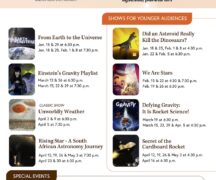
More information about upcoming planetarium events can be found on the facility website.
Follow live Artemis ll mission updates here.