By ROBIN STANTON GERROW
BG Independent News
An impressionistic forest of pink and purple tones, whimsical deer and butterflies, and a falcon peering over your shoulder are the new additions to Bowling Green’s mural scene.
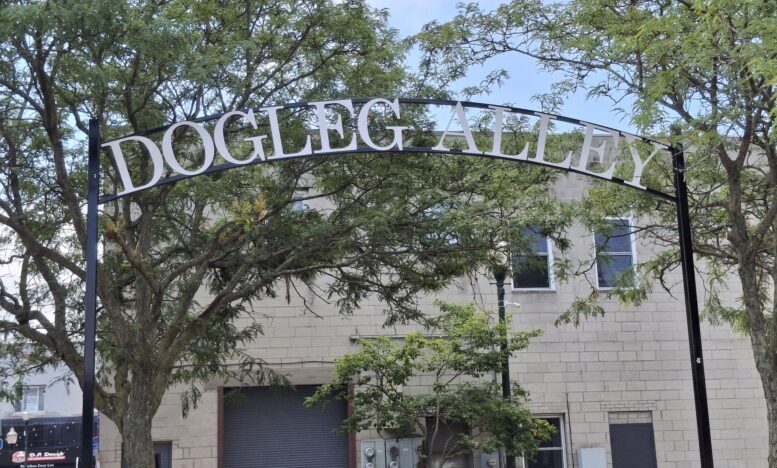
The three new artworks, part of a project to beautify the city’s alleys connecting parking lots to downtown, will be officially unveiled 7 to 9 p.m., July 25, starting in Dogleg Alley between Insomnia Cookies and the Amish Deli on East Wooster Street and is hosted by Downtown Bowling Green.
The call for artists was open to residents of northwest Ohio, and with community input, resulted in commissions being awarded to Dean Davis of Whitehouse, Ohio; Bowling Green muralists Carrie Day and Gordon Ricketts; and Bowling Green native Andrea Pereira de Almeida.
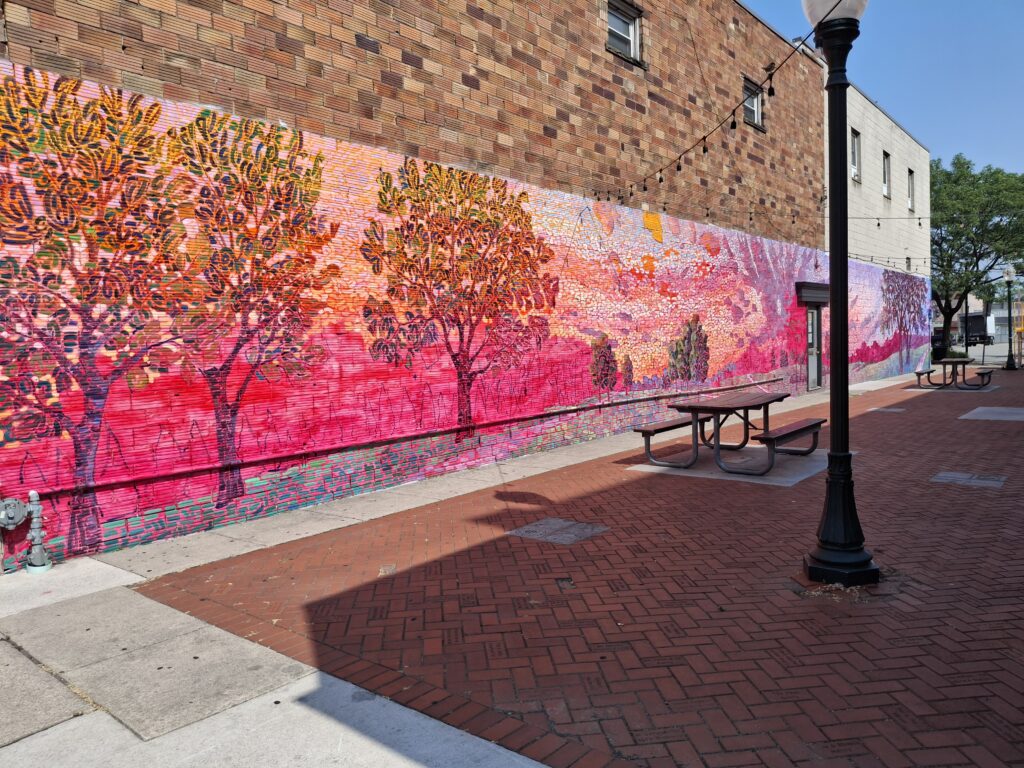
This is Pereira de Almeida’s first mural, and with it, she wanted to fill her hometown’s Dogleg Alley with vibrant colors meant to brighten even the dullest of days. She paints representations of the places she’s been to, and how those places make her feel.
“This is by far the biggest piece I’ve worked on,” she said. “ I think there is something so great about big colors. It changes your mood and is an immersive experience. I think the colors just brighten people’s day, and it’s been so nice to see people smiling when they walk by.
“Painting this mural has been really special for me,” Pereira de Almeida said. “When I saw this wall, I knew it could be an amazing space. It’s pretty cool that you see it as you are driving into downtown.”
While Whitehouse artist Dean Davis is an experienced muralist, he is excited about showing his work in Bowling Green for the first time.
“Growing up in Toledo and Oregon, I’ve always thought of Bowling Green as a very arts-driven place,” Davis said. “A lot of my friends went to art school here, and I’ve always liked how the city embraces public art, really embraces the whole culture of art.”
In his design for the portion of Dogleg Alley next to Finders Records on North Main Street, Davis wanted to capture the spirit of creativity and energy he associates with the city and has brought elements of both the university and community together in his work.
“Even while I’ve been working, people stop by to talk about it and were already enjoying it,” Davis said. “It’s great that the city doesn’t see it as just a big alleyway, but as a place for art and expression.”

Bowling Green residents are no strangers to the work of local artists Carrie Day and Gordon Ricketts. Their work can be found on several buildings in town, but according to Day, this project for Monarch Alley, seen from the city parking area on South Church Street, was different in that they were able to express their own creativity rather than coming up with a design to please a property owner.
“For this we had to come up with a design and submit it as part of a competitive process,” Day said. “We really had the freedom to come up with any design we wanted. Gordon and I are basically abstract artists, so we decided to do something that was abstract but still has some imagery.”
Ricketts said one of the aspects he enjoyed most about painting this mural is the community participation. In this case, the community previewed and voted on their favorite designs from eight artists, but as part of the process he and Day have also welcomed passers-by who want to stop and try their hand at painting.
“The murals are really valued by the community,” he said. “It’s fun, and we get to exercise our creative wings on work other people get to see.” The City of Bowling Green allocated funds to Downtown Bowling Green to spruce up the alleys to include art, lighting and signage. Additional funding was provided by the Bowling Green Community Foundation through a grant to the Bowling Green Arts Council.