
By JULES SHINKLE
BG Independent News
The 46th Annual New Music Festival this past weekend gave listeners a chance to bask in BGSU’s celebration of contemporary classical music. This year’s program featured two panel sessions, three masterclasses and eight concerts over three days.
Contemporary classical music is often deemed unapproachable and overly-demanding to non-academic audiences. The reality is that many people struggle to get into new music regardless of its genre, be it newly released albums or artists unfamiliar to one’s taste.
It’s comforting and rewarding to return to the sounds and sensations of long-appreciated works. Though as John Birge from Composer’s Datebook reminds us, “All music was once new.”
What’s special about the New Music Festival is that it provides listeners with an opportunity to experience an array of musical styles and instrumentation. Composers are always finding novel, enticing ways to express themselves through musical art; a festival like BGSU’s is a reminder that there are an infinite number sounds waiting to be conjured.
Saxophone choir, theremin, solo harp, wind ensemble, art song, symphonic concerto: these are just a few examples of what could be heard this weekend.
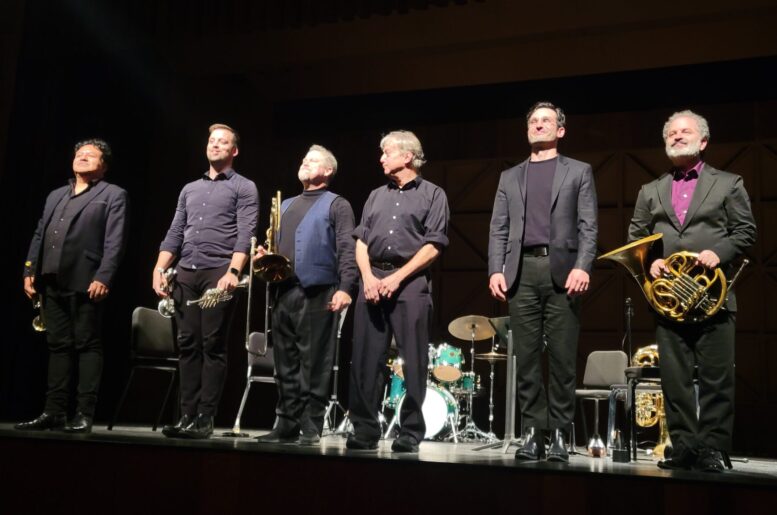
Friday night’s concert was a performance by the Meridian Arts Ensemble, a brass quintet (two trumpets, horn, trombone, and tuba) and percussionist. Since their founding in 1987, they have recorded 15 CDs and commissioned dozens of new works. They are an important institution in the world of brass chamber music.
The first half of their concert featured two world premieres, Tom Nazziola’s “Mad Clown” and Armando Bayolo’s “Dystopian Moods.” The unconventional addition of drums expanded their range of timbres – the snap of a snare drum and sizzle of rolled cymbals complimented the warm blend of brass very well.
Daniel Grabois, the group’s horn player, spoke to the audience about a composition of his that they were to play next. “Migration” emerged from an invitation to play at the Chautauqua Music Festival, whose programming that year was centered around Franz Schubert. Finding most of the brass quintet arrangements of Schubert unsatisfactory, Grabois wrote “Migration” – a piece decidedly unlike Schubert but still borrowing his melodic and harmonic ideas.
Meridian Arts Ensemble has a reputation for their boisterous renditions of Frank Zappa, and they concluded Friday with three of his songs arranged by Jon Nelson. Their repertoire slid through many genres, all of which felt convincing in the hands of such strong performers.
Saturday night’s concert was the eighth and final event of the festival. BGSU’s Collegiate Chorale sang five pieces for the first half. Richard Schnipke led the choir and accompanying instrumentalists.
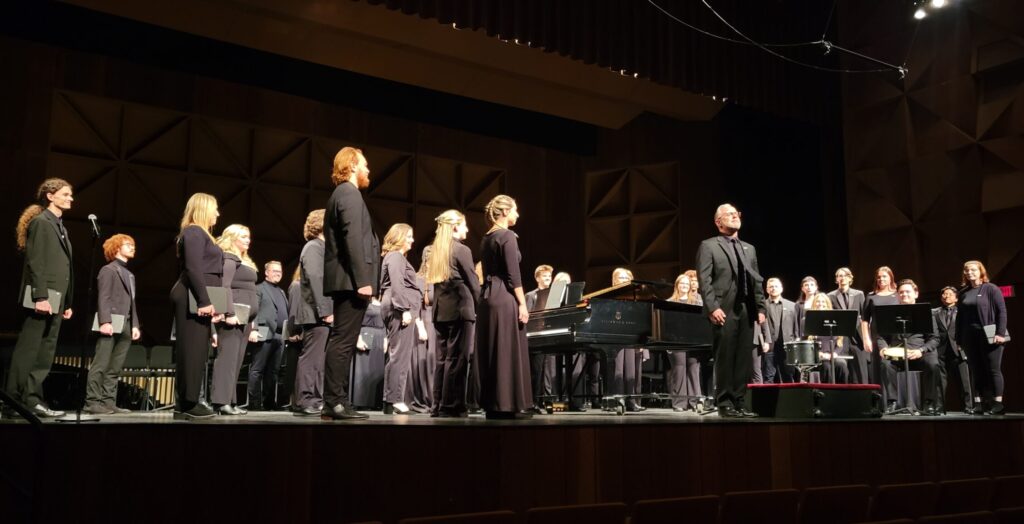
The Collegiate Chorale’s half of the concert was programmed around themes of faith, comradery, and liberation. Their first piece, Ily Matthew Maniano’s “Papuri,” revolved around the repetition of “Papuri sa Diyos,” or “Praise the Lord” in Filipino. Following that was a song set to the text of a W.E.B. Dubois poem titled “Children of the Moon” by BGSU alum Evan Williams.
Notes from the composer describe his interpretation of the poem as “both proto-Afro-Futurist and biblical in its scope, envisioning a future for Black people as free and untethered as the vastness of space.”
This vision for Black liberation was mirrored later in the chorus’s closer, “The Caged Bird Sings for Freedom” by Joel Thompson. Maya Angelo’s famous “Caged Bird” was represented by solo clarinet (Ricky Jurski), who plays a hopeful melody that spreads throughout the choir, leading to a united and triumphant conclusion.
After intermission, the Philharmonia took the stage. They played two pieces: “RE|Member” by Reena Esmail and “Into Light” by Marilyn Shrude. The former was written to express the strangeness of an ensemble coming back to play after the onset of COVID-19. Esmail writes, “But as the pandemic unraveled life as we knew it, the ‘return’ suddenly took on much more weight. Now the piece charts the return to a world forever changed … writing the musicians back onto a stage that they left in completely uncertain circumstances.”
Shrude’s “Into Light” was recorded by the Bowling Green Philharmonia back in 1999. It was fitting to hear this joyful, electric work marking the end of another New Music Festival.
