
BY NICK EVANS
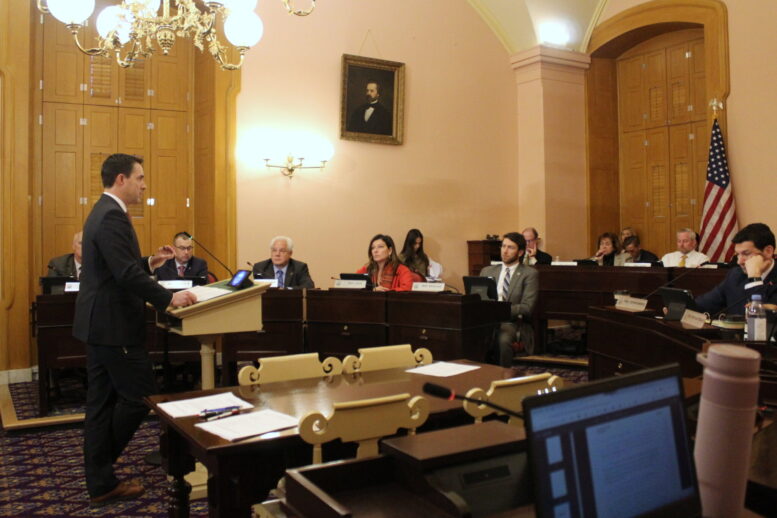
In a rare move Tuesday, an Ohio House committee voted to advance a bill changing the deadline for absentee ballots after a single hearing. What’s more, lawmakers folded in portions of a different controversial measure related to proof of citizenship just hours before the hearing.
Advancing the proposal, Ohio Senate Bill 293, puts both changes on the fast track for approval. State Sen. Theresa Gavarone, R-Bowling Green, was one of the primary sponsors of the Senate Bill.
The Ohio House could take up and vote on the bill during Wednesday’s session.
After Tuesday’s hearing, state Rep. Sharon Ray, R-Wadsworth, who chairs the committee, said she expects that to happen.
The Ohio Senate would still have to approve the changes.
It meets Wednesday (Nov. 19) and on Dec. 10, before breaking for the holidays.
One of the bill’s sponsors, state Sen. Andrew Brenner, R-Delaware, made no promises but said he hopes to secure approval for the bill quickly.
“I’m hoping that we can get something done before we go on break,” Brenner said, “so this is available for the primary next year.”
He contends it’s better to make the changes in a primary so officials can work out any potential “glitches” ahead of the general election.
Ray, who’s a former election official, made a similar argument.
But Ohio state Reps. Juanita Brent, D-Cleveland, and Allison Russo, D-Upper Arlington said the timeline is too rushed.
“We have sponsor testimony, all (public) testimony, amendments and a vote, all in one committee hearing the day before it is going to go on the floor,” Russo said.
“That is highly unusual, and I think speaks to the lack of interest in getting input into this legislation.”
Brent added, “(the) amendment being shown to us at 8:24 am, it just does not allow us a good enough time to vet this bill.”
“This is a rush job for somebody else’s agenda to encourage voter suppression,” Brent said.
Absentee ballot changes
The original bill eliminated Ohio’s current four-day grace period for the return of absentee ballots so long as they’re postmarked before Election Day.
That change represents the third successive reduction in the return timeline for federal elections.
As recently as 2022, properly postmarked ballots would still be counted if the arrived within 10 days of Election Day.
The changes come following pressure from the Trump administration.
In an executive order the president asserted a new reading of federal statutes claiming all ballots arriving after Election Day are invalid.
In a testy exchange, Russo argued that Ohio Secretary of State Frank LaRose is pushing for the changes because of the Department of Justice’s contention that absentee ballots open the door to fraud.
“That’s their argument. I never made that argument, and I’m not making that argument,” LaRose responded.
“But you’re asking us to change state law based on that argument,” Russo insisted.
Additionally, the U.S. Court of Appeals for the Fifth Circuit rejected a Mississippi law allowing a similar grace period for absentee ballots.
That circuit’s precedents don’t apply to Ohio, but the U.S. Supreme Court has agreed to hear the case.
LaRose cited both points in testimony for the bill but insisted considerations beyond Ohio’s borders aren’t driving his support.
“The arguments about what the federal law says or not have never been my primary motivation behind this,” LaRose said.
“My primary motivation for doing this is to make sure that Ohio is very clear with an easy to remember date.”
LaRose regularly reports his findings of alleged voter fraud. Those allegations have largely come to nothing.
Although cases of voter fraud do occur, they are exceedingly rare.
Still, LaRose emphasized as recently as two months ago, “even one illegal vote can spoil the outcome of an election.”
But when it comes to otherwise valid ballots arriving late, LaRose downplayed the issue.
He noted 7,579 ballots arrived after Election Day last year but said it’s “a logical fallacy” to assume that many voters will be disenfranchised by the bill.
“Human behavior isn’t static,” LaRose said, indicating voter behavior will change with new requirements.
The ACLU of Ohio’s Collin Marozzi dug a bit deeper into the potential impact of ballots arriving after the election.
In the election Ohio held this just a few weeks ago, more than 7,000 ballots arrived during the grace period.
Marozzi rattled off eight races where those absentee ballots could’ve decided the race.
“Lawful voters casting lawful ballots by a lawful method should not be punished for something completely out of the of their control,” he insisted.
Proof of citizenship
The last-minute changes related to citizenship would make it far easier to cancel voters’ registrations.
Under the original measure, Ohio Senate Bill 153, election officials would have to send confirmation notices to voters if they couldn’t verify the voter’s citizenship through state records.
The county board would only cancel the voter’s registration if they didn’t respond to two notices.
The citizenship requirements in Tuesday’s amendment, however, put far more emphasis on the secretary’s routine audits of state voter rolls.
The same reviews that have resulted in hundreds of flagged registrations, but only a handful of indictments, would be the only data point necessary to cancel a voter’s registration.
The measure states the “board promptly shall cancel” a voter’s registration if the secretary’s review of state and federal data indicates that person is not a citizen.
“That’s a problem, because the Secretary of State’s data is out of date,” Jen Miller from the League of Women Voters of Ohio said.
“We know that his investigations routinely call into question the citizenship of individuals who have been naturalized,” she added.
“So, using bad data to assume that someone is not an eligible voter and kick them off the rolls without significant due process is problematic. It’s not acceptable.”
The Ohio Capital Journal reached out to LaRose for comment but the secretary didn’t respond.
Without the confirmation notices, an otherwise eligible voter might have their registration cancelled and not know it.
“Well, I think they could always try to vote provisionally,” Rep. Ray said after the hearing, “or at least go down to the board of elections and remedy this situation.”
For a provisional ballot to count, the voter needs to provide proof of eligibility within the four-day cure period following Election Day.
That can present challenges when many people don’t have ready access to the documents they need.
Research from the University of Maryland indicates more than 21 million Americans don’t have ready access to documentary proof of citizenship.