The Ohio Redistricting Commission now has until Oct. 31 to pass a bipartisan map. After that, lawmakers can pass a partisan map with a simple majority before Nov. 30
BY SUSAN TEBBEN
Ohio Statehouse lawmakers missed their first deadline for congressional redistricting, with Republican lawmakers defending the move to kick the process over to the Ohio Redistricting Commission without them ever introducing or negotiating on a map.
The constitutional amendment passed by Ohio voters in 2018 required lawmakers to negotiate in good faith and attempt to pass a bipartisan map by Sept. 30 before the process went to the redistricting commission.
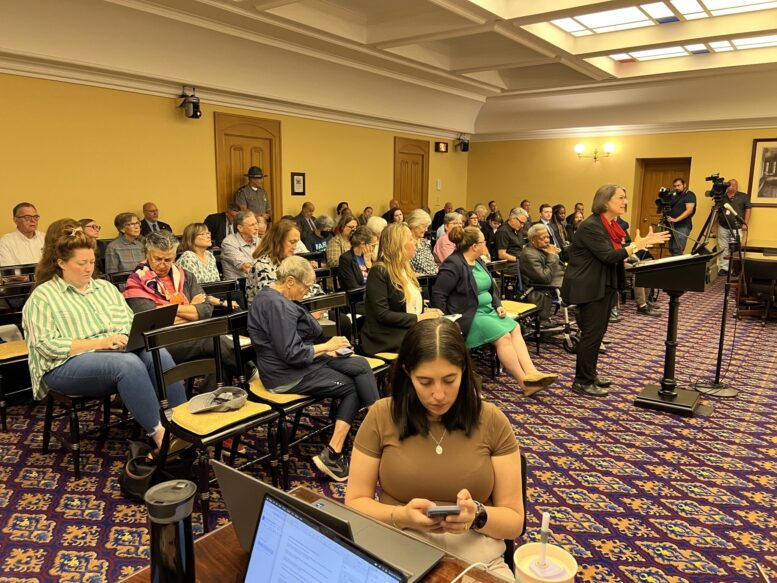
The Joint Committee on Congressional Redistricting met Tuesday in the House Finance Committee room for their second meeting of the month, on the day of the first deadline mentioned in the Ohio Constitution for passing a bipartisan map.
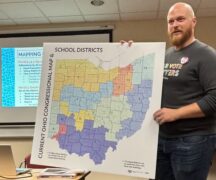
The committee began with Senate Leader Nickie Antonio supporting the Democratic map proposal, which is still the only map that has been formally introduced by either side of the General Assembly. The congressional map proposed by Ohio legislative Democrats at a Tuesday press conference.

The Democratic map presents a breakdown of eight Republican-leaning districts and seven Democratic-leaning districts in the congressional delegation, which they say came from taking an average of the last decade of voting results.
That average means a state ratio of 56% Republican to 43% Democrats.
The current map has 10 Republican districts and five Democratic, for 66% Republican control.
Republican lawmakers during the meeting argued that an average of the last decade of voting trends is not required by the constitution for congressional redistricting.
Amid Antonio’s testimony and questions from legislators, it was once again made clear that the process would be continuing into October and a vote would not be held on the Democratic map.
“I’m pragmatic enough to know … that (lawmakers passing a map with bipartisan support) is not only unlikely but impossible,” Antonio said. “We do not have a session today.”
“If needed” sessions that had been scheduled for both the Ohio House and Ohio Senate were cancelled before the Tuesday meeting, indicating the committee wouldn’t be holding a vote on a map.
State Rep. Brian Stewart, R-Ashville, claimed Antonio’s mention of the Sept. 30 deadline omitted the clauses of the Ohio Constitution that come after it.
“Can we just basically agree there are two options here in the constitution, and not passing a map by Sept. 30 is in no way a violation of any deadline, correct?” Stewart asked.
Antonio countered, saying the people “really wanted us, in this first step, to take the opportunity to work together in a bipartisan way.”
According to the constitution, if a bipartisan map isn’t adopted by the end of September, the process moves to the Ohio Redistricting Commission with an Oct. 31 deadline.
If no bipartisan map comes out of the commission, the decision-making returns to the General Assembly.
The map can be passed without bipartisan support at that point with a simple majority vote by Nov. 30.
At last week’s committee meeting, committee co-chair Rep. Adam Bird, R-New Richmond, agreed that while the September deadline is in the constitution, though he said the existence of the other deadlines opens up opportunities for passage “in the next couple of months.”
“I know that everybody wanted something done by today,” Bird claimed, “but we’ve still got a couple of months and we’ve still got time to keep talking.”
Co-chair state Sen. Jane Timken, R-Jackson Twp., also maintained an argument she made in the last meeting, that though the Democratic lawmakers are seeking a “fair map,” fairness is not a word used in the constitutional process of redistricting.
“The word ‘fairness’ is not in the constitution (with regard to redistricting), right?” Timken asked, eliciting laughter around the committee room.
Antonio said it’s difficult to talk about representation in drawing districts without taking fairness into account.
“Fairness was a part of the will of the people, and so through that lens, we used a fair measurement to be able to see how the people are voting, especially in national elections,” Antonio said.
Ohioans who spoke in support of the Democratic proposal noted the lack of opposition testimony to the Democratic map and once again accused the committee of a lack of transparency.
Math teacher and Columbus resident Tom Reardon counted the more than 140 testimonies submitted at the last meeting.
“What percentage of the testimonies were for gerrymandering, which is being done right now in our state? The answer is zero,” Reardon told the committee. “No one came and supported what you’ve been talking about.”
There was one person who came to Tuesday’s meeting who didn’t support the Democratic map.
Paul Miller was active in the last round of congressional redistricting, presenting his own proposal and accusing “liberal activists” of messing with the process.
His testimony submitted on Tuesday continued that message, with him claiming “Democrat activists were being entirely disingenuous.”
“In any case, the real issue persists with the present incarnation of their plan to flip Republican seats in the fact that they’re doing it at all,” Miller told the committee in his written testimony. “Instead of pitting Republicans against each other in primaries, now they just want to take them out right before the actual elections.”
Columbus resident Pari Sabety said the hour-long discussion that had already happened before she spoke hadn’t changed her mind about how the process was going.
“There’s no transparency here,” Sabety said. “Let’s be clear, you hold the reins in this process, you are the supermajority, and you have managed to rig this process to suit your end goal.”
No negotiations
On claims from Republican lawmakers that Democrats are trying gerrymander through their proposal, Antonio referenced comments from Assistant Minority Whip Rep. Desiree Tims, D-Dayton, at last week’s meeting.
“The minority does not hold any legislative power or majority, let alone the ability to gerrymander,” Antonio said.
Republican committee members also pointed to comments they said indicated the Democrats wouldn’t agree to a map that was less than 8-7.
“The Democrats said ‘8-7, take it or leave it,’ firm offer,” claimed state Rep. D.J. Swearingen, R-Huron. “So what are Republicans supposed to do … after we hear something like that?”
Antonio denied having said “take it or leave it,” and said she was “saddened that I didn’t communicate as well as I thought I did … that we were open for discussion.”
“I am always, and have been from the beginning, open to discussion,” Antonio said.
In fact, Antonio said, she reached out to Republican leadership before the process began to ask about a plan.
“I did knock on the door, quietly, respectfully, individually,” Antonio said. “…I got a response that was ‘It’s coming, there’s something coming.’”
Bird and Timken told reporters after the meeting adjourned that with no action that they don’t know of any discussions by their respective Republican caucuses about the drawing of a map.
“There’s not a map that I know of,” Bird said.
Timken said the caucuses plan to follow the process “through to the end of November.”
This indicates Republican lawmakers expect no bipartisan agreement from the Ohio Redistricting Commission before Oct. 31.
Bird was unmoved to see only one opponent of the Democratic maps come to the two meetings, pointing to a push from the Democratic Party to bring in supporters.
“I think we’ve all seen there’s been many calls and social media from the Democratic Party to have people come and testify,” Bird told reporters. “You’ve not heard that from the Republican Party. I don’t know that that’s good or bad, but we’ve heard a lot of testimony and, like you said, mostly one-sided.”
Now that the first legislative deadline has passed, the Ohio Redistricting Commission will need to be reactivated by Gov. Mike DeWine.
The governor is also required to serve on the commission, along with the state auditor and secretary of state. The General Assembly will be represented with two Republican legislators and two Democratic legislators.
Whenever the map is adopted along the way, if a court challenge is presented to it, the Ohio Supreme Court will have jurisdiction over lawsuits against the map.
Republicans added party labels to the Ohio Supreme Court beginning in 2022 and now control the court 6-1.