
BY SUSAN TEBBEN
Update: The Joint Committee on Congressional Redistricting announced its first meeting is scheduled for Monday, Sept. 22, at 11 a.m. in the Ohio Senate’s Finan Finance Hearing Room.
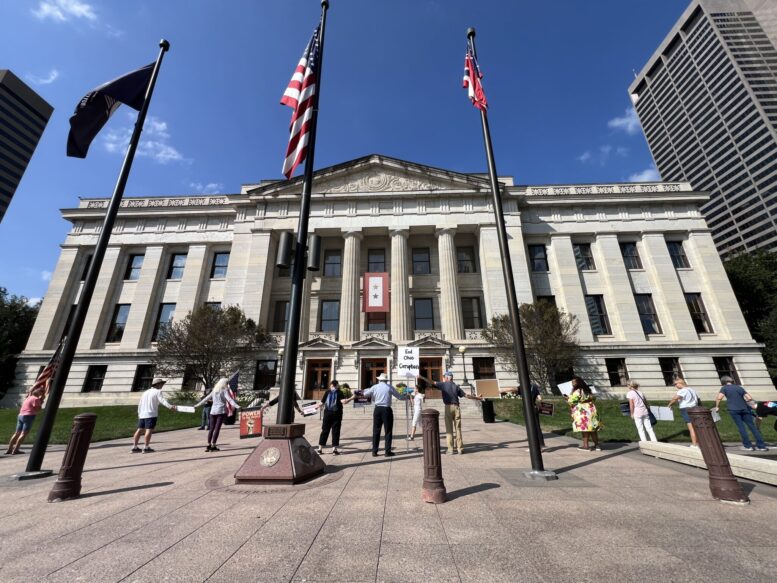
Ohioans from across the state’s congressional districts joined hands in a circle around the Statehouse on Wednesday, as a show of solidarity and hope for a fair redistricting process.
More than 100 Ohio citizens joined the demonstration organized by advocacy groups including Common Cause Ohio and the League of Women Voters of Ohio, demanding that legislators listen to their concerns and follow the state constitution as lawmakers begin the process of redrawing the congressional districts in the state.
“I hope that they listen, and I hope that they incorporate everybody, not just the politicians, not just the Republican politicians,” said Cedarville resident Bob Ford.
Ohio has to create a new district map for U.S. Congress members to be used in the 2026 elections, because the map that was adopted in March 2022 did not have bipartisan support and was therefore was only usable for four years, as state law dictates.
The General Assembly has until the end of September to come up with a bipartisan-approved map. A joint legislative committee on congressional redistricting has been announced, with its first meeting set to happen on Sept. 22.

In order for a map to be passed, the proposal would have to go through the normal bill process, with committee hearings on the bill before a full vote in both chambers. The legislative calendar showed an “if needed” session scheduled for the Ohio House on Sept. 23, but that session was cancelled on Friday. Both chambers have an “if needed” session scheduled for Sept. 30.
Ohio’s legislative Democrats introduced their own map proposal on Sept. 9, in what Democratic leaders said was an effort to get the process going and demonstrate urgency. The bill has not moved since it was filed.
A portal for citizens to submit their own map proposals is also up and running, with more than 60 proposals already on the legislature’s redistricting website.
Democrats proposed a congressional makeup of eight Republican-leaning districts and seven Democratic-leaning districts at the federal level. Currently, Ohio’s congressional delegation includes 10 Republicans and five Democrats. In 2024, Republican President Donald Trump got 52% of the state’s vote while Democrat Kamala Harris received 44%.
Anti-gerrymandering advocates, along with Democratic leaders like House Minority Leader Dani Isaacsohn, D-Cincinnati, have said Ohio’s map is “one of the most gerrymandered maps in the country.”
The Princeton Gerrymandering Project graded the current congressional map a “D,” particularly for it’s partisanship.
Despite that, Republican Ohio U.S. Sen. Bernie Moreno has said he wants to see an even bigger Republican majority in the state, to take 12 of the 15 seats,.
At Tuesday’s rally, voting rights and anti-gerrymandering advocates said the process should work the way it was laid out explicitly after ballot measures in 2015 and 2018. The constitutional amendments that were voter-approved lay out the process, the calculations for districts and the rules for drawing them, along with requirements for public hearings.
“It is not rocket science,” said Diedra Reese, of social justice advocacy group the Ohio Organizing Collaborative. “The legislators have a road map for exactly how we can get to fair maps, so there’s no excuse for why we are even having a conversation about going backwards instead of forwards towards fair maps.”
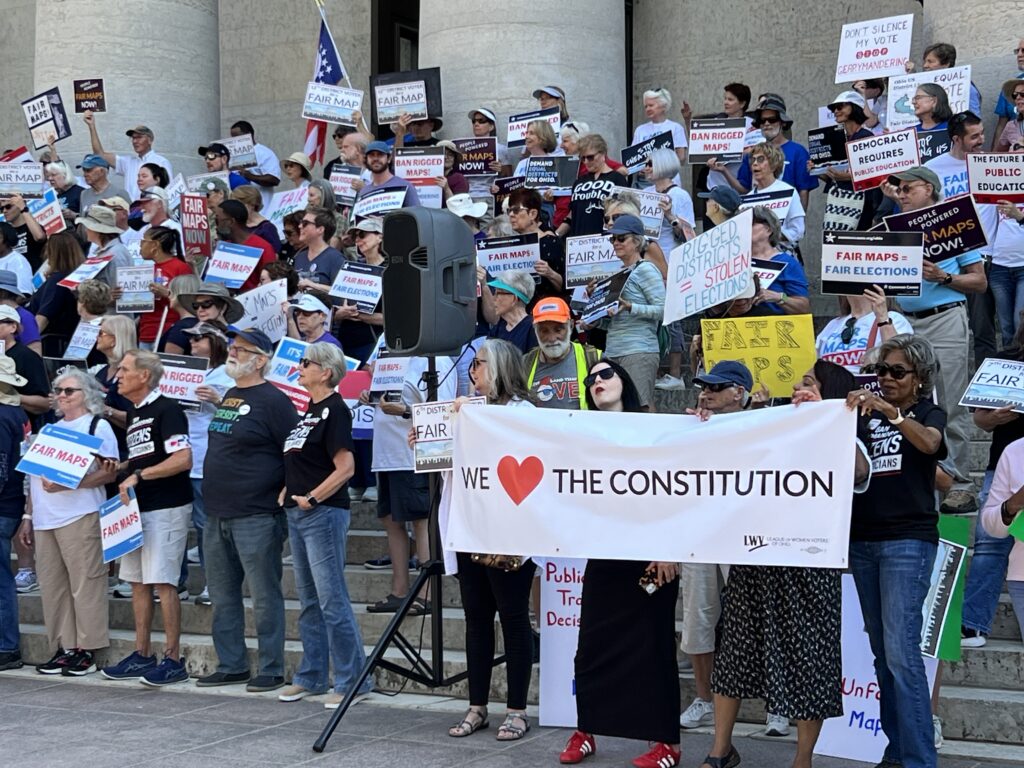
The rally emphasized the impact redistricting and voting districts have on all kinds of Ohioans, but Ohio State University student Grace Metz wanted to make sure college students’ voices were included.
“The truth is that every Ohioan, students included, should care about who decides where and how their vote counts,” Metz said. “All of us deserve a fair Ohio, but this is just the start.”
With the implementation of Senate Bill 1 – the sweeping higher education reform bill passed in the General Assembly largely along party lines – scholarships that could be related to diversity are at risk, classroom discussions have rules and new regulations exist around faculty tenure and negotiations.
Metz said the legislative process for the bill suffered from a lack of transparency and a lack of input from people who would be directly affected, factors she wants to see change not only in the Statehouse, but in the congressional delegation.
“The reality of the situation is that we are scared, not only by the looming threat of censorship, but also by the reckless abandon with which our representatives treat our tax dollars,” Metz said.
If the legislature can’t come to an agreement by the end of September, the process moves to the majority-Republican Ohio Redistricting Commission, which then has until Oct. 31 to come up with a bipartisan map. If the commission can’t agree, the process goes back to the legislature, which will have until Nov. 30 to come up with a map, this time with only a simple majority necessary to pass it.