From OWENS COMMUNITY COLLEGE
The work of being a college professor isn’t about awards for Genesis Downey, but there is some personal and professional benefit in being recognized.
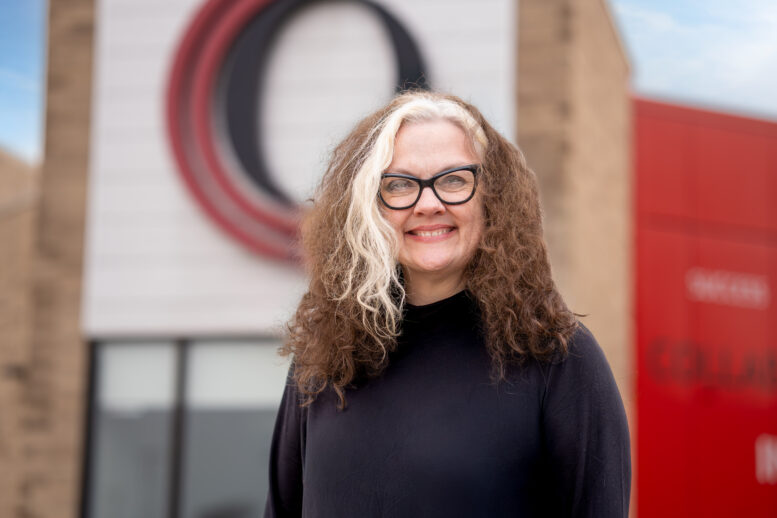
Downey, a humanities instructor at Owens, has been named a recipient of the Dale P. Parnell Distinguished Faculty Award by the American Association of Community Colleges. The designation, named in honor of former AACC President and CEO Dale P. Parnell, recognizes individuals making a difference in the classroom. Downey will be honored at the AACC’s annual conference in Seattle in April.
“I do like the push it provides,” Downey said. “It keeps the imposter syndrome at bay, and as I tell my students, imposter syndrome doesn’t ever go away entirely, but it does become manageable. There’s this little voice that immediately thinks they made a mistake, quickly followed by a sneaking suspicion that I didn’t actually earn it.”
She responded to that feeling by pushing harder.
“I reimagine assignments, put more emphasis on cocurricular work and more emphasis on getting out of my comfort zone, all so that I can feel like the award wasn’t a mistake,” Downey said.
Downey has taught in the humanities department at Owens for nearly 24 years, offering courses in Composition, Creative Writing, Introduction to Pop Culture and Interdisciplinary Studies, as well as honors course through the college’s Honors Program. She has also taught at the University of Michigan and the University of Toledo.
Dr. Michael Sander, dean of the School of Liberal Arts, has worked closely with Downey as a humanities faculty member and through the Honors Program. According to Sander, Downey encourages student growth and success through a variety of ways.
“She demonstrates a sustained commitment to student success through both academic excellence and the creation of meaningful opportunities, while mentoring the honors club and consistently bringing creative, student-centered teaching strategies into her classroom,” Sander said.
At the heart of Downey’s teaching philosophy is a commitment to student agency – the idea that students are capable, independent thinkers whose voices have real value.
“My goal is for students to finish my classes with a better sense of agency,” Downey said. “They are in control of their critical thinking and writing. And the skills they learn in the class can be applied to the rest of their lives.”
That student-centered approach extends to how Downey responds to challenges in her classroom. Rather than searching for a single right answer, she draws on colleagues, students, and even insights from other disciplines to find what works.
“I am pretty tenacious when it comes to creative problem solving,” Downey said. “If there is an issue I’m running into in the classroom, I will not stop brainstorming to figure out a new method that does work. I’ve actually become a much better instructor by looking at how other fields approach teaching.”
The rise of artificial intelligence has been among the more recent challenges reshaping higher education, and Downey has leaned into experiential learning as a response. She now builds writing projects around students’ own lives and experiences, a deliberate effort to push back against what she sees as AI’s tendency to erode students’ confidence in their own voices.
“So often, students take an easy way out because they don’t think their imperfect voices have value,” she said. “And when AI gets crammed down their throat as this supposed panacea, that imposter syndrome actually gets worse. I focus more on their own agency in writing and thinking, and then we see where it takes us.”
It’s a philosophy she sums up with a line she returns to often – there is always more than one way to get somewhere.
After nearly a quarter-century at Owens, Downey says she still finds energy in collaboration with colleagues, with students, and with the work of the community college education itself.
“I see myself more as a facilitator and guide,” Downey said. “That absolutely requires a team of like-minded collaborators. It’s no longer this weird private bubble, and I realized that I actually prefer bouncing ideas off other instructors.”