By JAN McLAUGHLIN
BG Independent News
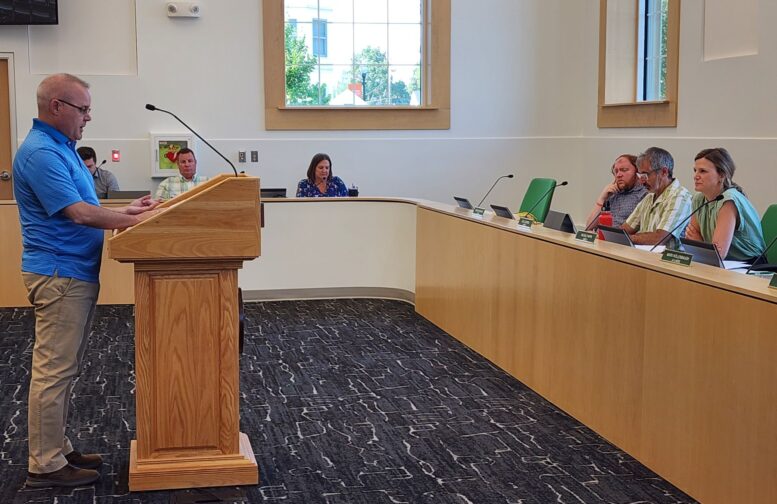
A plan to put more money into Bowling Green streets and sidewalks hit a dead end last week. The proposal, made by City Council member Bill Herald, was minus the math and missing the methodology needed to get the rest of council on board.
On council’s agenda last Monday was an ordinance redistributing the city’s existing unvoted 1.5% income tax to shift capital funds from water and sewer projects to fire and police station improvements and street repairs.
The ordinance allocates $500,000 more a year to roadwork and sidewalks.
But believing that was not enough, Herald offered an amendment which would take more from the current formula from water and sewer projects.
“We have more roads than money,” he said. “We all know streets and sidewalks need work.”
Four city residents spoke in favor of shifting more money to streets and sidewalks. Debbie Thompson and Jim Evans talked about their recent experience conducting a “walk audit,” and the need for more pedestrian safety measures. Chris Waterfield talked about the need for maintenance funds for pedestrian infrastructure. And Rose Drain talked about the city growing and the need for a greater investment in accommodations like shared use paths.
While all the council members supported the redistribution of the funds, most favored the plan devised by the city administration over several months of studying the issue.
The city administration’s formula would require increases of roughly $5.40 a month in residential water and sewer bills to make up the difference. Herald’s amendment would push those increases up to $7.20 per month.
Council member Rachel Phipps asked Herald if he did the math as he worked on his amendment. “As we reallocate, we need to be mindful” of effects on other departments, she said.
Council member Joel O’Dorisio noted that Herald’s amendment would nearly double the increase already planned in the administration’s proposal. He asked for Herald’s methodology in asking for even greater funding.
Herald said his proposal was based on “decades of observing this issue.”
Mayor Mike Aspacher explained the administration’s proposal was based on a “deliberate and mindful process” that had been deliberated for many years before a formal proposal was made to council.
Aspacher said city leaders have worked to “chip away at capital needs,” and did consider different scenarios of taking more from the water and sewer fund. However, he added, the administration also wanted to minimize the negative impact on utility users and taxpayers.
Municipal Administrator Lori Tretter reinforced the mayor’s description of the planning process.
“That sounds very thorough,” O’Dorisio said.
Council President Mark Hollenbaugh said he is “protective” of the city’s funding for water and sewer projects – noting that Bowling Green is careful to maintain funding for water and sewer infrastructure unlike other cities that often don’t have revenue to make repairs or expansions.
Hollenbaugh said that in 20 years, he does not want the city to fall behind in repairs because too much money was shifted over to streets and sidewalks.
Council member Greg Robinette asked Utilities Director Brian O’Connell for his views on Herald’s amendment. O’Connell said he was unable to respond since he had just heard of the proposal that evening.
Robinette also pointed out the city’s policy requiring landowners to install and maintain sidewalks. The city offers a 50/50 program which splits the costs for sidewalk repairs with homeowners.
He questioned the need for more money to be shifted to that program since there is already $450,000 in the account, and only $20,000 was used last year.
When the vote was taken on Herald’s amendment, it lost 5-2, with Herald and Jeff Dennis voting in favor, while Hollenbaugh, O’Dorisio, Phipps, Robinette and Jordan Musgrave opposing.
Immediately after that vote, Herald offered a second amendment, this one halving his original increase for streets and sidewalks. He said the compromise meets the city administration half way.
“We do need money for street repairs,” Herald stressed. “So we can have a fighting chance of keeping up with it.”
His second amendment failed by a vote of 4-3, with Phipps being the only person to change her vote.
The ordinance, as proposed by city administration, then passed by a unanimous vote by council.
“I think we have just squandered an opportunity,” Herald said.