By DAVID DUPONT
BG Independent News
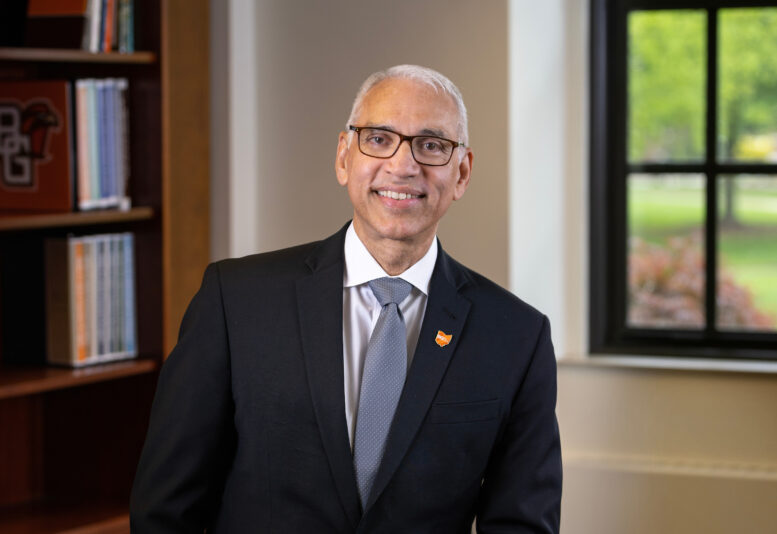
Once he realized being a player on the Indian National cricket team wasn’t in the cards, Ravi Krovi turned his attention to business. Then inspired by his grandfather, Krovi moved into education.
In May, Krovi brought skills and scholarship developed over four decades to Bowling Green State University, where he is serving as provost.
Explain his new position, the native of Mumbai said: “I like to tell students that I am sort of inherently responsible for the quality of their degree, of their experience in the university, and I see my role that way. … That involves not just in the classroom, but it also involves outside the classroom, ensuring that all the learning outcomes are met.”
Philosophically, his approach was inspired by his grandfather.
His grandfather founded a four-year college because he didn’t feel those in rural India had the opportunities to further their education under the British system. Krovi remembers in the 1970s, as a child visiting with his grandfather on the campus.
“Growing up in India, you could see the difference. For kids who had access to affordable education, it was a big deal, and the kids who didn’t were mired in poverty,” he said. “That has carried through with me the recognition that education actually helps students from an upward mobility standpoint.”
That’s the mindset that Krovi brings to BGSU. “We have a lot of students in this country who potentially don’t have the same opportunities and need higher levels of access and affordability.”
That involves more than providing scholarships. As an academic his offspring received constant coaching along their educational pathway.
“A lot of first generation kids, their parents, not having gone to college, are not getting the same advice. So, for them, when they come to college, they may get lost,” Krovi said. “Our programs like life design, career design, really are a good guiding paths for these students.”
BGSU’s reputation as an institution dedicated to preparing students for life and work beyond graduation is what attracted him to the post. That BGSU has earned top ranking for career readiness, career preparation. That’s a big deal, he said. Students and their families are expecting a return on their investment. “I really believe that Bowling Green has got the right mindset. … I love the fact that we have within the university a lot of what I would call living labs, where you can go and get not just getting learning from the classroom, from your professor, but you’re actually doing things.”
And the university also has partnerships with companies that get students into the field.
The analytic , data gathering, and critical thinking skills are valuable across disciplines — nursing, engineering, business — but also in life. “It’s beyond your discipline.”
BGSU’s mission involves “preparing students to be successful citizens and to be successful in life, whether it’s from a personal context.”
The university’s signature Life Design Program epitomizes that approach. “It is a recognition that every student is different, and that the path to success is not the same sequence. … It’s not like I planned on becoming a provost.”
In his younger years, he said he dreamed of joining the India National Cricket team. He played in school into his late teens, but pursuing sports was frowned upon. Education was “the path to upward mobility.”
So after graduating from the University of Baroda, India, in 1986, he got a job in technology, and then the opportunity to pursue graduate studies. That’s when he emigrated to the United States where he received his master’s in mathematical sciences with dual tracks in computer science and statistics from the University of Memphis in 1988 and his doctorate in management information systems and decision sciences with a minor in artificial intelligence and cognitive science, also from Memphis in 1993.
From 1999 to 2020 he was on the faculty at University of Akron, including serving as dean of the College of Business Administration. In 2020, he was hired as provost at Weber State University in Utah, where he served until being selected through a national search as BGSU provost.
In announcing Krovi’s appointment, BGSU President Rodney K. Rogers wrote in a letter to the university community: “As we look to leverage our momentum and differentiate the Bowling Green experience, Dr. Krovi brings extensive knowledge of student success and access to public higher education, guided by a philosophy of meeting students where they are. Dr. Krovi is uniquely positioned to elevate our academic offerings to meet the evolving needs of our students and state, with a deep understanding of the landscape of public higher education in Ohio.”
With his expertise in artificial intelligence, Krovi’s arrival on campus comes at a propitious time.
In May, the Board of Trustees approved a new multi-disciplinary artificial intelligence program, known as AI + X. This will allowed students to pair studies in artificial intelligence with majors in other disciplines that span the university’s offerings — Computer Science, History, Journalism, Mathematics, Physics, or Public Relations. While those are the initial offerings, then interim Provost Glenn Davis told trustees that others will be added as demand arises.
“That definitely a piece which I’m interested in,” Krovi said. “I would like to really build on that momentum, because I do think that the future of work and the future of society will be different.”
He sees the world changing, and as it does “problems have inherently become a lot more complex,” he said. “So our approaches to solutions cannot be based on a single discipline. They have to be based on multiple disciplines.”
Complex problems such as finding cures for opioid addiction or Parkinson’s Disease, demand the expertise from a multitude of disciplines.
Still for all the technological advances, Krovi said, “we have come to realize that the one thing you cannot replicate is human intuition. And so when you look at all the research in cognitive science, human intuition, human judgment, human understanding cannot be replicated. … The reality is that we still are going to be living in a human-centric world. And so I think us emphasizing critical thinking is an attribute which is not going to be duplicated anytime soon.”
His own involvement in artificial intelligence came through business as he started looking at algorithms for bankruptcy data and failures and “trying to apply them to real world problems and recognizing that you have traditional approaches, you have these new machine learning approaches and even understanding how can these approaches go, still deal with uncertainty because we don’t live in a perfect world.”
Krovi saw a way to use I to address the uncertainties in the data and come up with creative solutions.
“Our students need to understand the potential, but also understand the ethics and how to use AI as responsible citizens, and also the pitfalls,” he said. “If you are going and using one of these large language models, recognize that you are leaving a data footprint, a digital footprint behind you every time you do that. So it’s important for our students to be what I would call AI literate and digitally literate.
There is concern, he said, about AI replacing jobs. That may be misplaced. “What we are seeing and what we will continue to see is AI enhancing a lot of jobs. So understanding the potential will serve us well,” Krovi said.
“The students who will be successful are the ones who understand these technologies and understand the applications, not necessarily at a technical level, but know how to use these tools.”