By JAN McLAUGHLIN
BG Independent News
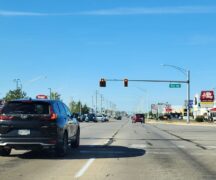
The possibilities seemed nearly endless for the 2.5-mile stretch of Main Street where Bowling Green City Council wants to make it easier for bikers and walkers to navigate.
A roundabout at North Main Street and Poe Road? Less on-street parking? More one-way streets? Fewer lanes of travel. A bike bypass of the downtown? More pedestrian beacon crosswalks?
The “Reimagining Main Street” study requested by City Council was presented Monday by Pat Etchie, of Mannik Smith Group, after a community survey with nearly 450 participants, and a two-day charrette to brainstorm the possibilities.
Data was collected on the crash history on Main Street from Newton Road to Napoleon Road, involving vehicles with pedestrians and bicycles. The information showed:
- 44 crashes from 2015 to 2024.
- 93% of the crashes involved injuries.
- One fatality and seven serious injuries.
- Average of 4.4 pedestrian/bike crashes per year.
- Highest year was 12 crashes in 2023.
Etchie started up on North Main Street at Parkview Drive and worked his way south. While there are no lane reductions proposed between Newton and Poe roads, there is a proposal for lane reductions from Poe Road to Napoleon Road.
At the intersection of Poe and Main Street, the study recommends a single-lane roundabout. According to Etchie, the roundabout will reduce time spent at the intersection by 17.5 seconds in the morning peak hour, and by 6.3 seconds in the afternoon peak hour.
The roundabout would make the intersection safer for vehicles and pedestrians, Etchie said.
“That intersection is huge,” he said. “It’s a sea of asphalt.”
Instead of pedestrians having to cross up to four lanes covering 77 to 101 feet of asphalt now, they would just have to walk 15 to 20 feet before reaching the roundabout refuge areas.
Continuing the study southward, Etchie said the Main Street between Poe and Clay/Ridge streets could be reduced from the current four lanes to one lane in each direction. Bike accommodations could be added to the corridor, and pedestrian hybrid beacon crossings could be installed at Frazee Avenue, Merry Avenue and Clay Street.
The study looks at three options for the Main Street lanes from Poe to Ridge:
- Single lanes in each direction, with a center two-way left turn lane, on-street northbound and southbound bike lanes, and two-foot buffer lanes.
- Single lanes in each direction, with a raised median possibly for plantings, and on-street northbound and southbound bike lanes, with two-foot buffer lanes.
- Single lanes in each direction, with a center turn lane, shared use path on one side, sidewalk on the other side, with buffers for each.
When Etchie hit the downtown area, the proposal got a little trickier. Should the bike lanes continue on Main Street through the downtown? Or should bike accommodations be routed to parallel streets of Church Street and Prospect Street?
“Do you want to peel bikes off and go around the downtown?” Etchie asked.
The bypasses could require some one-way streets, and small areas of no on-street parking.
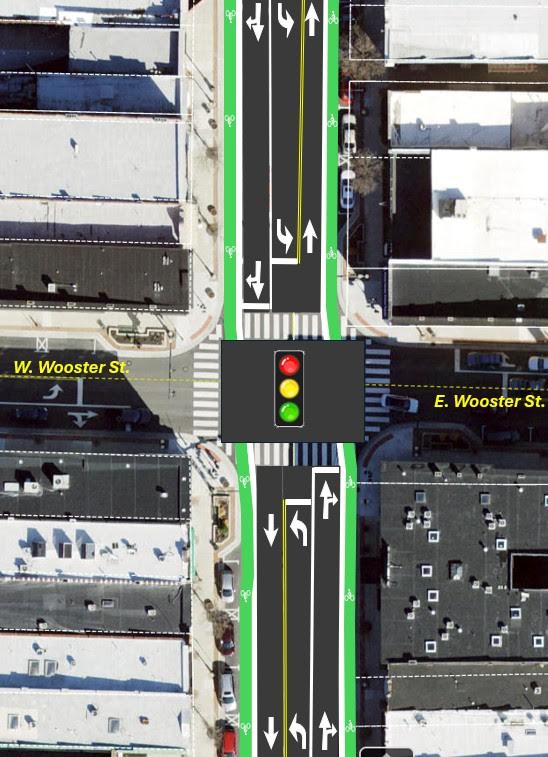
If the bike lanes were to be placed on each side of Main Street as it passes through the downtown, street parking would still be allowed, but there would be only three lanes of vehicular travel. In both northbound and southbound lanes, the left turn lanes would remain, but the exclusive right turn lanes would be eliminated, and combined into straight/right lanes.
According to Etchie, reducing lanes on Main Street north and south only adds 0.9 seconds delay in morning peak hours, and 1.4 seconds in afternoon peak hours.
Some options for the downtown call for raised medians in the center of lanes for plantings.
If the bike lane bypass was used, the bike lanes would rejoin with South Main Street at Washington Street. Headed southward, there would be one vehicular lane in each direction, with the bike accommodations on the sides.
Between Washington Street and Napoleon Road, the same options were offered as on North Main Street between Clay and Poe Road. Pedestrian hybrid beacon crosswalks were suggested at the intersections with Main and Ordway Avenue and Sandridge Road.
The preliminary cost estimates for the options ranged from $2 million to $20 million for some stretches of Main Street, depending on the plan selected.
There were also proposals submitted by landscape architects from the state of Oregon with themes to make the Main Street corridor aesthetically pleasing.
“You could really transform this corridor,” Etchie said.
Funding options will be explored, with the Ohio Department of Transportation providing funding for safety projects, he said.
But first, City Council will have to study the data presented Monday evening.
“There’s going to be a lot to discuss,” Mayor Mike Aspacher said.
Council member Bill Herald suggested input be gathered from the city’s Bicycle Safety Commission.
Council President Mark Hollenbaugh said the study was requested due to council’s interest in Complete Streets. “We want to look at what options are available to use for the accessibility of bicyclists and pedestrians.”
“I anticipate it will be utilized,” Hollenbaugh said of the study. “We’re hoping for large grants that would pay for large swaths of it.”