
By JAN McLAUGHLIN
BG Independent News
After being in and out of prison the last 30 years, Daniel Schmidt found himself in an unfamiliar position on Thursday. He stood before fellow inmates and Wood County Jail officials and spoke about taking a different path in life.
Schmidt was one of six jail inmates to graduate from a voluntary program designed to give inmates the tools and confidence to change their lives upon release.
“I keep failing at real life,” Schmidt said as he stood at the podium. At age 50, he wondered aloud if he could turn around his life. “Is it too late?”
The “light bulb” moment for Schmidt came when his former parole officer saw him in jail.
“I saw the disappointment on her face,” he said.
After eight months in the Wood County Jail for theft, Schmidt found a lifeline in the new IGNITE program at the jail.
“This is solidifying that I need changes in my life,” he said. “I’m seeing true restoration.”
Jails across the nation have been offering educational programs for decades. But most aren’t working, according to sheriffs who are trying a new strategy. Recidivism rates are still through the roof, with generations of families cycling through the system.
So in November, Wood County Jail became the fourth jail in Ohio and the 30th in the nation to offer inmates the IGNITE (Inmate Growth Naturally & Intentionally Through Education) program.
Two sheriffs already operating the program in their jails swear by the success. Genesee County in Michigan has seen a 25% drop in recidivism. And Sandusky County in Ohio has seen a decrease in “generational incarceration.”
IGNITE is designed to provide incarcerated individuals with educational opportunities, instilling hope, and preparing them for successful reintegration into society. The program partners with businesses and organizations that can share valuable skills. For example, the jail has the area carpenters union on board.
Courses include skilled trades training, employment counseling, peer-to-peer mental health services, financial literacy, ServSafe certifications, parenting classes, religious and counseling services.
In addition to teaching the inmates useful skills, the program also boosts the confidence of inmates who have had limited success in society.
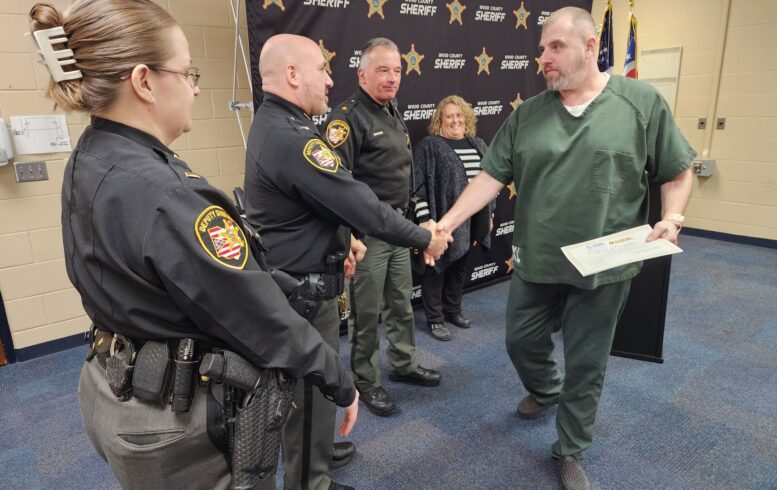
Thursday was the graduation of the first IGNITE class. The inmates wore their jail uniforms, not graduation gowns, and the playing of “Pomp and Circumstance” kept cutting out – but there were speeches and cake to celebrate their success.
“Today is more than a graduation. It’s a milestone,” said Lt. Jamison Martinez, with the sheriff’s office.
Five of the six graduates worked up enough courage to speak in front of everyone there.
Kevin Stichler, 55, serving time for receiving stolen property, thanked his classmates for sharing vulnerability during classes – something not typically done in jail. Most of them weren’t accustomed to a “feelings class,” he said. “It’s pretty rough to go through it.”
Stichler, who has spent time in multiple county jails, said he will leave Wood County Jail with goals.
“Coming out of here, I’m going to have to recreate myself,” he said.
While incarcerated, he lost his job, his housing, his identity. “IGNITE is going to give me a headstart.”
Stichler has big plans for the ServSafe certification he is working on through IGNITE to train him for the food service industry.
Like all the others in the class, Stichler has mental health issues. The Peer-to-Peer Program, led by NAMI (National Alliance on Mental Illness) of Wood County, helped the inmates examine their issues and learn how to manage them. The program encouraged the men to open up about their mental health struggles.
As Stichler’s nerves got the best of him while he spoke, his classmates reminded him to breathe.

Charles Hands shared his struggles with depression, and Mario Carter expressed hope for his future. “You guys have supplied me with tools to better my life.”
Clayton Pryor, who has anger issues, worked on learning social skills, setting small attainable goals, and caring about others. If not for the NAMI class, “I would still be looking at the world like ‘I don’t care about you all.’”
According to Wood County Sheriff Mark Wasylyshyn, approximately 75% of inmates in the U.S. have some type of mental health problems.
“We’ve failed as a society in treating and recognizing mental illness,” he said.
As part of the graduation ceremony, the inmates were congratulated for their efforts to improve themselves through the voluntary IGNITE program.
“It’s about the decision of each of you to step forward,” said Lt. Brittany Brown, with the sheriff’s office. Instead of looking at their pasts, “Today we focus on what’s ahead.”
“You chose growth. You chose responsibility. That takes courage,” Brown said. “When you guys walk through the jail doors, you’re no longer an inmate. You’re a member of the community.”
Wasylyshyn said the goal is for inmates to learn new skills useful on the outside. When released, they may be going back to the same environment, and the same people with the same habits. But they don’t have to do the same thing, he said.
“If you don’t come back, that’s a beautiful thing,” the sheriff said. “You can take a different path.”

Wasylyshyn said he’s hoping to run into some of the IGNITE graduates at future county fairs or trips to the grocery store – where they can tell him how their lives have changed for the better.
“I’m proud of you all,” he said.
Researchers from Harvard University, Brown University, and the University of Michigan have noted the IGNITE program’s effectiveness at not just reducing recidivism, but also improving post-release employment opportunities, and fostering positive behavioral change inside jails.
“We could have very easily not done this,” Wasylyshyn said. “But we’re not about coasting here in Wood County.”
When he learned of some jails experiencing 30% drops in recidivism after using IGNITE, he was sold.
“We have a lot of repeat offenders,” Wasylyshyn said. “If we can break that cycle, it’s going to change lives. Why wouldn’t we do this?”