By HANNAH SANDER
Special to BG Independent News
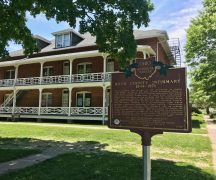
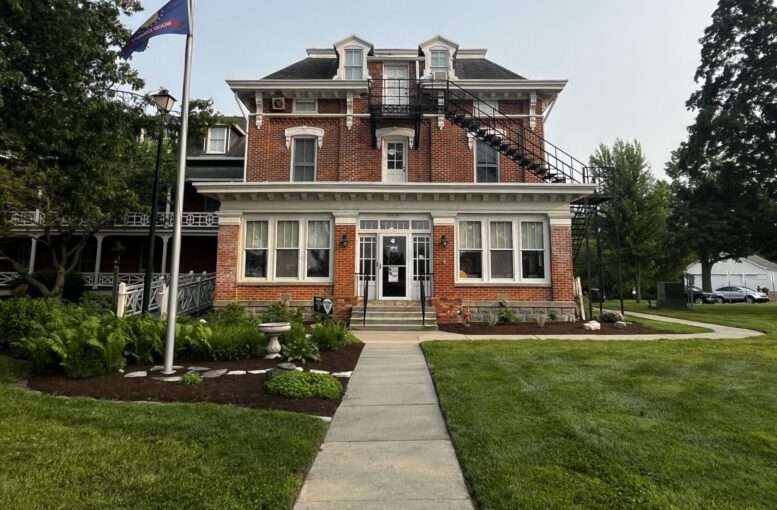
In the winter of 1869, just three years after the Civil War’s end, Wood County’s infirmary opened its doors. For the next century, this brick, Italianate-influenced building located off present-day U.S. 6 would provide shelter and care to people with mental illnesses or disabilities, those in poverty and anyone in need of public assistance.
But this year, this relic celebrates its golden jubilee anniversary as the local county museum. It stands as the only other county infirmary building in the state — aside from Lake County’s – that is used as a museum.
Museum creates its own history
In 1971, Wood Haven Health Care opened, and the Wood County infirmary shut its doors for good after a little over 100 years. And with a demolition price tag upwards of $40,000, tearing down such an unknown piece of local history was no easy – or inexpensive – task.
Museum curator Holly Kirkendall jokingly said, “Thank goodness the commissioners could not afford to tear us down.”
But it was also the late Lyle Fletcher, who held various positions within the county’s parks commission and historical society, who proved an influential figure for and advocate of the infirmary’s protection and preservation.
In 1976, an article from a local newspaper referred to the proposal of restoring the building as a museum as Fletcher’s “brainchild.”
In 2025, Kirkendall said Fletcher “was really managing the building and the site to make sure that it was sustained for these 50 years.”
However, Kirkendall and other museum staff acknowledged that the longevity of a “brainchild” is dependent on the greater community’s sustaining curiosity. Annette Wells, the museum director, said, “It is a business when you come down to it, … I think that it’s really important to be open-minded to what your audience is looking for.”
And prior to the professionalization of the museum field, audiences viewed rooms dedicated to a specific time period and theme. For any museum with period rooms, incentivizing visitors to return proves challenging due to the stagnant nature of the exhibits. The museum would become “a mausoleum of stuff,” as Wells said, and if nothing ever changed, then there wouldn’t be a reason to return.
For Wood County Museum specifically, it wasn’t until after Kirkendall became curator in 2012 that exhibits began rotation. The installation of an elevator in 2017 helped too, as well as equipping the third floor with museum storage.
Period rooms were replaced with exhibits on Victorian era undergarments, World War I and the 80s.
Exhibits have also become more kid-friendly. In the museum’s current exhibit, “We’ll Meet Again: Remembering World War II,” kids can write postcards or unscramble codes.
Museum marketing and events coordinator Marissa Muniz Kolhoff said the current World War II exhibit is “one of our most immersive exhibits that we’ve done.” War footage and clips play from projectors installed specifically for the exhibit. And with dress uniforms on display, visitors can use touch screen devices to learn more about each individual who wore that particular garment.
“For the visitor,” Wells said, “that puts how much or how little they want to know about the subject matter in their control.”
Looking back, looking forward
Long before the museum became what it is today, it told its own history as an infirmary. Now, visitors can learn more with exhibits like “For Service and Support: Creating An Accessible Community,” or four-time award winning “For Comfort and Convenience: Public Charity in Ohio by Way of the Poor Farm.”
Some of this history, however, can be told by museum members themselves. Like Ruth Steele, whose mother helped with the Sunday services at the infirmary. Or by Stanley Patten, whose parents met at the infirmary as employees. The infirmary matron at the time, Lottie Brandeberry, made his mother’s wedding dress.
To Wells, the museum is a place “where you’ll get to see everyday people and learn their story.”
But the museum is no longer just a place to tell stories of the past, it is also for venturing outside county history to enjoy its very grounds. With events like Music at the Museum, the same porches once used by the residents of the infirmary are now used as stage space.
“We’re trying to become a place in the community that people feel that they are welcome to come no matter what their interests are,” Muniz Kolhoff said, “be that community hub.”
Even if such activities aren’t directly related to local history, it is still considered a step forward.
“We appreciate all the work each generation has done for us to get to this point,” Kirkendall said. “Had [someone] not dumpster dove and saved the infirmary records, they’d be in a landfill somewhere.”