By JULIE CARLE
BG Independent News
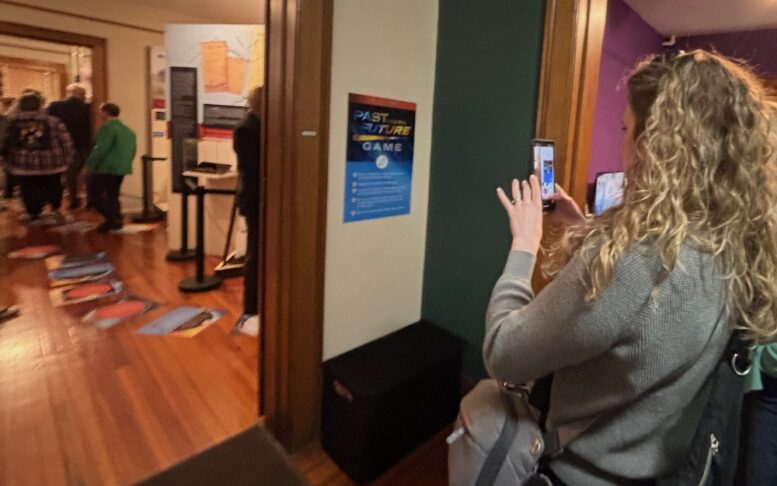
The Wood County Museum officially opened the doors on Thursday to introduce its new exhibition, “Past Into the Future.”
Tied to America’s 250th anniversary celebration, the multi-room exhibit on the museum’s second floor tells the stories of everyday Wood County residents who were the innovators, laborers, teachers and families who built this community.
From surveyor equipment and a blast-from-the-past kitchen to local businesses’ advertising merchandise and a collection of Wood County Fair juice glasses, the exhibit offers a bridge between our past and our future.
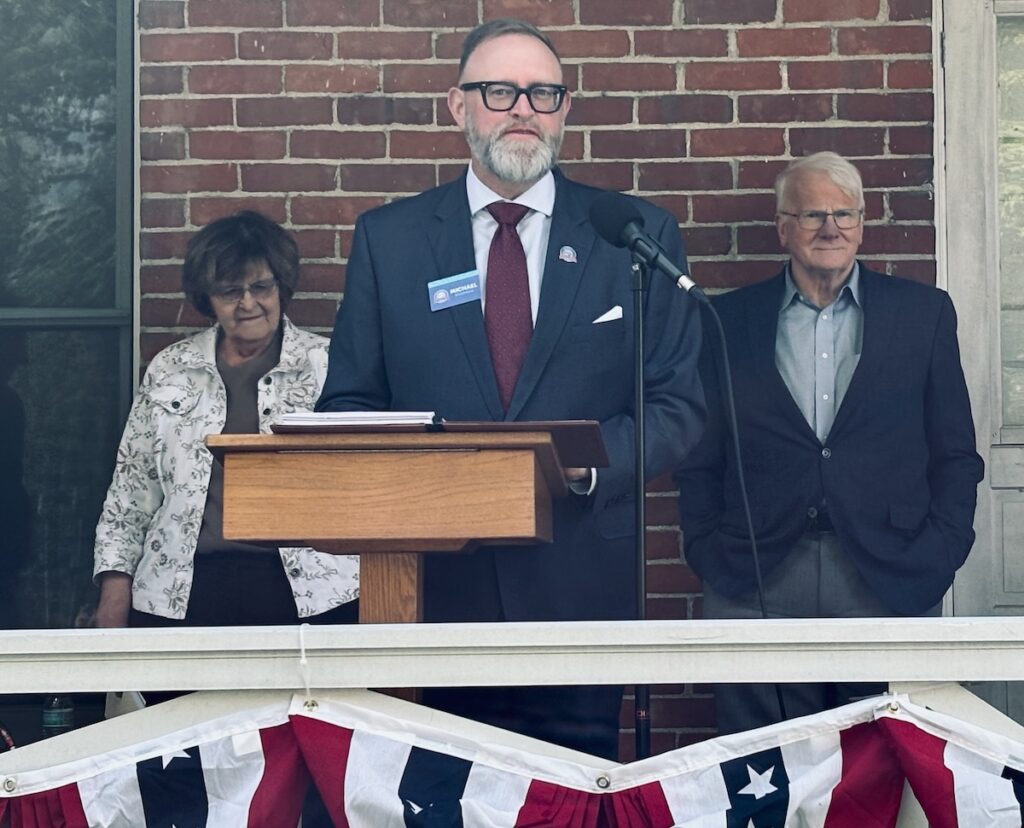
The exhibit “reminds us that history is not just a collection of dates or the biographies of famous political leaders or generals,” said Michael Brennan of the America 250 Ohio Commission. “Here in Wood County, we know that the story of the United States didn’t just happen in Philadelphia. It happened and continues to happen right here in Ohio, the heart of it all, and right here in Wood County.”
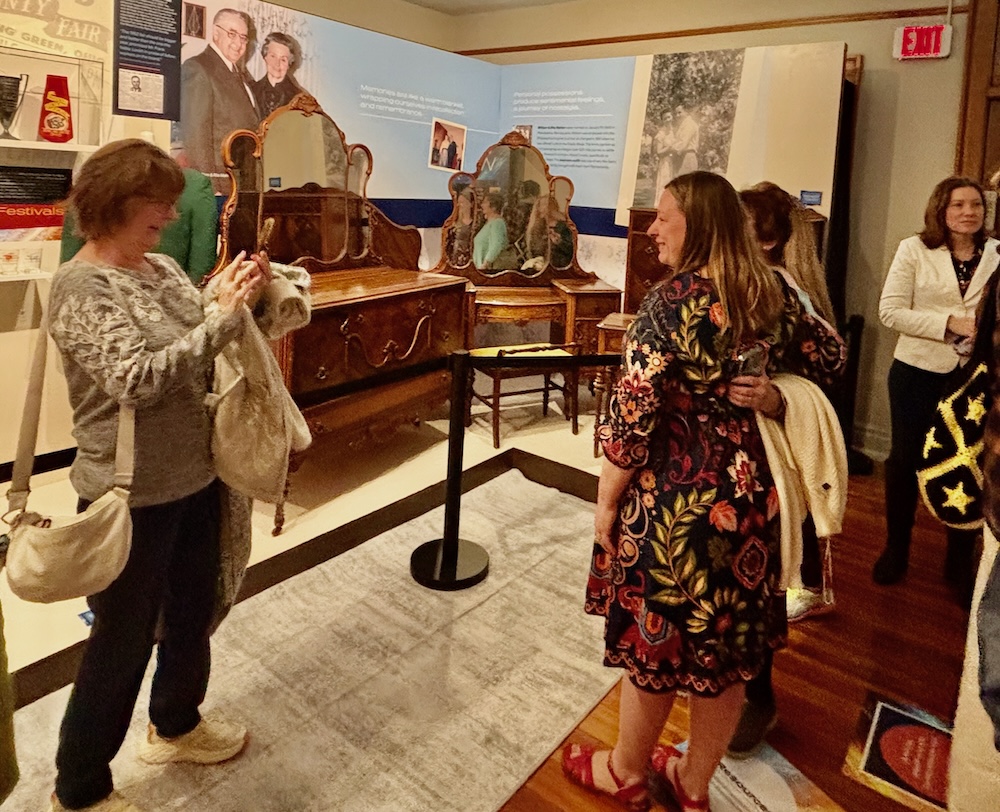
One item in the collection actually had its roots in Philadelphia but spent the majority of its life in Wood County. A complete bedroom outfit, which was transported from Philly to Northwood in 1951, is one of those stories that hits home.
As the verbiage near the bedroom furniture states: “Memories are like a warm blanket, wrapping ourselves in the recollections and remembrances.”
Pat Squibb and Rose Reising are the daughters of William and Rita Mahler, who transported the furniture and the family to Wood County when William was offered a job at the Toledo Blade.
When the sisters walked into the space that featured their parents’ story and the furniture, the memories surrounded and kind of overwhelmed them. They gasped and got teary-eyed seeing the bedroom suite, the photos of their parents as a young couple and later in life, and words that shared the nostalgic journey of the family and its furniture.
The Mahlers were married on Jan. 19, 1940, in Philadelphia, Pennsylvania. But as the behind-the-scenes story goes, they were secretly married on a Friday night and then each went their separate ways to their family’s homes, which means they didn’t have an official wedding photograph.
They kept it quiet for a few weeks because Rita’s father didn’t think his children needed to go and get married, Squibb recalled. A few weeks later, Rita’s aunt asked when she was going to tell because “You can see it. It’s all over your face.”
The furniture’s significance was that once the couple brought it to Wood County, it never left. Afte their parents’ deaths in 1978 and 2000, the middle sister, Terri, lived in the family home. When she died in 2022, Squibb was determined to find a home for a few of the furniture items, especially a table and the bedroom outfit.
“Holly (Kirkendall, museum curator) liked the fact that the furniture never left Wood County and that it was from the northern part of the county, which not much comes to the museum from that part of the county,” Squibb said. “That makes it even more special, she told me.”
Rita Mahler took such good care of the furniture and the house, Reising said. She loved the bedroom suite and kept a collection of antique dolls in the middle drawer that her daughters would ask to see on occasion.
When the time came to do something with the furniture, Squibb didn’t want it to go someplace and not be appreciated. She was thrilled when the museum agreed to accept it.
“My mom would be tickled pink” to see the furniture in the exhibit, Squibb said. “She would just love the fact that this didn’t go just anywhere. It’s going to be appreciated.”
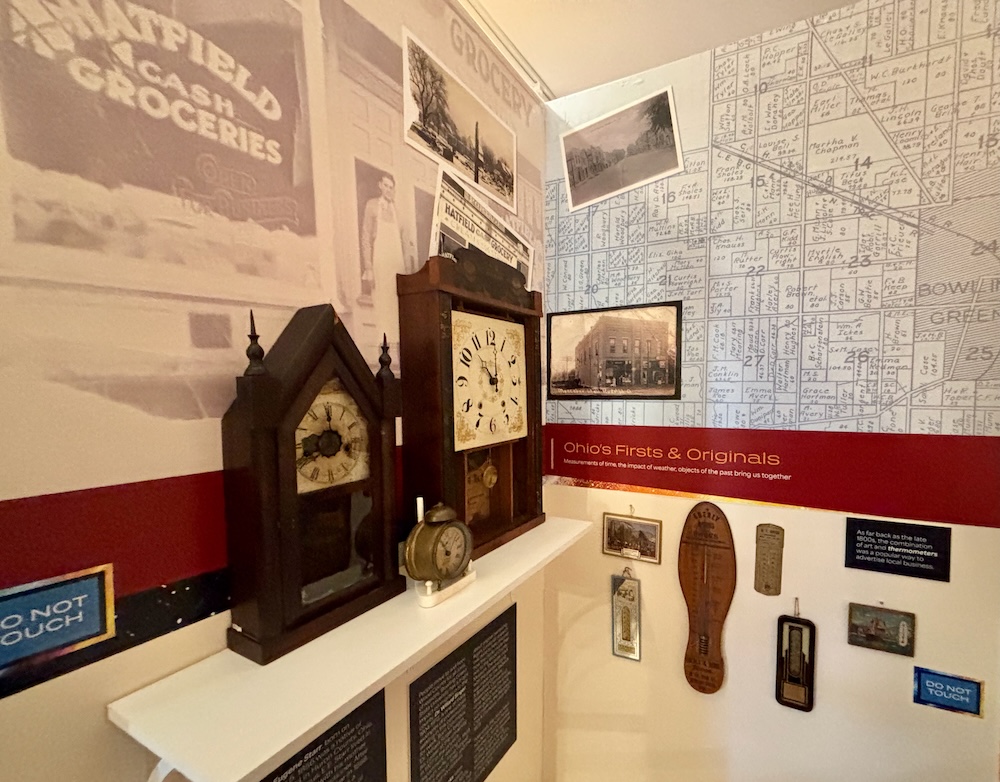
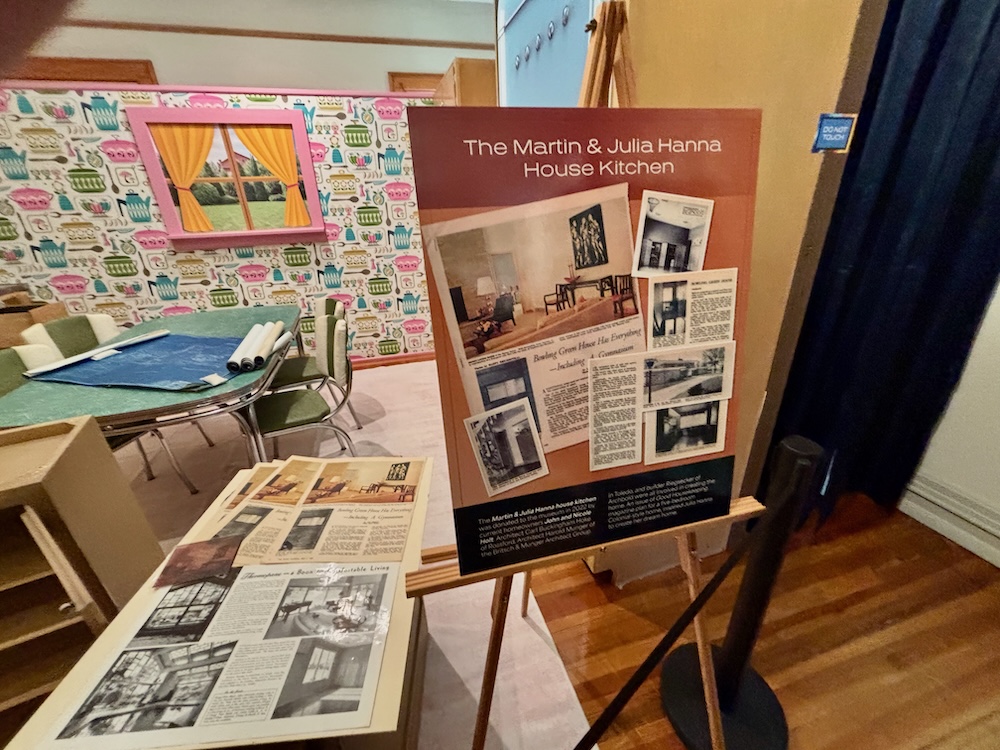
The museum’s exhibit also features sections highlighting: Ohio Works: Innovation & Industry, Ohio Goes to the Fair: County Fairs and Festivals, Ohio Serves: First Responders & Heros Ohio Entertains: Music and Entertainment, Ohio Creates: Arts, Culture & Literature, The Martin and Julia Hanna House Kitchen, Ohio Natural Resources, Ohio Arts, Ohio Moves: Transportation, Ohio Gathers Statewide: Picnics, Ohio’s Firsts & Originals, The Surveyors of Wood County,
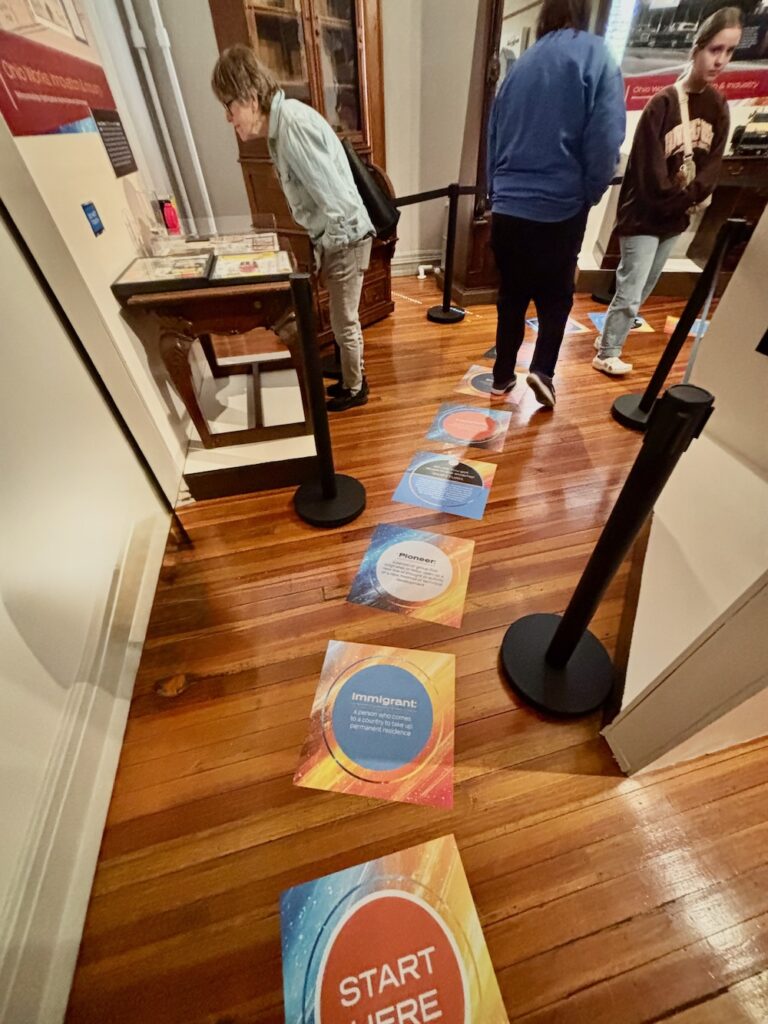
In the Ohio Works section, business owners who helped build the economic foundation of the county are featured, including Henry C. Uhlman.
Uhlman (1842-1923) was the child of German immigrant parents. He left farming at age 15 to learn the dry goods business. He first worked with Ira B. Banks of Pemberville, then he went to Toledo until 1867, when he and Ira went into business together. Moving to Weston, Uhlman invested in a store, was a leading grain buyer, and became of one of the chief organizers and first president of the Citizens Banking Company.
The Klever family is prominently displayed for their jewelry business, which occupied a location in Bowling Green for three generations (Alex, Grant & Roy, and Jon) over nearly 100 years.
An entire case of advertising merchandise such as pens, rulers, thermometers and key rings that harken to legacy businesses: The Loraine Oil Company, Bee Gee Block and Lumber, Kaufman’s, Doren Toyota, Nearing-Huber Regional Insurance Agents, Gravel’s TV & Radio, Earls, BG Livestock and Wilson Shoe Store.
For Museum Curator Holly Kirkendall, learning the stories of the people who donated objects to the museum, sharing those stories and making people feel happy about family is “one of the best parts of the job,” she said.
“When we have donors who are still living, it’s nice to have them come to the exhibits because then they feel a connection, she said. “A lot of times it’s donations from parents or grandparents, and it makes the family members feel very connected. That’s the most important thing about local history.
The themes used were born out of meetings with the America 250 committee and seeing a list of Ohio’s monthly themes. “I didn’t use all the themes, but I picked those with the thought of how to localize it,” she said. “For example, Ohio Creates, we have something two-fold because I. M. Taylor, not only was in the oil business, he was also a painter. And so it kind of goes hand in hand.”
Wood County’s oil boom was huge in the county’s history. “We have a lot of stuff, but this is a great place to start to get people interested and excited about it,” she said.
She also chose to feature some of the surveying equipment used in the county, because of the importance of surveying the Black Swamp and making it habitable.
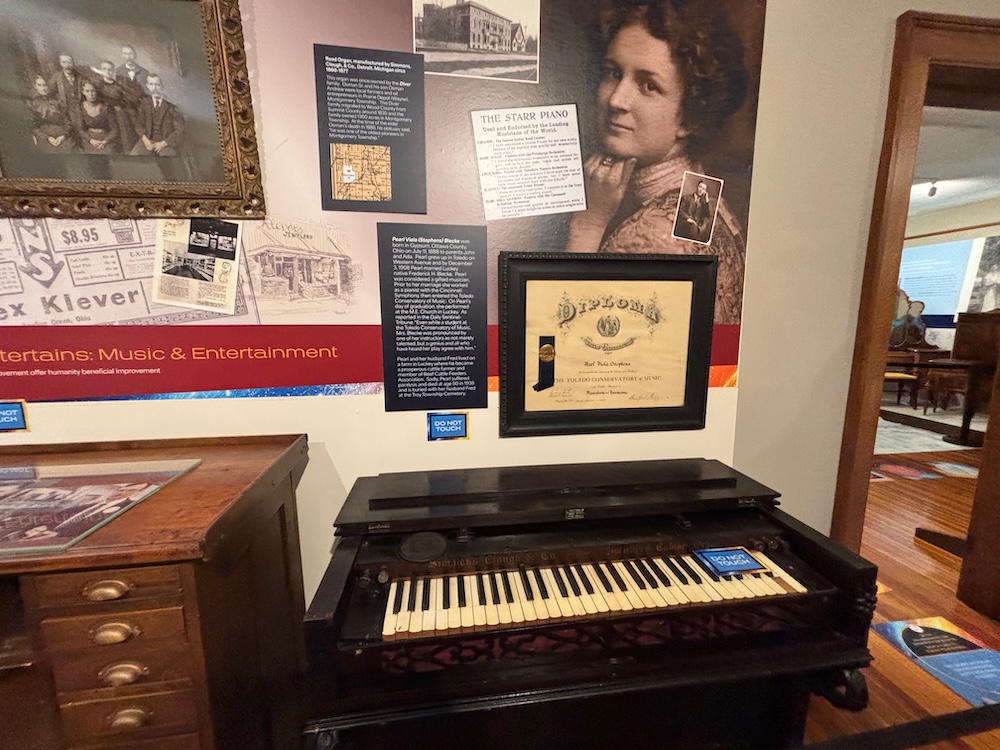
Her favorite piece in the exhibit is a Civil War organ owned by the Diver family of Montgomery Township. She researched the organ based on the scribbled notes of longtime Wood County historian Lyle Fletcher. She pieced together the information about the Diver family and the organ.
“The fact that this organ, out of the Diver family, having 1,300 acres now scattered to the winds, this is what still exists,” she said. “Lyle didn’t keep good, professional records, but luckily he wrote it down on scraps of paper and gave me the clues to do the research and figure it out.”
“These are great objects to start (the exhibition) with. But we have a whole collection, and behind the scenes, we are doing collection management when we’re not doing exhibits,” Kirkendall said. “We are making sure they’re conservationally cared for, researched and photographed for future inclusion in exhibits.”
The hope is that as younger generations see these exhibits of historical items, they will gain a sense of what future generations will want to see 50 and 100 years in the future.
The ribbon-cutting ceremony by the Bowling Green Chamber of Commerce that preceded the exhibit opening, celebrated the “often undertold stories of Wood County residents who worked quietly to make Wood County a place of opportunity and resilience and often did so without fanfare,” Brennan said. “Ohio’s role in the development of this country is profound. We have been the frontier. We have been the breadbasket, the industrial engine, the research lab and the incubator for perfecting American democracy.”