By JULIE CARLE
BG Independent News
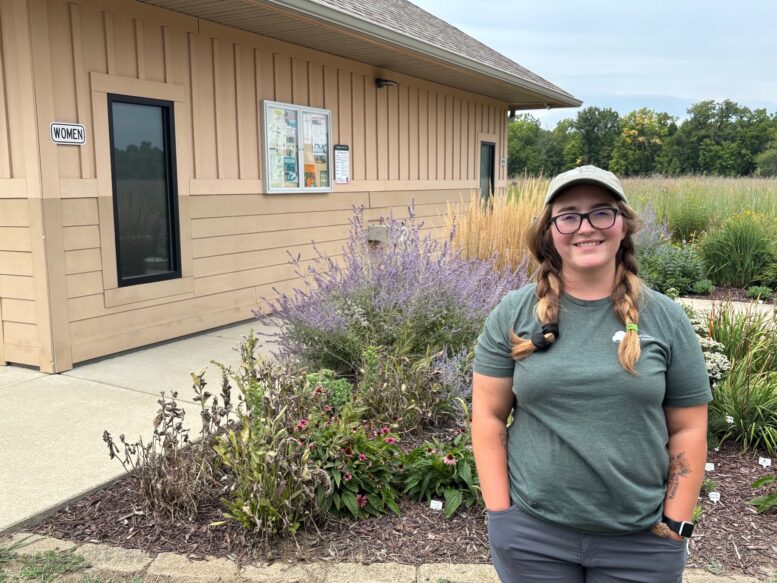
Alexandria “Alex” Helwig was planning to become a veterinarian when she experienced the regional environmental crisis of the Lake Erie algal bloom in 2014. Suddenly, and somewhat unexpectedly, she pivoted and discovered environmental science.
Her interest was fueled by a perspective-altering environmental geography course and a couple of enthusiastic and energetic environmental science professors. She graduated in 2017 from UT with a bachelor’s degree in environmental science.
During her time at UT, she was introduced to the value of native plants for the environment. Helwig was part of a group that helped transform an abandoned lot into a garden filled with native plants.
“I just loved that concept and was lucky enough to find a job with the Toledo Metro Parks doing native plant installation and propagation,” Helwig said.
After five years in that role, she gained additional experience doing invasive species management with the Nature Conservancy and park operations management with Outdoor Sylvania Community Parks.
With her diverse background dealing with invasive species management and native plant collection, Helwig was hired as a restoration specialist to do all the tasks she enjoyed for the Wood County Park District.
Most recently, she was promoted to stewardship manager for the park district/ Now, her responsibilities include managing a small stewardship team of five people who manage 600 to 800 acres of prairie and woodlands. She also oversees the large-scale restoration projects on the natural areas across the park district, supervises the native plant greenhouse and nursery at the J.C. Reuthinger Memorial Preserve on Oregon Road, and trains seasonal staff.
In her new role, she supervises one part-time and three full-time employees. There are also seasonal employees and interns. She delegates the tasks that need to be done, but she also trains the interns on anything they are interested in.
“They’ve gotten a lot of chainsaw experience from a coworker, and worked with heavy machinery like tractors,” she said.
Because the internship is often one of their first field jobs, Helwig helps them develop their skills and confidence.
“They start with us like little caterpillars, and by the end of the season, they find themselves and emerge like butterflies,” she said. “A lot of the job is helping your staff be the best they can be, but also helping upper management,” which means participating in more meetings.
Promoting the use of native plants continues to be a labor of love for Helwig.
“There are a lot of benefits to native plants for landscaping, ecological health and the environment,” she said. Their roots go deep, which makes them drought resistant.
“During drought times here, if you looked around, the turfgrass was brown; everything was brown,” she said. “But if you walked into our prairies at Black Swamp or Cricket Frog Cove, everything was just green and thriving because their roots are deeper.”
The other plus is that pollinators love native plants. “Pollinators in this area have evolved with our native plants,” she said, and many are plant specific.
She gave the example that the monarch caterpillars choose only milkweed, though the monarch butterflies like everything. And the Karner blue butterfly loves lupine.
The benefits outweigh the concern that native plants sometimes look weedy because they get tall and can flop over. The trick is to chop them back about halfway in June or July to promote the plants becoming bushy rather than tall, she said.
The Fall Native Plant Sale on Sept. 13 will be at the W.W. Knight Memorial Preserve, 29530 White Road, Perrysburg. A keynote speaker is scheduled in the morning before the sale begins. The fall plant sale focuses on late-blooming species such as asters and goldenrods, which are critically important for providing pollinators a final food source before winter, she said.
She highlighted a strategic focus for the fall plant sale on late-blooming species like asters and goldenrods, identifying them as critically important for providing pollinators with a final food source before winter. In her work at Wood County, she had to adapt her knowledge of native plants a bit. She had worked with native plants in the sandy soils of the Oak Openings region. Now in Wood County, she is learning how to manage native plants in the heavy clay soils that are common to the county.
Among her favorite tasks is seed collection, because it allows her to explore the parks, the woodlots, and prairie areas, “and maybe find some things that nobody knew were there, which is fantastic,” she said. “It also gives you an opportunity to get outside, get your hands dirty, and be one with nature.”
She has grown to love the many individual parks in the district, but her favorite is Cricket Frog Cove in Cygnet. There are such diverse offerings at the somewhat secluded and not overly populated park, she said.
“The woodlot is great, but you also have tall grasses where it is dry, and then there are some areas that are very, very wet, and hold a lot of water,” she said. “It’s so peaceful and quiet, you can hear the bugs and insects. It has the best of both worlds.”
The close-knit community at the Wood County Park District is a good fit for her. “We can hire people who are actively following the mission of the park district,” she said. “Everybody that we work with likes what they do and wants to see a future in this kind of environment.”