By ROBIN STANTON GERROW
BG Independent News
Even though his books are full of serious subjects—war, serial killers, natural disasters—Erik Larson has quite the sense of humor.
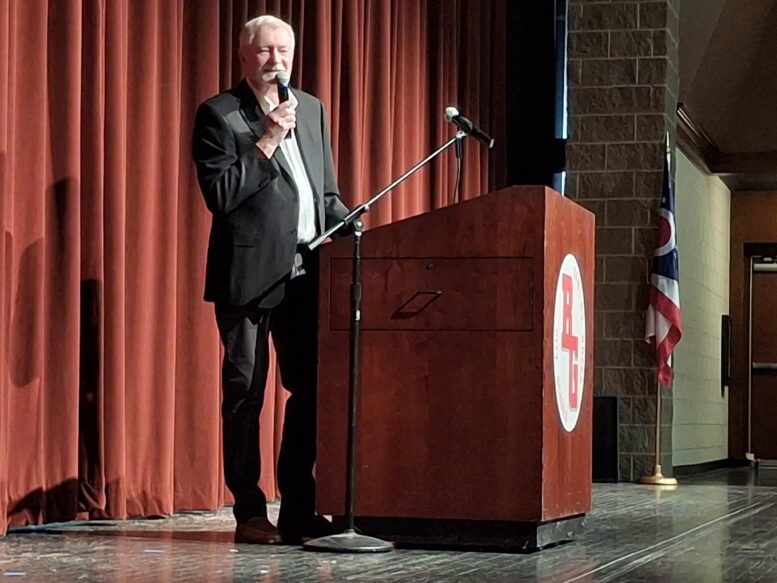
Blending stories of failed early book signings, attending successful festivals with his daughters, and the importance of his wife as a first reader, Larson spoke about his writing process and the need for curiosity when it comes to writing motivating nonfiction history. He appeared on Wednesday as one of this year’s speakers for the Wood County Library District’s Foundation Series event.
“I don’t think of myself as a historian,” he said. “And believe me there are historians who don’t think I’m much of a historian, either. Rather I think of myself as an animator of history. My goal is to create as rich a historical experience as possible so that you’ll sink deeply into the past, so deeply that maybe you’ll experience things as if you were going through them the same way people at the time were doing.”
Telling the story to the laughter of the crowd of when his daughter asked him at a festival being broadcast on C-SPAN how much of his writing is made up, he explained how he creates tension and allows the reader to be immersed in the story.
“It’s not about making things up,” he said. “It’s about finding the right bits and pieces of detail to light the readers imagination and then arranging those pieces in as compelling a manner as possible.
“There’s a beautiful paradox here,” he continued. “It is the magic of reading and of the imagination. And that is that even though we may in fact know the ending of an event or a particular episode in history, if you tell a story properly, people will suspend their knowledge and allow themselves to get caught up in the story.”
Larson is the author of six New York Times bestsellers including “Devil in the White City,” “Isaac’s Storm” and “Thunderstruck.” His most recent book, “The Demon of Unrest,” is about the five months between Abraham Lincoln’s election and the beginning of the Civil War, which he began writing during the COVID-19 pandemic.
He explained his four-step process for choosing a subject.
“I have a regimen for testing the viability of book ideas,” Larson explained. “It has to be of interest to me and has to continue to interest me for three or four years. It has to have a natural narrative arc, something about the story is inherently suspenseful. There has to be a rich reservoir of fine-grained archival materials such as letters, telegrams, diaries and so forth; you have to have the details. Finally, my fourth test is, I need to be able to say something new or at least tell a story in a new way.
“Now, maybe this is still the pandemic speaking, but I felt confident that even though there were already 60,000 books about the Civil War, I could do something different,” he said, smiling.
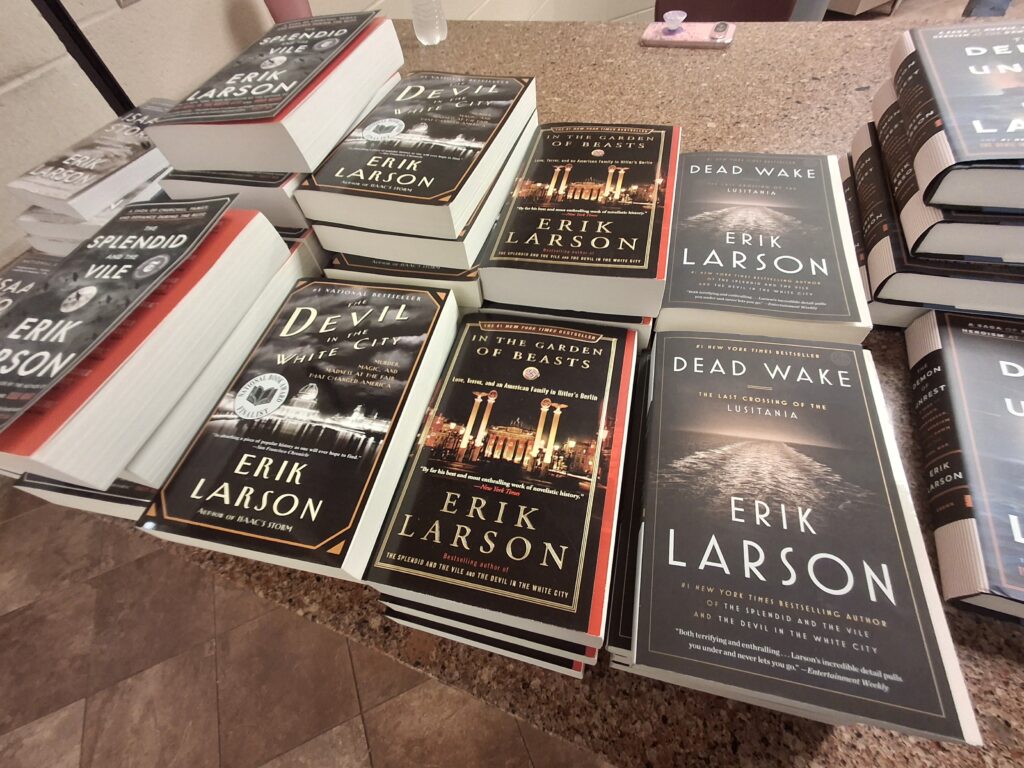
Traveling to the locations where his books are set has become an important part of his writing process as well. Galveston, Texas, for “Isaac’s Storm,” Italy for “Thunderstruck” and Berlin for “In the Garden of Beasts” to name a few.
“My book, “In the Garden of Beasts,” was set in 1933-34 about the rise of Adolf Hitler in Germany and the experience of America’s first ambassador to Nazi Germany and his daughter. I flew to Berlin because I really needed to see where all of this actually took place, and it was a revelatory thing.”
Although for “The Demon of Unrest” most of his research was done online because archives were generally closed, Larson said immersing himself in libraries and archives can lead to some of his favorite discoveries.
“What I’m always hoping to leverage is what I call the ‘serendipity effect,’ something that happens in open stack libraries,” he said. “You look for one book and you see all of the books that are on the subject, and others that are just slightly tangential. And it’s the tangential books that so often yield absolute gold for me.
“One of my favorite details that emerged during my research on Churchill of my book “The Splendid and the Vile,” was that he wore pink silk underwear,” he laughed. “It just sets off fireworks in your mind, doesn’t it?
“I like to think of the central spine of my books as a Christmas tree if you will,” Larson explained. “All of the detail are the ornaments, the danger is that I’ll so overload the tree it will fall over, right in front of the New York Times. Knowing which details to keep, which to cut, is very important to me.”