By JAN McLAUGHLIN
BG Independent News
While American soldiers were on the frontlines in World War II, their families on the home front were helping with the war effort by scrimping on food and using creative substitutes to stretch meal items.
The menu at the recent monthly tea at the Wood County Museum was a stark contrast to the discussion topic of wartime rationing. Among the decadent items served at the sold-out tea were chocolate truffles, pomegranate tartlets and chocolate peppermint scones.
When the scheduled speaker canceled the day before the tea, Alyssa Garland, museum and events assistant, pulled together a program that satisfied attendees.
“I tweaked this from a presentation I did for third graders,” Garland said with a smile.
While the U.S. was already rationing some items to assist European allies, the effort became much more earnest after the attack on Pearl Harbor on Dec. 7, 1941.
The rationing effort changed how much and what Americans ate. Roasts became a rarity. Soups and stews stretched out ingredients. Coffee beans were brewed multiple times, and kitchen fats were turned in at grocery stores to help the war effort.
“Meals were encouraged to be simple,” Garland said. Some recipes from the era – like beans on toast in Great Britain – have retained their popularity, she said.
In the U.S., items like SPAM were created out of necessity to feed the troops. And Americans’ love affair with traditional meat and potatoes was put on hold. Recipes were created to use cuts of meat – hearts, livers, brains, tongues and pork knuckles – that may have been previously scrapped.
“This was the way to assure food for our fighting men,” Garland said.

The military needed the calories and essential vitamins from meat, fats, fruit and vegetables. And canned vegetables required tin, another important resource needed for war effort.
The military needed to be able to can foods for military rations – both for the U.S. and for the allies. Huge quantities of meat, chocolate, coffee and other foods either disappeared or were highly restricted from the consumer market back home.
At the same time, families were encouraged to plant “Victory Gardens” and can their own food items.
“Women and children at home were able to do their parts for the war effort,” Garland said.
While the war resulted in shortages of common products like rubber, metal and clothing, it was the scarcity of various types of food that affected just about everyone on a daily basis.
Much of the processed and canned foods were reserved for shipping overseas to U.S. military and allies. Transportation of fresh foods was limited due to gasoline and tire rationing and the priority of transporting soldiers and war supplies. Imported foods, like coffee and sugar, were limited due to restrictions on importing.
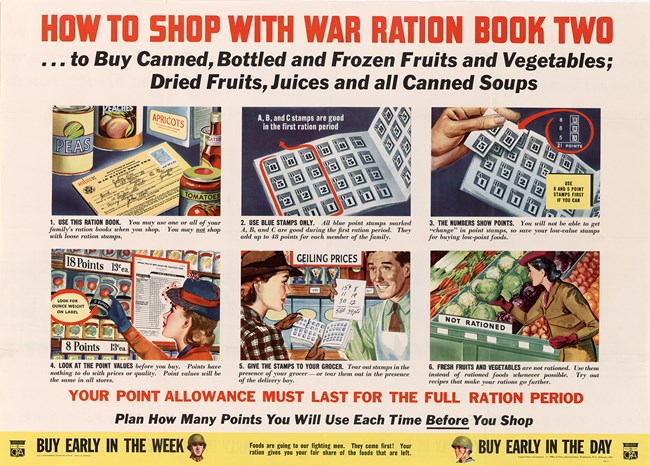
Because of these shortages, the U.S. government established a system of rationing that would more fairly distribute foods that were in short supply. Every American was issued a series of ration books during the war. The ration books contained removable stamps good for certain rationed items, like sugar, meat, cooking oil, and canned goods.
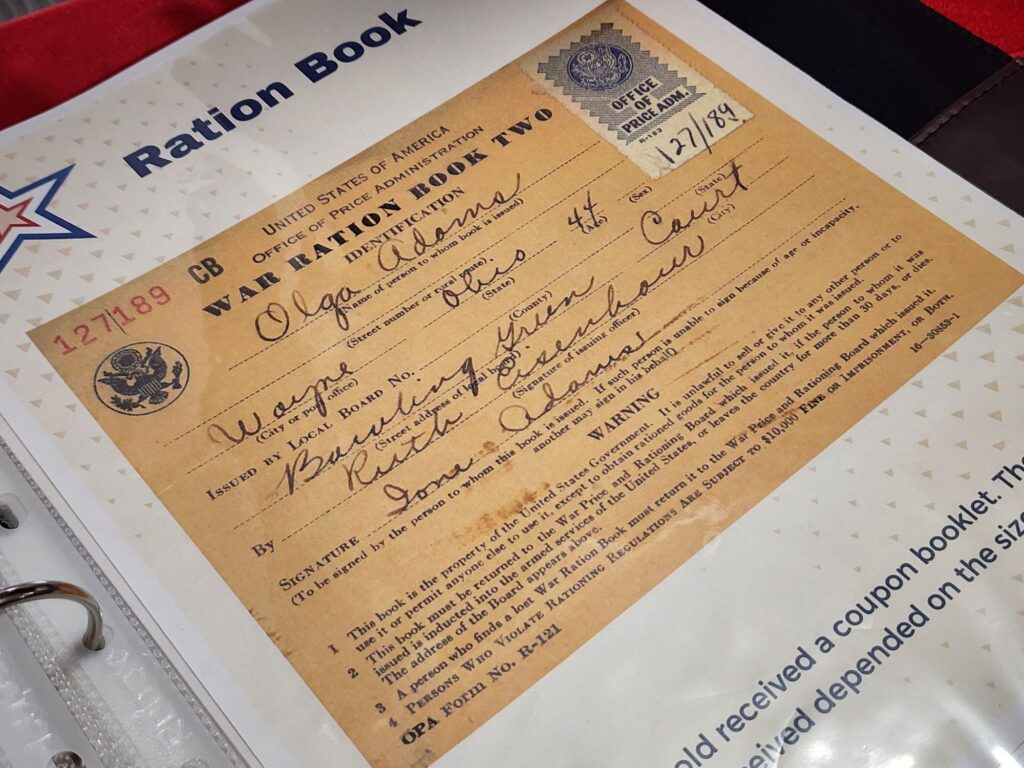
A person could not buy a rationed item without giving the grocer the right ration stamp. Once a family’s ration stamps were used up for a month, they couldn’t buy any more of that type of food.
Rationing was managed at the local level by volunteer rationing boards.
This meant planning meals carefully, being creative with menus, and not wasting food.
Gasoline was also rationed, with allowable amounts dependent on whether a person’s job was important to the war effort. Nylon hose became a luxury, with some women instead drawing seams up the back of their calves to mimic nylons.
Garland showed a black and white video featuring Mickey Mouse produced by the U.S. government to promote rationing – including the saving of kitchen grease and fat to go from the “frying pan and into the fighting line.” A skillet of bacon grease could help in the war effort, Garland said.
Fabrics were also rationed, leading to shorter skirt lengths – rising from the ankle or calf up to the knee.
“I know – scandalous,” Garland said with a grin.
Board games for children became more popular, since they did not require rubber or tin.
Recipes were promoted for meatloaf, using crackers, bread, vegetables and lard. “You take a small amount of meat and stretch it,” she said.
Hungarian goulash could be made with neck meat, and beef barley soup could be made with beef shank. Knox gelatin could stretch a stick of butter.
“You don’t have to follow the recipe. Use what you’ve got,” Garland said.
Following are some of the prime rationed food items, according to the series The American Home Front and World War II.
Sugar
Sugar was rationed from May 1942 through June 1947, well after the war ended. It was the first food rationed, and the last to be taken off the ration list. People used alternatives to sweeten their foods, including maple syrup, corn syrup, and fruits. Those canning their own foods could apply for extra sugar.
Coffee
Coffee was rationed from November 1942 to July 1943. There were bumper crops of coffee in Central and South America at the start of the war. But U-boat attacks on cargo ships and the diversion of cargo capacity for the war meant that a lot of it wasn’t making it to the U.S. The coffee that did arrive was prioritized for the military.
People extended their coffee by brewing it multiple times, or with other non-rationed products like chicory. Leftover coffee was also saved to be reheated or used in recipes.
Processed foods
Processed foods were canned, frozen, dried, or otherwise pre-packaged. Over 300 processed foods were rationed, beginning in March 1943 and lasting through August 1945. By rationing processed foods, scarce metals needed for tin cans and preserved foods were prioritized for military use.
Fresh fruits and vegetables were never rationed during World War II. This, however, didn’t mean that the produce wanted was always available. Consumers could also grow and preserve their own produce in Victory Gardens to avoid spending ration points.
Cheese and canned milk
Cheese, canned milk and fats were rationed from March 1943 to November 1945. It was important that the military got enough calcium in their diets. But shipping fluid milk was a problem.
Instead, cheese, butter, and canned milk (evaporated and condensed) were rationed. This ensured a supply of dairy for the military, and diverted more tin cans for the war effort. Fresh milk was not rationed during the war.
Fats
Fats like oils, lard and butter were also rationed. What little was available in the U.S. was rationed to ensure the military had enough. Fats were not just used for food – animal fats were also processed to make glycerin. It was a key ingredient to explosives like nitroglycerine, and was used to make bullets and bombs. Glycerin was also needed for war-critical pharmaceuticals, paint for tanks and planes, and for dyeing uniforms.
Even with rationing, the military did not have enough glycerin. Civilians were encouraged to save their kitchen fats, which they could turn in to their butcher. In December 1943, those who turned in waste fats received 2 red ration points and 4 cents per pound.[32]
Red stamps in ration books were points used for meat, cheese, and fats. Each person got 64 red stamps per month, giving a family of four a total of 256 points. Lard was taken off the ration list in March 1944, and shortening and oils in April 1944. Butter and margarine were rationed through November 1945, with butter needing more points.
To ensure margarine was not being sold as butter, it could not be colored yellow except by the consumer. Each pack of margarine was sold with a packet of yellow food coloring that the buyer would mix in. Work-arounds included using peanut butter in baking to replace fats and stretching butter by whipping in other ingredients like honey or incorporating up to 50% of gelatin.
Meats and canned fish
Meats and canned fish were rationed from March 1943 through November 1945. The beginning of the canned fish ration began with a sudden halt to all sales to help prevent hoarding. Canned fish was needed by the military as a source of protein. In 1943, the military took 80% of canned sardines and mackerel and 60% of the canned salmon. Fresh fish was not rationed.
Meat rationing was done by the cut and the pound. Every cut of most every kind of meat had its own point value plus a ceiling price. These were adjusted as availability and demand shifted. Recipes explained how to stretch meat ration points by making soups, stews, and casseroles instead of roasts and steaks. There was also a campaign promoting organ meats, rebranded as “variety meats.” Some civilians kept rabbits and chickens in their yards to provide meat and eggs, even though poultry and eggs were not rationed.
Americans, however, loved their meat. Especially beef, which had some of the highest point values and ceiling prices throughout the war. The result was a thriving black market. It was the food that Americans were most willing to go to unpatriotic means to get.