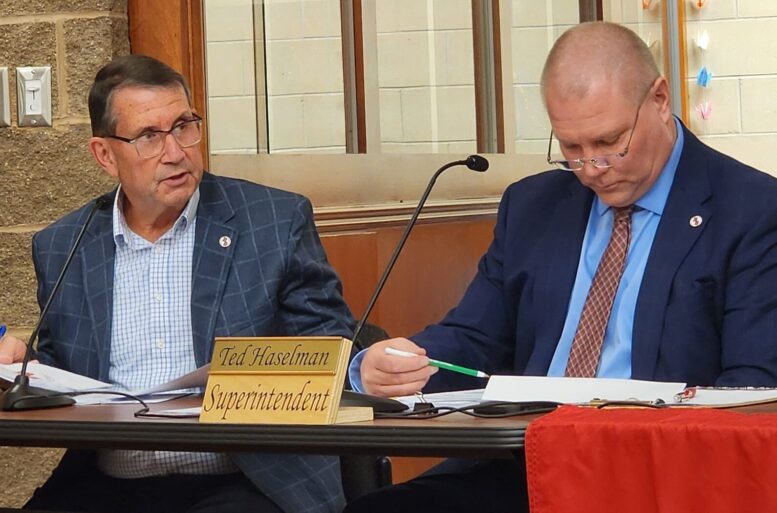
By JAN McLAUGHLIN
BG Independent News
School districts across Ohio are being asked by the state to file financial reports to the state while wrinkles in new state rules are still being ironed out.
That has 611 school districts and 88 county auditors in Ohio “scratching their heads,” Bowling Green City Schools Treasurer Matt Feasel said last month during a school board meeting.
“This forecast has been prepared with a significant degree of speculation. We have done our best to prepare this forecast with a lot of information that simply does not exist at this point. There are still a number of unknowns,” Feasel said.
While multiple bills affecting district finances have been passed by state legislators, the guidelines have not been established on how they will be implemented – even though the bills go into effect on March 19, he said.
“The state continues to make the forecast even more challenging as we strive to operate a multi-million-dollar system with the funding available to us. We remain optimistic that fair school funding will remain in place and be funded adequately in the future,” Feasel said in his report.
The district continues to carefully manage its finances while planning for change in how school funding works in Ohio, he explained. Recent property tax reform legislation passed by the Ohio General Assembly – including House Bills 186, 335, 129 and 309 – is gradually changing how much revenue school districts receive from property taxes.
“These laws are designed to slow the growth of property tax collections when property values rise, creating more predictability for taxpayers. As a result, school districts across the state, including ours, should expect to receive less revenue over time than what had previously been forecasted under older funding rules,” Feasel said.
The school board and administration regularly review budget forecasts and compare revenues to actual results to ensure resources are aligned with educational priorities, operational needs, and long-term stability, Feasel reported. While these funding changes present challenges, the district remains committed to thoughtful planning, transparency, and maintaining strong financial stewardship on behalf of the community, he said.
“This forecast is conservative and we still have a few ‘unknowns’ hanging out there, but we had to project what we felt comfortable with that accurately portrayed a realistic financial picture,” he stated.
“There are so many moving targets as we look ahead to the future. It makes things extremely more difficult to project with any degree of accuracy. We have tried to gather historical data and as much information from the state level as we possibly could to compile this information,” Feasel wrote in his report. “We look at all areas – past, present and future – to create a realistic financial picture of the district.”
During the last two decades, Ohio has cut its share of state funding for public schools, funneled taxpayer money to private school vouchers, overridden the governor’s efforts to protect school funding, and is now proposing easing property tax burdens on Ohioans by shifting the pain to public schools – retroactively.
And last year, the state legislature passed multiple bills to take property tax revenue from schools and return it to taxpayers.
House Bill 186 is expected to cost Bowling Green City Schools $5.5 million over the next four years.
Currently, property tax rates on voter-approved levies get reduced as home values increase. The idea is voters shouldn’t pay more (without voting on it) just because their home became more valuable.
But those rate reductions have a hard stop at 20 mills, known as the 20-mill floor. That means school districts can’t get a windfall if valuations skyrocket – but districts can’t go below the 20-mill floor.
However, HB 186 would remove that floor – retroactively, capping at the rate of inflation.
If approved in its latest three-year retroactive form, the bill is expected to save Ohio property owners nearly $1.7 billion over the next three years, while stripping $1.7 billion from schools.
Rural school districts would be the most affected.
House Bill 309 allows county budget commissions to reduce property tax levies to avoid unnecessary or excessive collections, and House Bill 129 would include emergency and substitute levies into the calculation of a school district’s 20-mill floor.
Feasel stressed the difficulty managing school finances with so many unknowns.
“I basically tried to touch on the recent legislation and how it ‘might’ affect Bowling Green Schools,” he said after the financial forecast at the board meeting. “The concepts are there but the details are not. We are trying to project our financial future and they continue to change the picture on us, daily.”