
By JULIE CARLE
BG Independent News
Today’s economic crisis for agriculture is starting to mirror the Farm Crisis of the 1980s. Republican Iowa Senator Chuck Grassley is vocal about how the combination of rising borrowing costs, low grain prices, and market disruptions due to tariffs is creating severe financial stress for farmers.
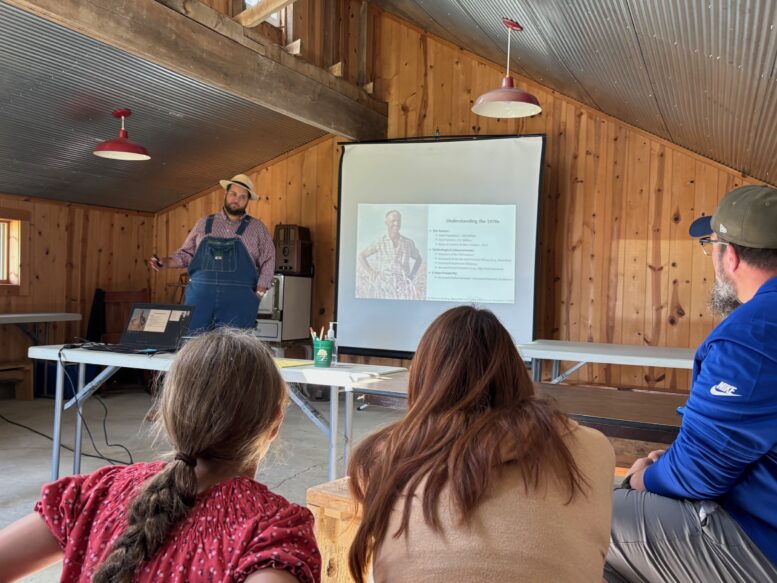
With the backdrop of the Wood County Park District’s Carter Historic Farm, agricultural historian Chase Fleece, recently shared the historical perspective of the 1980s Farm Crisis and connected the historical events to contemporary issues.
“The farm crisis of the 1980s was not a sudden event,” said Fleece, who is an adjunct history instructor at Bowling Green State University. “It was the direct consequence of farm policies and the debt-fueled expansionary period in the 1970s.”
There were approximately 204 million people in the U.S. and 9.7 million farmers. Agriculture was undergoing significant technological advancements including the adoption of no-till practices, increased herbicide and pesticide efficacy and implement efficiency, and improved varieties of high-yield crops.
There was “a new prosperity” that increased domestic production in response to increased global demand. The demand in the early 1970s was fueled by a worldwide drought in 1972 and the U.S.-Soviet grain deal that same year. Soviet agriculture had failed, which prompted the Soviets to purchase 10 million tons ($1 billion worth) of wheat and corn of which the U.S. subsidized $300 million.
Beyond the increase in domestic production, the consequences ranged from increased food prices, depletion of global wheat stocks, and eroded trust in then-President Richard Nixon and the U.S. Department of Agriculture.
Domestic policies at the time encouraged farmers to “plant fencerow to fencerow” and “get big or get out,” Fleece said. Farmers experienced “debt-driven operation expansion.”
During the decade from the 1970s to 1980, land values skyrocketed nearly 10% each year. In 1970, farmland was valued at $197 per acre. By 1980, farmland was valued at $737 per acre. Farmers were reaping the benefits in commodity prices. In 1973, soybeans were selling at $10.96 a bushel, and in 1974, corn was $3.80 and wheat was $5.96 per bushel.
The winds of change started in December 1979 when the Soviet Union invaded Afghanistan and President Jimmy Carter enacted a grain embargo against the Soviets in January 1980. That decline in grain exports, along with the drastic rise in interest rates between 1977 and 1979, high farm debts and the decline in land values created the “perfect storm” for what became the 1980s Farm Crisis, Fleece said.
By 1982, crop prices fell to $2.20 for corn, $3.12 for wheat and $5.34 for soybeans.
Between 1978 and 1991, nearly 300,000 farms failed, and proliferated by shame and guilt, the number of suicides, divorce and alcoholism increased in the farm population, Fleece said. The rural areas lost populations as much as 80% in the Great Plains and 63% in the Midwest.
“Some of the highest rates of suicide in the country are farmers,” he said about the lasting human toll of the economic hardships faced by farmers.
The government didn’t subsidize farmers, but it eased some of the regulations on who could receive money, letting the banks give more loans to farmers to meet the demand. The skyrocketing land prices were the basis for the expansion.
“No one stopped to think ‘What if this bubble collapses?’” Fleece said. “By the ‘80s when that collapses, everybody goes, ‘oh shit,’ the collateral’s gone and everyone’s left with debts.”
That was the era when there were foreclosures. By the end of the 1980s, people were allowed to restructure debt “but by that point, they had already lost,” he added.
In response to the farm crisis, the American Agricultural Movement (AAM) was founded. The national organization with state-based chapters, sought economic parity and encouraged farmers to strike. They also led the Washington D.C Tractorcade in February 1979 demanding more profitable and equitable agricultural policies by the government.
The American Farm Bureau Federation’s tactic was to advocate for farmers using conservative approaches to seek legislative and political relief.
The lasting effects of the Farm Crisis included decreased diversification of farm practices, increased farm consolidation and gutted rural economies.
The grain embargo ended up being more of a symbolic act of betrayal, solidifying farmers’ distrust in the government.
“The grain embargo really didn’t hurt farmers that much,” Fleece said, “It was more a slap in the face. But it showed them that they could be easily discarded by the federal government.”
“Was the farm crisis a periodized event or has it become a chronic issue that hasn’t really gone away?” Fleece said. The farm crisis should be understood, not as a closed chapter in history, but as the beginning of an ongoing state of agricultural instability
“Something that happened 40 years ago still carries a bunch of weight on what’s happening right now,” he said. “It’s all interconnected. Things like this (the farm crisis) have a legacy.”
His current research focus at chasefleece.com moves beyond the exclusive domestic view, and examines the farm crisis as a shared experience among Western agricultural nations including Canada and parts of Europe. Additional agriculture talks are planned at Carter Historic Farm; the next talk, presented by Fleece and Chris Dauer, is Nov. 23 from 2 to 4 p.m. at the farm. The topic is “More Than Corn? A History of Wood County’s Specialty Crops.”