By JAN McLAUGHLIN
BG Independent News
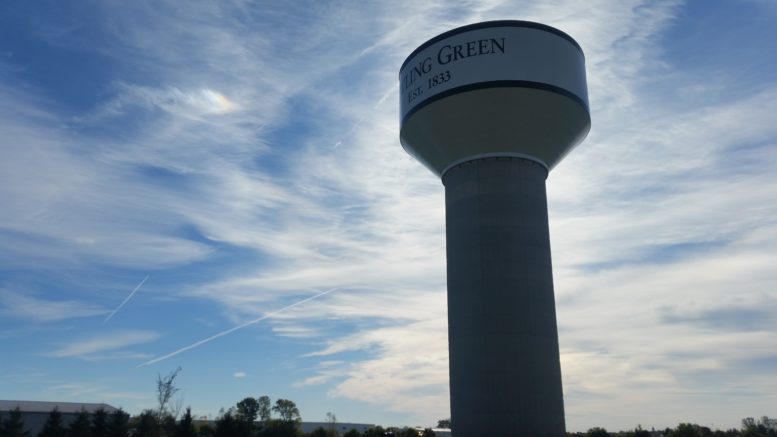
Bowling Green City Council was cautioned Monday evening about relying solely on the Maumee River for its water source.
As drought conditions occur more frequently in the region, geologist Jim Evans, who lives in Bowling Green, suggested the city look at wells or Lake Erie as supplements to its river water source.
“As a professional hydrologist, I have ethical responsibilities to warn City Council of the seriousness of this vulnerability of our water supply, and will be obliged to continue to be annoying until something is done about it, something meaning either the city develops access to a Lake Erie water supply or installs a municipal well field as a backup water source,” Evans said.
But Bowling Green Utilities Director Brian O’Connell on Wednesday said the city has tracked its Maumee River water source for decades, and added the U.S. Geological Service data does not take into consideration the deeper upriver location of the city’s water intake.
O’Connell also said the options of well water and a Lake Erie water intake are not realistic for the city.
During Evans’ presentation to council, he noted that northwestern Ohio has seen extreme drought conditions seven times since the year 2000, including the last two years.
This year’s drought, which resulted in a 7-inch rainfall deficit in Northwest Ohio, was directly centered over the Maumee River Valley. This type of drought is called a “flash drought” because it came on suddenly, was accompanied by higher temperatures, 3% stronger winds, and more concentrated rainfall. This resulted in severe loss of soil moisture and the fall of the groundwater table, Evans reported.
The cause of these droughts has been linked to climate change, Evans said. In northwestern Ohio, mean annual temperatures have risen 2.50F (1.50C) since 1950. The warmer air holds 10% more moisture, which is obtained by pulling water out of the soil, as the air mass travels across the region.

At the same time the warming atmosphere is pulling moisture out of the soils, the atmosphere is becoming super-loading with moisture, causing more intense rainstorms (heavy rains in NW Ohio are 24% more frequent, and the largest storms deliver 42% more water). However, these rainstorms do not recharge soil moisture or groundwater because most of the water is lost as run-off, Evans said. So the net impact of the warmer and wetter air is drought and the groundwater table falls.
Overall, the water levels of the Maumee River at Waterville have been dropping since early July. The river channel was about 50% dry by the end of October, Evans said.
“It should be clear that the vulnerability of Bowling Green’s water supply is serious and is increasing each year. Delay addressing this could have very serious repercussions for the community,” Evans said.
But O’Connell said the USGS gauge in the Maumee River is in Waterville at a level considerably higher than Bowling Green’s deep water intake upriver from the gauge.
“Even at the lowest point, there are 50 cubic feet per second flowing past the gauge,” O’Connell said. That’s more than 30 million gallons a day, he said.
The city’s water intake location usually sees more than 100 cubic feet of water flow per second.
“We typically treat five to eight million gallons a day,” O’Connell said.
“There’s still a lot of water even during a drought or dry period,” he said. “There’s still a tremendous amount of water that flows past that point.”
During his report to council, Evans also expressed concerns about the city’s recent water commitments to the data center being built north of Bowling Green (1 million gallons per day) and the Abbott Labs (600,000 gallons per day).
“I understand the need for the city to pursue economic development projects, but I would caution that those kinds of commitments should have some restrictions attached,” Evans said.
Data centers mostly need water for cooling purposes, he said, adding there is no reason why those types of businesses could not be required to install heat exchangers to re-cool and then reuse that water. Some water is lost due to evaporation in a heat exchanger, but 80-90% of the water could be recovered and reused, significantly reducing water demand during an emergency, Evans explained.
“The goal here should not be to make water distribution commitments to the maximum extent of our ability to pump water from the Maumee River during a good year, because difficult years are sure to come,” he said.
But O’Connell said he remains comfortable with the city’s water contracts.
The suggestion of tapping into well water would not be feasible, since the city’s water treatment plant is not designed to treat groundwater, which contains many solids, O’Connell said. That would require the city to build an entirely new water plant, he said.
And installing a raw water line to run 40 to 50 miles from Lake Erie is just not reasonable, O’Connell said.
However, the city is in the process of studying expansion of its reservoirs next to the water treatment plant, and has been exploring the possibility of establishing an emergency interconnection with the Northwestern Water and Sewer District for Toledo water if necessary.