
Review by CARROLL McCUNE
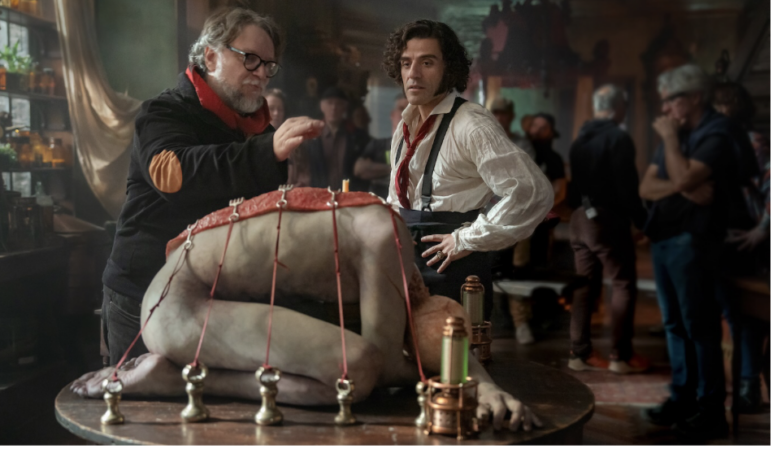
When Mexican director Guillermo del Toro was a child, he watched Boris Karloff portraying Frankenstein with his Catholic grandmother. “Monsters are my religion,” the director mused, “My Grandma has Jesus. I have Boris Karloff. He was my Messiah.” At eleven-years-old, del Toro determined to one day make a Frankenstein movie himself. By his own admission, he was obsessed for the rest of his life with the Creature of Mary Shelley’s 1818 novel Frankenstein: Or The Modern Prometheus. He read the novel five times and kept a notebook of his own drawings of the Creature and his concept for a film adaptation.
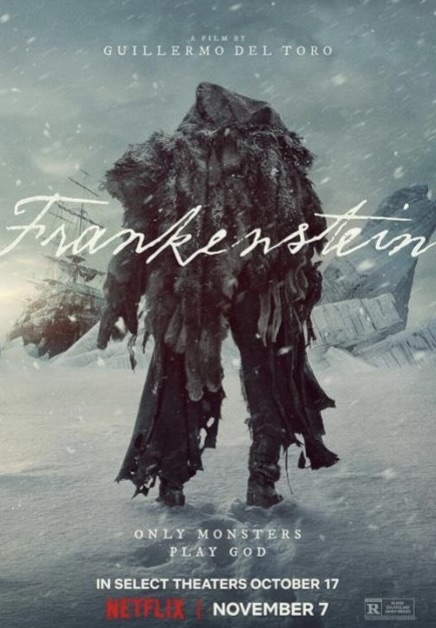
As devoted as the director claims to be to the spirit of Mary Shelley’s 200-year-old gothic tale of horror, del Toro’s Frankenstein interprets the maniacal doctor and his wretched creation more as a psychodrama between an abusive father and a sensitive son rather than as an “overcoming-the-monster” horror story. Noted for his succession of award-winning horror films, del Toro refers to his version of Frankenstein as a father-and-son drama, eschewing the horror genre completely, “It’s an emotional story for me. It’s as personal as anything. I’m asking a question about being a father; being a son. I’m not doing a horror movie—ever. I’m not trying to do that.”
As director and scriptwriter, del Toro rewrote all of Shelley’s characters to fit his autobiographical interpretation of the novel. He omitted some and conjured a new one, the war profiteer Henrich Harlander (Christoph Waltz) who financed Frankenstein’s elaborate laboratory. Harlander made a bizarre request that Victor flatly refused causing Harlander to try to destroy the unanimated corpse. If Harlander is part of del Toro’s biography, he must stand for the film financiers who thwarted the auteur’s twenty-five-year quest to make a Frankenstein movie. However, according to renown film theorist Howard Suber, audiences will accept fewer characters in an adaptation of a beloved classic, but they will never forgive the creation of new ones.
Of all the many screen interpretations of Frankenstein, the father/son theme has seldom been stressed. (Beginning with Thomas Edison’s movie in 1910, there have been 433 feature films, 212 short adaptations, and 85 TV series based on the novel.) In order to project his own biography into the film, del Toro begins with a great deal of backstory about Victor’s father Leopold (Charles Dance). The character was kindly in the novel, but del Toro turned him into an imperious physician and tyrannical task master who whipped the boy Victor Frankenstein for not learning his anatomy lesson; a behavior Victor repeats with his Creature who failed to learn more than one word while chained in the dungeon. In the film, the boy Victor despised his father and blamed him for his mother’s death in childbirth, scoffing, “You, the best surgeon, why did you not save her?”
When Victor narrated his tale to Captain Anderson, he confessed, “I was to protect myself and William [his younger brother, Felix Kammerer] from the beast [his father Leopold]. And in exchange, I would have command over the very forces of life and death. I would create life and prevent death—I would become every once the surgeon my father was and I would even surpass him. But before any of that would come to be—I had to kill him.”
In Shelley’s novel, Victor Frankenstein is well-motivated. He wanted to benefit mankind by uncovering the source of life in order to create a species of perfect humans unaffected by disease. He is likened to Prometheus, the Titan of Greek mythology who stole fire from the gods to benefit mankind. His creation, however, became a ghastly killer instead; a Satan-like personification of evil. Del Toro flipped the script by portraying Victor as a moral monster and the Creature as his innocent victim. “What manner of creature is that? What devil of a man made him?” asked ship captain Anderson (Lars Mikkelsen).
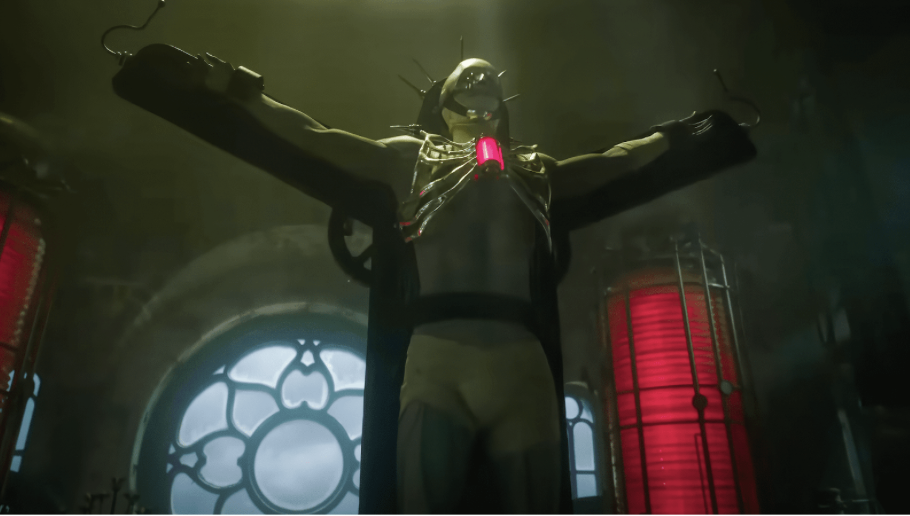
In the creation scene, the corpse is hung up in a a so-called reverse-crucifixion. This intentionally conflates Christian theology of death and resurrection with cinematic grotesqueness. As a self-confessed “lapsed Catholic,” del Toro made the monster a messiah cursed with eternal life while Frankenstein was blessed with death—the only escape from life’s misery. Abigail James of the Catholic Online News sees no heresy in this perversion of the Christian meaning of life and death. She praised the film as a meditation on God, creation, and the cross itself and called it an allegory for the Holy Trinity of Catholicism. She wrote, “For del Toro, the bond between Dr. Frankenstein and his creation mirrors that divine relationship, a Father who brings forth life, only to abandon it.”
The handsome, 6’5” Australian actor Jacob Eldori played the Creature. He was made to to look like a cracked alabaster statue—no stitches, bolts, or flat head—by the prosthetic specialist Mike Hill and makeup artist Jack Pierce. Del Toro explained that “the Creature needed to have the essence of a newly formed, innocent human being.” Presumably, it would be easier for audiences to empathize with the Creature if he were not hideous.
Victor, who in the film became like his own tyrannical father, was not horrified by the creature, just exasperated by his inability to say any other word besides a long, throaty “Victoooor.” Jealousy amplified his disapproval of the Creature after Elizabeth Harlander (Mia Goth) discovered him chained in the dungeon and pitied him. Victor then tried to destroy the creature by burning down his castle laboratory, but he escaped and found refuge in the farm mill of a blind man (David Bradley) and his family, albeit unknown to them. He learned to speak and read and searched for the “father” who abandoned him.
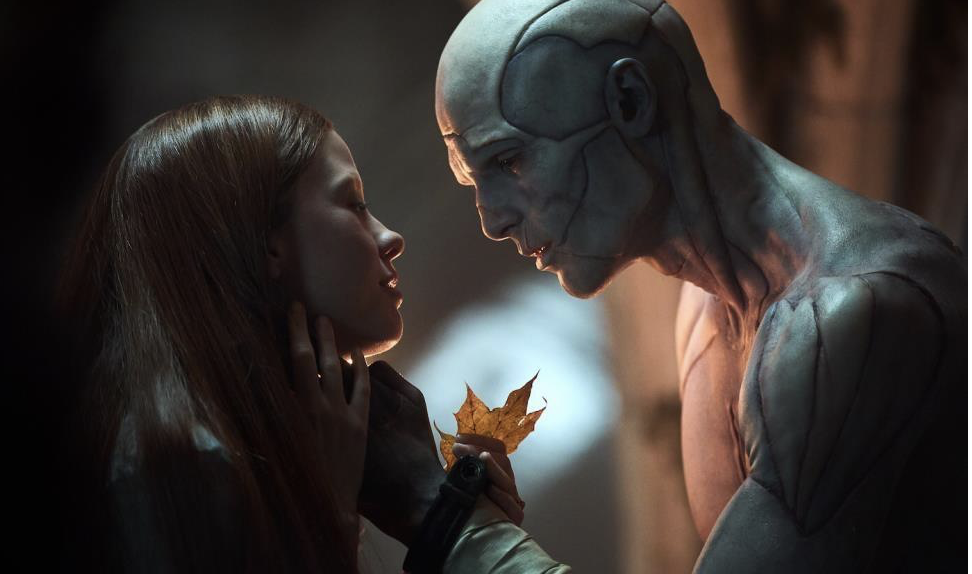
Del Toro’s Elizabeth bears no resemblance to Shelley’s character. In the novel, she never knew about Victor’s unholy experiment and loved him unconditionally. In the film, she’s engaged to Victor’s brother William and denounced Victor’s cruelty and conceit. “You, the great Victor Frankenstein, made a mistake?“ she mocked, after Frankenstein admitted that something had gone terribly wrong with his experiment. Victor flirts with Elizabeth but she spurns him. Since Mia Goth also plays Victor’s mother, the film hints at Victor’s Oedipal complex (a son’s hostility towards his father and desire for his mother).
Oscar Isaac, a Latino American actor, portrayed Victor as a sociopathic artistic genius rather than a mad scientist. Del Toro sees himself in both the character Victor as well as in the Creature. Isaac described the film as “high melodrama which is a biography of his own [del Toro’s] life.” Del Toro explained, “The creation scene is like an artist creating his masterpiece, something joyful and beautiful rather than a mad scientist.” He envisioned the character as “Puccini-like, a joyful artist who creates an operatic masterpiece.” Costume designer Kate Hawley dressed Victor like a 19th century romantic poet rather than a laboratory scientist.
Two-time Academy award-winning French film composer Alexander Desplat, who worked with del Toro on The Shape of Water and Pinocchio, created the orchestral accompaniment. Like the film, the music is symphonically romantic—not creepy—in order to compliment del Toro’s painterly cinematic style. Desplat explained that the music of Frankenstein should be something very lyrical and emotional. He said, “I’m not trying to write horrific music…the challenge was to find the sound of the Creature; what was driving his emotions as he comes forward like an innocent child.” He chose a solo violinist (Norwegian Eldbjørj Hemsing) to evoke the Creature’s sensitivity and isolation.
Both the film and the novel begin and end with a scene of an exploration ship bound for the North Pole with its hull encased in ice where Victor and the Creature reunite. Production designer Tamara Deverell constructed a real 130-foot-long sailing ship patterned after Lord Franklin’s 1845 doomed expedition in search of a Northwest Passage. Del Toro said, “I want a real ship because the ship is a character.” Commentators often regard the immobilized ship as a symbol of the vain quest for the unknown. As a character, it represents the mutinous sailors’ hope for salvation. As a Christ-like figure, the Creature provides for the seamen’s salvation by freeing the ship from the ice.
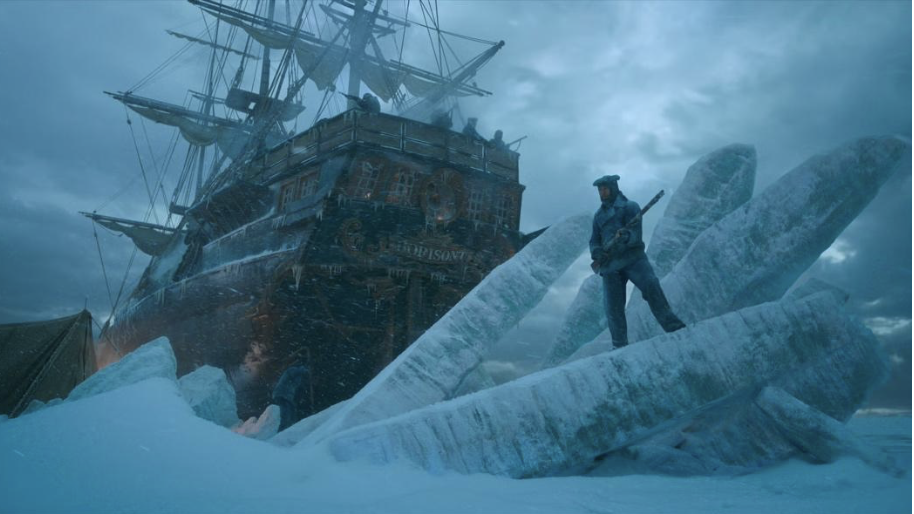
Danish cinematographer Dan Laustsen made viewing Frankenstein a pleasurable experience rather than an unnerving one. He shot the entire movie with an Alexa 65 mm large format camera and a 24 mm wide angle view lens with a steel blue in-camera wash. Single-source exterior lighting emphasized the symbolic feature of sunlight throughout the production. Speaking with The Hollywood Repoter. Laustsen said “So I read the book, which is amazing. And then I got the screenplay, and I was like, ‘Oh, this is a very, very special twist.’ Which shouldn’t be surprising because Guillermo does that all the time. I think the way he changed the story makes it a masterpiece. For me it’s a movie about love and forgiveness. It’s a love story, not a horror movie.”
But the filmmaker’s “special twist” is faithful to neither the spirit nor the text of Mary Shelley’s novel, which itself is a parody of John Milton’s 1667 epic poem Paradise Lost. Her book begins with the epigraph: Did I request thee Maker, from my clay, to mold me man. Did I solicit thee, From darkness to promote me?” (Paradise Lost, X) In her novel, Shelley turned John Milton’s fallen angel “Lucifer the Devil” into the Creature and “God the Potent Victor” became Victor Frankenstein. Her story unfolds in two long monologues dramatizing the argument between God and the Devil who accuses God of a selfish motive in creating man. Although Shelley’s Creature won the argument because “there was some justice in it” he remained a malevolent, vengeful character in the novel. By portraying Frankenstein as a murderous villain rather than as a Prometheus-like benefactor of mankind and reimagining the Creature as a superhero rather than the Devil, del Toro scrambled the theological symbolism in Mary Shelley’s classic story and subverted its timeless literary archetypes.
While other Frankenstein filmmakers have simplified the novel by turning it into a parable about the disastrous consequences of playing God, del Toro overwrote it by turning it into a psychological relationship drama. His formulaic sentimental ending undermines the novel’s tragic sensibility. Rather than adapt its universal themes to a new audience, he appropriated its iconic characters for the sake of highly idiosyncratic self-expression. He explained, “This is my primordial myth—the song I was born to sing.” And “I’m trying to find out things about myself through this movie…”
Nevertheless, it wasn’t necessary to honor the source material of Mary Shelley’s Frankenstein in order to make this superb movie, which has been nominated for nine Oscars and already received 47 other critics’ and international awards. Del Toro plumbed the depths of his darkly chthonic imagination to create a fascinating retelling of Frankenstein that will endure largely on the strength of its cast and ingenuity of its crew. Jacob Elordi’s portrayal of the incongruous Creature has been especially acclaimed.
