By JULIE CARLE
BG Independent News
Stories older than the state of Ohio came alive when cultural leaders from the Wyandot Nation gathered recently in Bowling Green, offering more than a performance — they offered a living connection to their ancestral homeland, history and resilience.
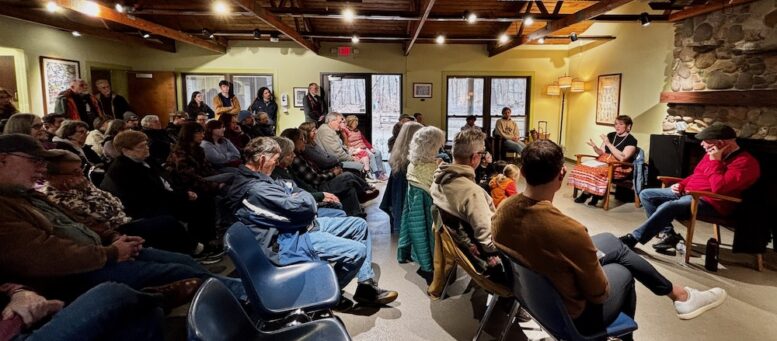
Chris Houk and Ciara Cotter of the Wyandot Nation Cultural Center of Oklahoma shared Wyandot stories as part of Bowling Green State University’s 2025-26 “In the Round” series. The annual speaker series welcomes Native American creatives to enrich the learning experiences and perspectives of the campus and local communities.
Framed by themes from the book “Braiding Sweetgrass” by Robin Wall Kimmerer, who will be the series’ keynote speaker later this month, the event blended scholarship, oral tradition and cultural education.
Kimmerer’s work emphasizes reciprocity between humans and the natural world — a principle that echoed throughout the storyteller’s talk held before a standing-room-only audience at the Bowling Green Rotary Center in Wintergarden Park/St. John’s Woods.
Stories as living knowledge
Cotter, whose Wyandot name translates to “she has a story,” told the audience that storytelling is not entertainment alone but responsibility. Having practiced since age nine, she described how traditional narratives are shared with care and according to protocol.
“The story itself… is as it should be, without need for further explanation,” she said, noting that listeners are meant to carry their own interpretation from each of the stories shared.
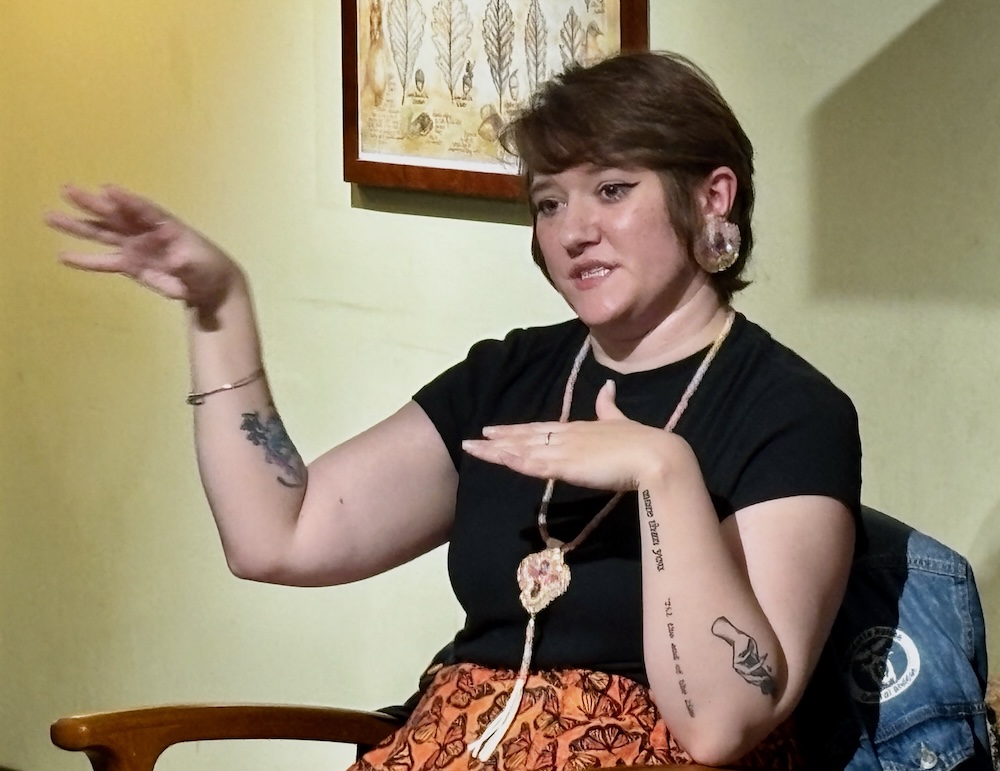
Storytelling by the Wyandot people has “specific cultural protocols,” including that animal stories cannot be told except in the wintertime.
“If you tell them in the summer,” Houk explained with a smile, “snakes might crawl into your bed.”
“I like to tell all of the stories,” Cotter said. “It’s one of the great honors of my life to be able to carry on this tradition from my ancestors. We are excited to be able to be with you today, as these are our traditional homelands in Ohio, so it is one of the places where we have the best connections.”
Houk complemented the storytelling with cultural context drawn from his work as a lifeways researcher. Together, the pair performed creation stories, trickster tales and the origin of the Rabbit Dance, even sharing a traditional social song.
Homeland and history
Throughout the event, the speakers returned to one central truth: Ohio remains the Wyandot people’s ancestral home.
They recounted the tribe’s forced removal in 1843 and the long shadow of historical misrepresentation. One of their goals is to correct historical records and challenge colonial narratives.
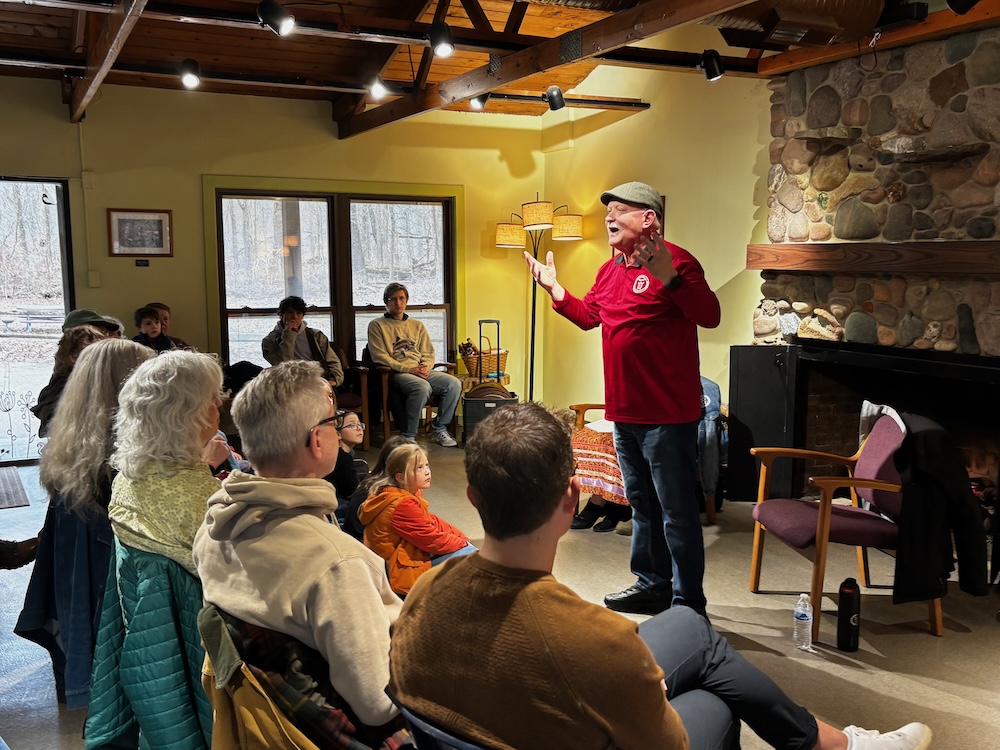
“We were here more than 100 years before the removal, migrating here about 1725-1735,” Houk said. “We changed so much. We went from long houses to cabins to frame houses.” A framed house in Upper Sandusky still stands that belonged to one of his ancestors.
“We went from Three Sisters (corn, beans, squash) farming to conventional farming,” he said. What changed was when the U.S. government decided they needed to pay their soldiers for the Revolutionary War.
The government went to the Haudenosaunee and paid them for the land; however, the Haudenosaunee did not own the land.
“Nobody talked to us or the Miami or the Shawnee,” Houk said. “They just said, we paid for it. We’ve got the papers.”
Cotter recited part of the farewell address given in 1843 by Wyandot leader Squire Gray Eyes.
“Here our dead are buried. We have placed fresh leaves and flowers upon the graves for the last time. No longer shall we visit them. Soon they shall be forgotten. For the onward march of the strong white man will not be turned aside for Indian graves,” she said to a hushed audience, underscoring the weight of the tribe’s displacement.
“We will always treasure our time in Ohio,” Cotter said. “One day we will return because this is our home.”
Cotter and Houk also challenged common misconceptions about Native identity, including the origins of outsider-imposed names and stereotypes that continue to circulate.
Women at the center of Wyandot society
Every story carries a moral, Houk told the audience. In the creation story of the Three Sisters — corn, beans and squash — the lesson centered on maternal responsibility and sacrifice.
“Mothers are to provide for their children,” he said. Women have always played a central role in the Wyandot nation. Historically, the three major divisions were led by women; the structure continues to shape cultural values today, he said.
The pair also highlighted ongoing cultural revitalization efforts. Much of today’s language and song recovery work draws on early 20th-century recordings by anthropologist Charles Marius Barbeau.
Houk noted that partnerships with institutions such as Ball State University are helping the Wyandot Nation apply modern tools — including ground-penetrating radar — to locate unmarked graves at former residential school sites.
The work, they emphasized, is about both remembrance and renewal.
Christine Thompson, who recently retired from Ball State, was the project manager for “St. Clair’s Defeat Revisited: A New View of the Conflict” where she worked with the second chief of the Wyandotte Nation for over five years. She also helped organize several Beyond the Battlefield events at the Fort Recovery Museum with the Wyandotte Nation. The project was established to help address historical injustices, she said.
“It was one of the most emotional experiences of my life,” Thompson said. “Everything I had ever learned was turned on its head. I had to relearn what I was taught growing up in Ohio. I had to empty my head of all that and relearn. It has changed my view, how I look at things and approach things.”
She chose to attend the Bowling Green event “to show support and reciprocate on all the partnerships that we’ve done. It’s important work,” she said.
A message of resilience
Despite dispersal, removal and generations of assimilation policy, Houk and Cotter emphasized that the Wyandot Nation shows endurance and continues to rebuild language, ceremony and community knowledge.
Their closing message to the Ohio audience was both gracious and resolute.
“Wherever you stick us,” they said, “we’re going to grow.”