
By JAN McLAUGHLIN
BG Independent News
The rushed rollout of hyperscale data centers is happening so fast that most communities not only can’t get the information they need to make educated decisions – they don’t even know what questions to ask.
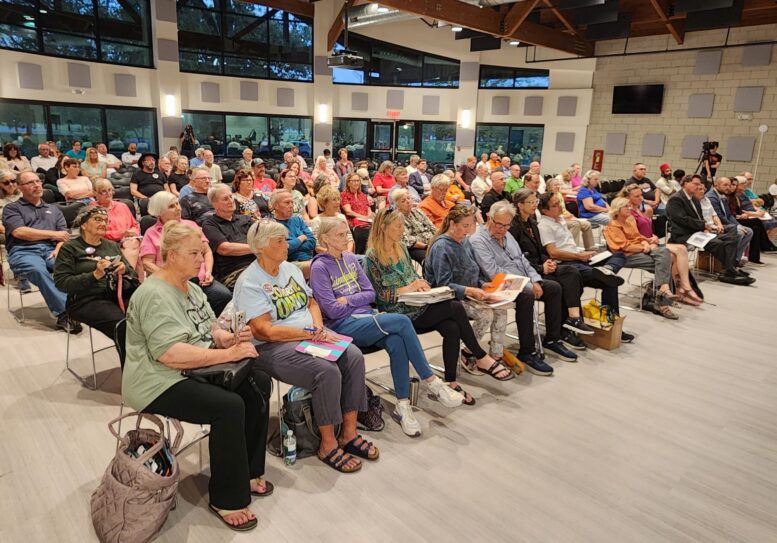
A panel of experts offered their advice Tuesday evening at a town hall in Bowling Green on “Data Centers, Community and Sustainability in Northwest Ohio,” organized by the BGSU Institute for the Study of Culture & Society and moderated by Steve Kendall.
The panel included three industrial hygienists, who have worked across the country to mitigate the effects of industry on employees and communities, the mayor of Maumee, and the executive director of the Ohio Township Association.
The audience was made up of people with general concerns about large scale data centers, and those with specific worries about the massive Meta data center currently under construction 10 miles north of Bowling Green in Middleton Township.
With nearly 200 in the state, Ohio ranks fourth in the nation for the most data centers.
Some are small and have been around for years. But it’s the new hyperscale centers – like the one being built in Wood County – that concern the three health and safety experts on the panel.
And it’s the undeserved tax abatements and lure of eventual tax dollars that trouble the city and township officials.
Municipalities and townships are in tough financial positions, according to Maumee Mayor Chelsea Ziss and Ohio township director Kyle Brooks. The cost to provide services to citizens is growing, while the backlash on property taxes is leading to revenue cuts and citizenry not keen to approve any new funding. That could make a data center proposal attractive to a community that needs big ticket items like a new firetruck that can start at $1 million.
“That can be very enticing,” Brooks said.
Representing more than 1,300 townships in Ohio, ranging from 100 to 65,000 residents, Brooks explained that townships have one source of revenue – property tax. And they are the most likely locations with large swaths of land needed for hyperscale centers.
“Townships in general are a great target for those,” he said.
So it doesn’t sit well with Brooks that it’s almost a given that data centers are granted tax abatements.
“Does Meta, Amazon, Microsoft, Google need a tax exemption?” he asked.
“A data center should pay its way,” for roads, utilities, and emergency services, he said. “We don’t want township residents footing these bills.”
But across the state, township officials are being told that data centers are needed to help America’s race for AI, that they are great for business, and that everyone needs more AI.
“We generally hear arguments that it’s great for the state,” Brooks said.
“Data centers, any economic development, is rarely black or white. It’s rarely good or bad,” Brooks said, stressing that townships should make their own decisions about potential data center developments.
“If townships want to pursue data centers, they should be able to. But they should not be forced to have one.”
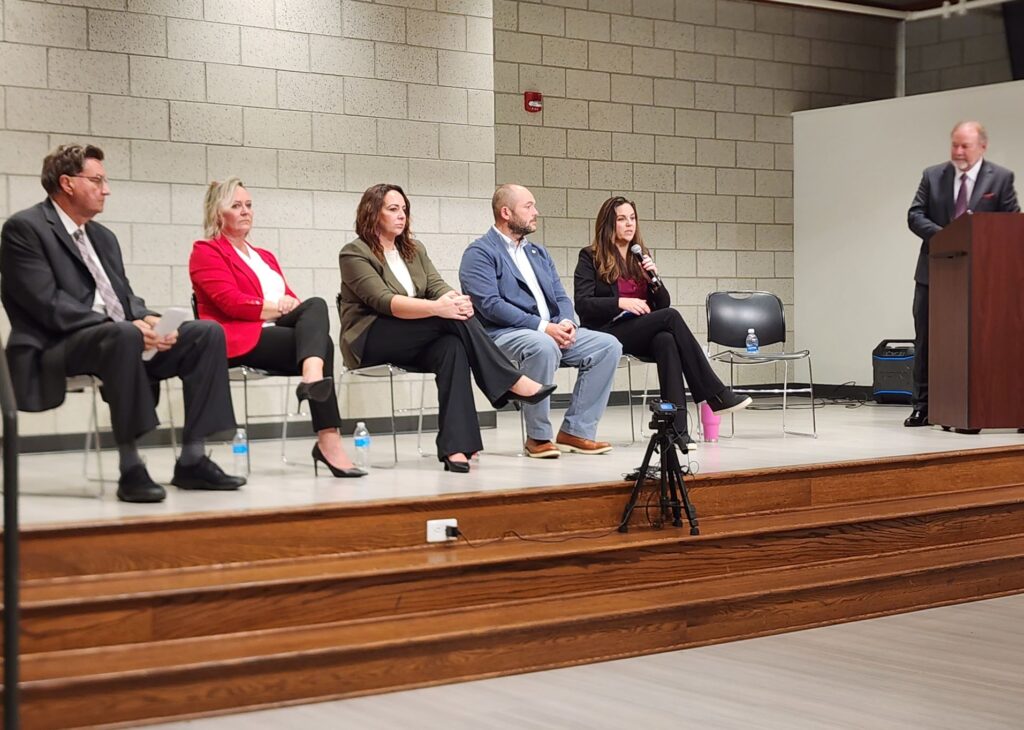
Ziss said municipal and township officials are oftentimes rushed into making such decisions – without having the information needed. Some communities, like Maumee, have adopted moratoriums to temporarily slow the process and give them time to research the pros and cons.
“We simply don’t know enough about them,” she said. And how can a small city on a tight budget fully research these multi-million dollar corporations, she questioned.
“I’m here to learn as much as all of you are,” she said to the town hall audience.
But Ziss put it bluntly. Local governments in Ohio are hurting for tax revenue – and data centers make some pretty big promises.
However, the mayor has heard her constituents. “Hard as it is for elected officials to say ‘no,’ my residents don’t want it,” she said.
And the reality is, “a multi-million dollar investment is not necessarily a multi-million benefit to the community,” she said.
Not helping is the fact that data centers have become a deeply polarizing issue across the nation, with claims from both sides being exaggerated. All sizes of data centers are being lumped in with hyperscale sites as being evil, Ziss said.
And help from state leaders isn’t coming anytime soon. A data center research group established by the state in February has yet to release any information to grassroots governments looking for direction.
“We have to move faster,” so educated decisions can be made, Ziss said.
Township officials are still waiting for a determination from the state if they can ban data centers, Brooks said. “All of you in this room will be suffering with the consequences,” he said.
Two industrial hygienists and environmental specialists, Tammy Clark and Kristen Kelly, talked about the “reckless rollout” of large scale data centers. Neither are anti-technology, they said, but they are opposed to allowing such industry into communities with so many unanswered questions.
“We have a problem with what we’ve seen coming in the last couple years,” Clark said. “How can you make an informed decision?”
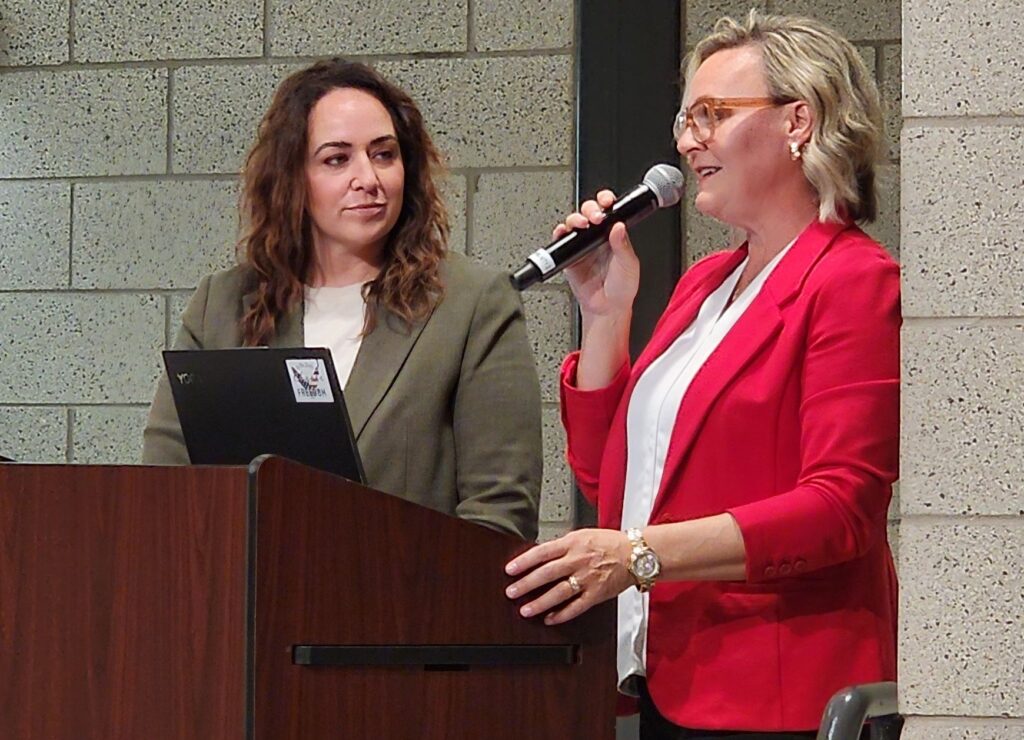
For more than 20 years each, Clark and Kelly have worked to recognize, evaluate and control hazards at industrial sites. That includes exposure to noise, chemicals, light, and harmful contaminants to water and air.
In many cases, hazards can be reduced by engineering controls. But some corporations adhere to OSHA standards without considering the 24/7 impact on the community. Or they “dodge the questions” and tell communities that they have Ohio EPA approval – neglecting to state that many hazards or chemicals at large-scale data centers are still unregulated, Clark and Kelly said.
“They prey on weak zoning, struggling communities and struggling farmers,” Kelly said.
While the sites may pass OSHA tests for employees, many don’t take into consideration the impact on neighboring residents, farmland, livestock, and water aquifers. The communities around the data centers are affected by “cumulative and compound exposures,” Kelly said.
The steady hum of “tonal noise,” the spread of industrial lighting round the clock, the diesel emissions in the air, the frequent use of back-up generators, and the cooling equipment’s effect on nearby land temperatures, all need to be monitored and mitigated.
“Hyper-scales are heavy industrial. Who is going to protect you?” Kelly said. “Local communities should have 100% of the say. Nobody can tell you that you have to do this. Don’t let lawyers scare you. We have time to stop, pause and fix this.”
In some communities, large-scale centers and their hazards are on the edge of housing subdivisions and school properties. “That’s insane. That’s egregious,” Kelly said.
The third industrial hygienist and safety expert to speak was Stephen Petty, who has testified as an expert witness in approximately 400 exposure cases, including the East Palestine, Ohio, hazardous train crash, plus cases against RoundUp and “forever chemicals.”
Petty warned there are several “forever chemicals” that are currently unregulated, but will cause problems in the future. By 2029, many of those chemicals will be regulated, and communities may be left with the problem since data centers aren’t planning ahead for that expense, he said.
Legislation has been proposed in Ohio to ban non-disclosure agreements that many data center corporations require to be signed by elected officials prior to public announcements being made about data center locations, Petty said.
Petty also said the sites should be self-sufficient for their electric, water and wastewater needs.
He disputed the reduced water use at large data centers due to what the industry calls “closed loop” cooling systems.
“There’s no such thing as a closed loop,” Petty said. “It’s semi at best.” And municipalities get stuck treating twice as much wastewater as is treated from the community, he said. “We should know what their release levels will be.”
The group also discussed the high probability that the mega data centers being built today will be obsolete within five years. Clark advised that communities require funds up front for a decommission plan.
The panel agreed that Ohio needs more time and data.
“The people making the decisions don’t have the information,” Ziss said.
