By JAN McLAUGHLIN
BG Independent News
The proposed solution to Bowling Green’s deteriorating fire and police stations seems straightforward – but getting there will take a pretty winding route.
If all the pieces fall into place, city officials hope to begin construction on two new fire stations in 2026, with the goal to have them operational in 2027. Next, work will transition to renovation of the police station in 2028. During construction, the police division will be temporarily housed in the Court Street fire station, which is slated for demolition when the police renovations are complete.
But to get there, Bowling Green City Council must approve six ordinances and one resolution. And voters must pass a 0.15% income tax in the November election.
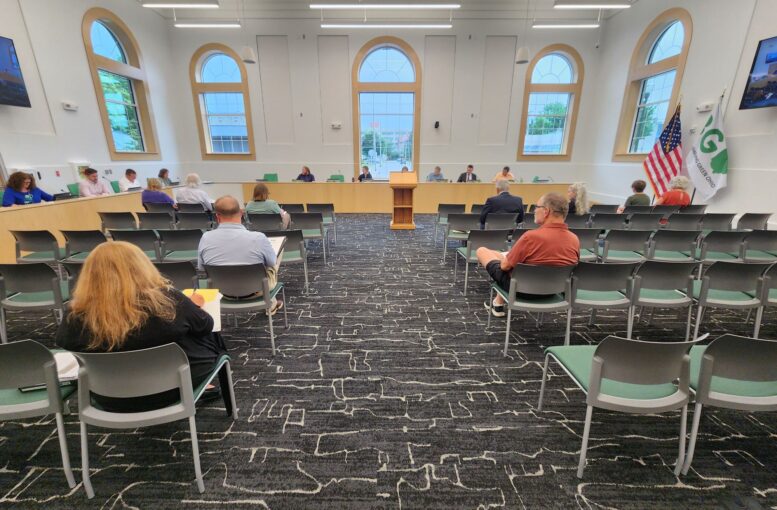
At Monday’s City Council meeting, Municipal Administrator Lori Tretter went step by step through the process before council. Following are those steps – including legislation that is prepared now but can only be passed if voters approve the income tax:
- Ordinance 9286 – allows for applicable expenses that occur prior to the bond issuance to be reimbursed once bonds are issued.
- Ordinance 9287 – permits the redistribution of the unvoted 1.5% of the income tax beginning on Jan. 1, 2026, to allocate more capital funds to capital improvements and street repairs.
- Ordinance 9288 – this adds the 0.15% income tax increase to the city’s tax code, if voters approve it in November.
- Resolution 3885 – places the income tax increase of 0.15% before voters. If passed, funding would be allocated for bond payments for two fire stations and fire equipment.
- Ordinance 9289 – if approved by voters in November, this legislation would authorize the city to seek $27.72 million in bonds to pay for two fire stations.
- Ordinance 9290 – if approved by voters in November, this would authorize $4.95 million in bonds that will pay for an aerial ladder truck and other fire equipment.
- Ordinance 9291 – authorizes the city to enter into contracts for building and renovations of city safety facilities.
Tretter explained the city’s plans for redistributed capital funds, taking a portion of the money that traditionally goes to the city’s water and sewer capital improvement fund.
Funds will be shifted to street repairs, ongoing capital expenses for equipment and vehicles and building maintenance, revenue source to reduce deferred maintenance log, police division renovation, and city debt payment.
The $2 million taken from the water and sewer capital improvement funds will be recovered through increases in utility rates.
In June, after years of discussion on the condition of the Bowling Green Police Station, the Court Street Fire Station, and the desire to decrease emergency response time in the city, a proposal was presented to the Council Committee of the Whole.
Tretter and Finance Director Dana Pinkert presented a plan addressing the fire station needs first and putting the police station needs on a temporary pause.
Based on the increase in fire and EMS calls, and the unsafe conditions at the Court Street Fire Station, the following recommendations were made:
- Two new stations will be constructed, and the Pearl Street Station will remain in operation.
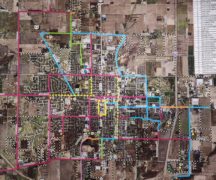
- A station with administrative headquarters will be built somewhere in the north end of the city, in the area between Haskins and Main streets, and Newton and Van Camp roads. Negotiations are still going on between the city and the landowner, Tretter said. That station will be larger, at an estimated 20,944 square feet.
- A satellite station will be built in the southeast area of the city, on property already owned by the city at Carter Park. Tretter stressed that all the recreation uses will remain in the park, with the disc golf course possibly needing to be reconfigured. This satellite station will be an estimated 14,215 square feet.
- The predicted cost of building and equipping the two new stations will be in the ballpark of $30 million. That includes $14.7 million for the headquarter station, $10.5 for the satellite station, $2.5 million for an aerial ladder truck, and $2 million for other fire and ambulance equipment.
The police station is also in dire need of improvements in its 130-year-old building downtown. Not only is the space difficult to use for a modern police operation, it’s also not user-friendly for the public.
While the building presents challenges, “we can renovate that building so it can serve a modern police department,” Mayor Mike Aspacher said.
City officials asked that the police station renovations be revisited, with no definite decisions being made now. It was suggested that the police renovations be paid for with city capital improvement funds.
Pinkert explained a proposal to change the long-standing process of how the existing income tax is distributed among city departments. She suggested 0.15% of the existing 0.3% income tax collection go from the water/sewer capital fund into a capital improvement fund and street repair fund.
But that will only pay a portion of the costs for the new fire stations. So Pinkert also recommended that City Council place a 0.15% income tax increase on the November ballot.
Utilities Director Brian O’Connell explained that to make up for the capital improvement money taken from the water and sewer funds, those rates will need to be increased to collect about $1.5 million annually.
The average residential customer in Bowling Green would see their monthly water bill go up 70 cents, and their monthly sewer bill go up by $1.10 a month, O’Connell said.
Even with the increases, Bowling Green residential bills will be lower than many in the region, he said. Currently, the total monthly water and sewer bill for a residential customer in Bowling Green is $36.95, compared to $54.13 in Findlay, $93.10 in Perrysburg, $107.08 in Defiance, $136.25 in Maumee, and $147.45 in Napoleon.
That will be up to the BG Board of Public Utilities to set any rate increases.
But it is up to City Council to put an income tax on the ballot. The filing deadline to get on the ballot is Aug. 6, and council is required to have three readings of such resolutions.
While city officials don’t take it lightly to ask for citizens to pay more taxes, “we all feel a responsibility for the health and safety of our residents,” Aspacher said.
Response times of four minutes or less anywhere in the city is the goal.
“It is achievable with this model,” he said.
Tretter said that a report in December on the unsafe conditions at the Court Street fire station was a “wake-up call” to the city.
Following are some of the factors under consideration:
- Staff has doubled since the Court Street station was built in 1984.
- That station was built for an all-male workforce.
- Vehicles are much larger. Soon, new fire engines will not fit inside the bays.
- New fire stations are now generally limited to one story to speed response and meet ADA guidelines.
- Fire stations are now designed with multiple zones and air exchange to reduce exposure to carcinogens.
The number of fire and EMS calls have tripled, from 1,095 calls for service in 1992, to 3,418 calls in 2022. The number is expected to hit 4,000 this year.
Calls for police have doubled from approximately 15,000 in 1984, to 30,000 in 2024. In that same period, the number of officers has gone from 28 to 42, and the number of dispatchers has grown from nine to 11.
Architects identified the following shortcomings of the current police station:
- Security – Facility does not provide the current recommended layered security separation/isolation strategies for a modern police headquarters.
- Transparency and engagement – Public engagement and a transparent image for the police station is not possible in the current setting.
- Disjointed operational configuration – Individual units are spread out across the building, on multiple floors, reducing efficiency of daily operations and effectiveness of staff.
- Evidence processing and storage – Evidence processing areas lack the appropriate equipment and functional spaces to address the increased demands of these operations.
- Firing range – Range lacks appropriate ballistic and HVAC filtration systems, creating health and safety risks.