
By JAN McLAUGHLIN
BG Independent News
Democracy is weakened by the lack of opportunities for people to discuss their differences. Not on social media, but face-to-face, civilly, with listening being as important as talking.
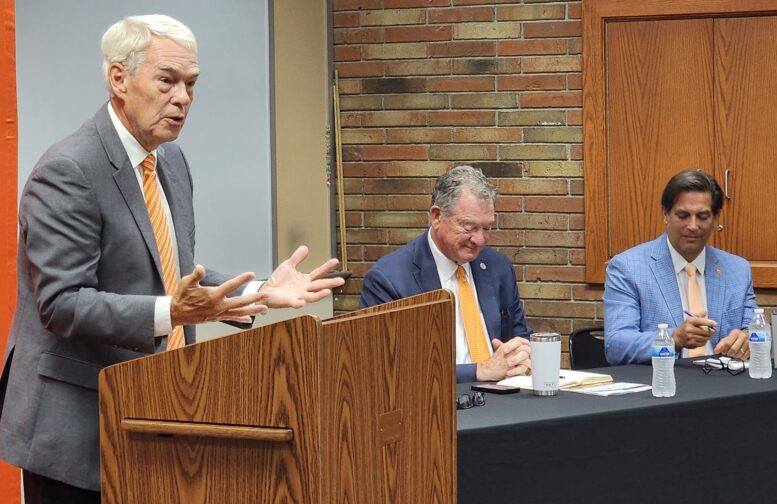
A town hall was held Tuesday morning at the Wood County District Public Library, to hear from local residents on how Bowling Green State University and the community can help facilitate public forums and policy discussions.
“Too much of the public discussion goes on social media. I don’t think that’s healthy,” said Randy Gardner, current BGSU Democracy and Public Policy Network chair and former state senator and chancellor of the Ohio Department of Higher Education.
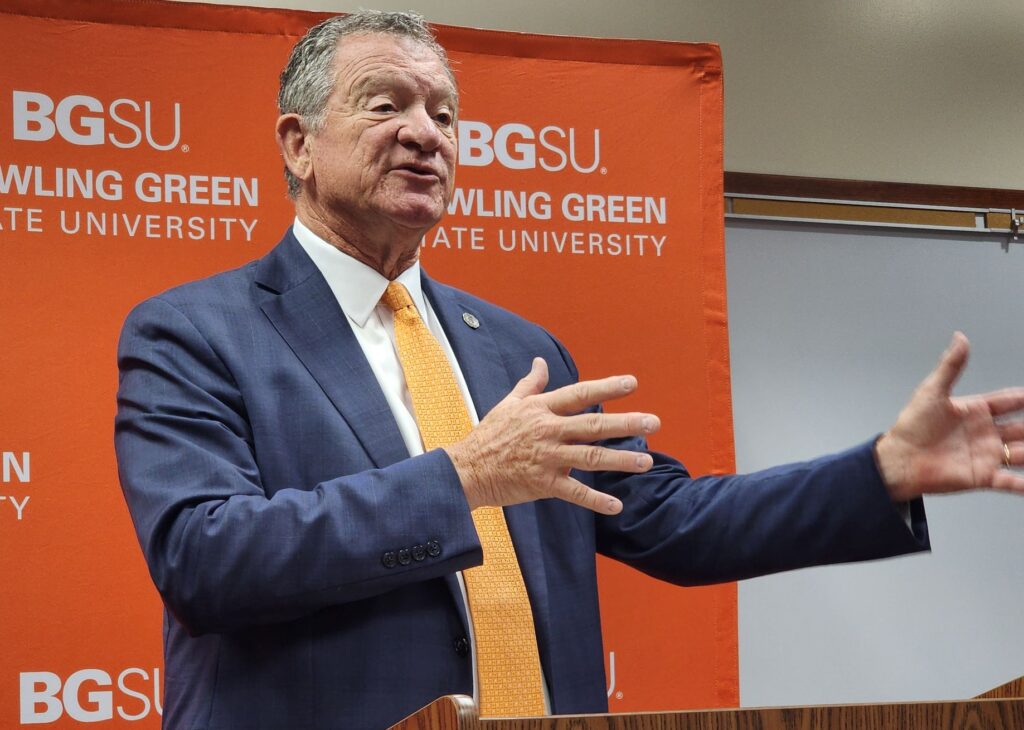
In the spirit of wanting to be a catalyst for civil conversations, BGSU President Rodney Rogers asked for community input.
“We need to make sure we’re listening,” he said. “Let’s start right here.”
Rogers talked about the efforts of the BGSU Democracy and Public Policy Network to get students engaged in civics and in their community during college.
Rob Alexander, director of the network, said student polling has shown that many people don’t want to discuss politics for fear of losing friends or family relationships.
“People are afraid to talk about politics,” he said. “It’s a very toxic environment.”
But by talking face-to-face, people are often able to find common ground, Alexander said.
After Gardner, Rogers and Alexander made their pitch for BGSU’s new program, they asked for the community’s help.
“It’s your turn,” Gardner said to those at the town hall.
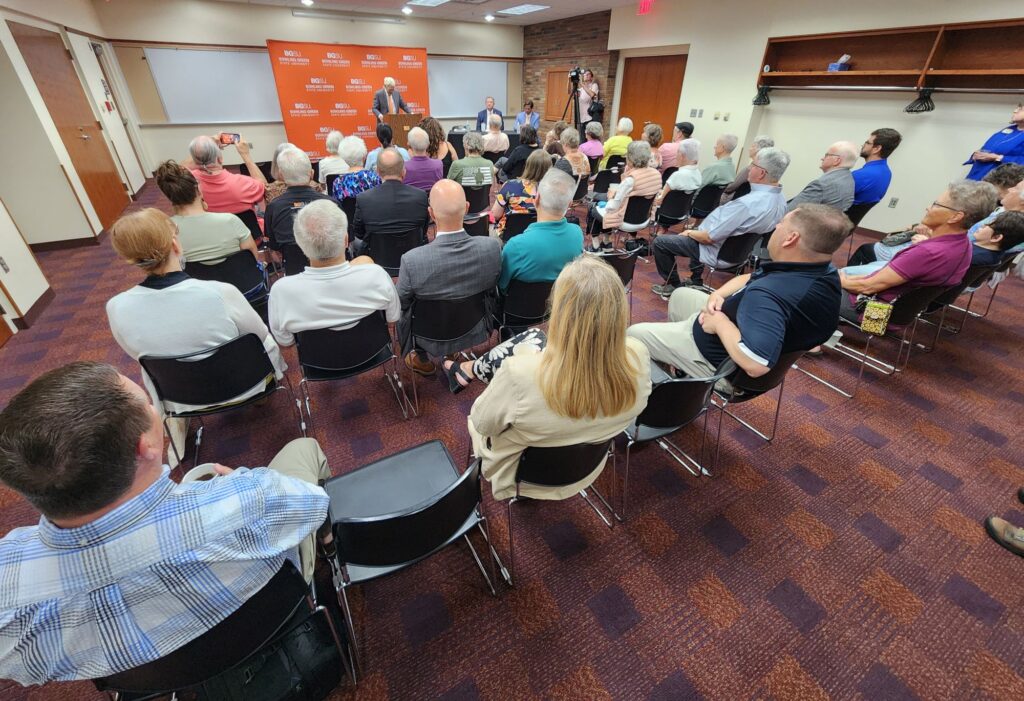
Maria Simon, of the Wood County District Public Library, asked that BGSU consider a library card sign-up drive for students and faculty when they arrive on campus. She also suggested that some difficult conversations might be made easier with the presence of Benny, the therapy dog.
Debbie Dalke, a local voters’ rights advocate, asked for BGSU’s help getting students registered to vote. She talked about the confusion many young voters have about needing to register, needing to show up in a particular polling place, and needing to bring proper identification.
Dalke also suggested the student polling program take a look at the barriers encountered by Wood County residents when they vote, and how those might be remedied.
Wood County Prosecuting Attorney Paul Dobson suggested that in addition to studying the U.S. Constitution, that students learn about the Ohio Constitution through the BGSU Democracy and Public Policy Network. And Wood County Common Pleas Judge Matt Reger recommended the Northwest Ordinance also be studied.
Shar Katzner, president of the League of Women Voters in Bowling Green, said that organization also engages citizens in discussions on matters on the ballot, but is in need of local venues to host public meetings.
BGSU retiree Faith Olson spoke in support of more opportunities for the public to engage with each other on sometimes sensitive topics.
“We all have to grow,” she said. “Not everyone has to agree with me. We can find commonalities.”
Another BGSU retiree, Travis Chapin, told of going from being a climate ignorer to a climate change believer. “The biggest threat to humanity is the threat we pose to climate,” he said. But yet, many people remain unaware, Chapin said.
More conversations need to be held on the “untouchable” topics of politics, religion and climate, he said.
Mike Kuhlin — the Kuhlin Center School of Media and Communication at BGSU is named for him and his late wife Sara — asked the Democracy and Public Policy Network to consider the media as a voice that should be listened to. Journalists and columnists can have valuable perspectives that would be helpful during discussions, he said.
Pam Day, who with her husband Frank are “Falcon Flames,” suggested that BGSU bring its democracy program into the community, perhaps by meeting places like the Wood County Senior Center. This would allow students to converse with community members and vice versa.
Erin Hachtel, a BGSU alumna who works with a statewide housing organization, said BGSU has the opportunity to be a vital part of the conversation about the link between housing and democracy. The current shortage of 275,000 affordable housing units in Ohio would be a worthy polling topic, she said.
Carol Kinsey asked if there are still opportunities for students to connect with community members, possibly being “adopted” by local residents, and getting a home-cooked meal every once in a while.
With each suggestion, Rogers, Gardner and Alexander jotted down notes.
“This has been incredibly valuable,” Rogers said. “We want to keep this dialogue going.”
But some community members at the town hall felt a great urgency to address threats to higher education learning and inclusion from federal and state legislative influences.
Amy French, a member of the BGSU faculty, said learning history is good, but the bigger concern right now is how Ohio Senate Bill 1 affects higher education innovation and diversity.
Another woman voiced worry about trans, undocumented and international students on campus. Universities have long been a safe place for discourse, with a sense of belonging afforded to all. But that is no longer the case, with SB 1 in effect, she said.
“It’s not a safe space for all,” she said. “Who is being left out?”
Another woman addressed national issues that are trickling down to communities – the lack of support for diversity, equity and inclusion, attacks on free speech and the right to protest, deportation of immigrants, and restrictions on women’s health care.
“How are we going to work together to protect each other?” she asked. “I want to know we will be protected in this community.”
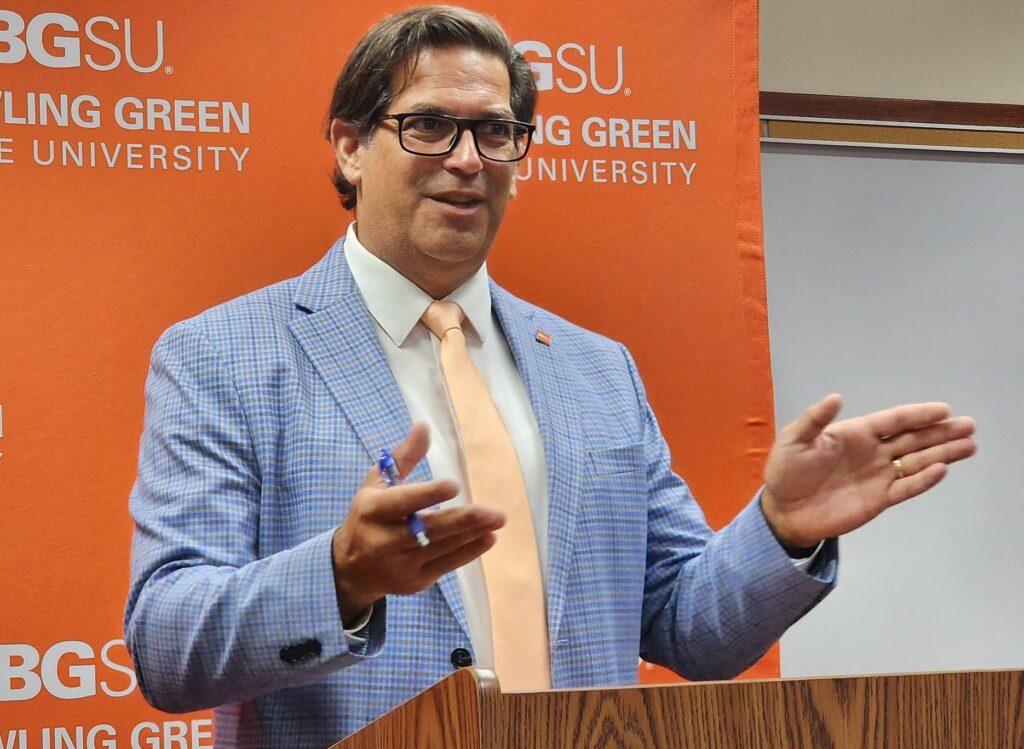
Armstrong said BGSU students share those concerns about free speech and inclusivity. If such difficult topics continue to be swept under the rug, it becomes a tripping hazard, he said.
BGSU faculty member Nancy Patterson asked about teaching future educators a lesson on gerrymandering and redistricting. “Am I in trouble?” she asked, questioning how high school social studies can be taught without those lessons.
“As long as you allow robust discussion of the subject,” it is allowed, Rogers said of his reading of the law.
“I hope we can keep talking about hard histories,” that show the good and bad, Patterson said.
Rogers offered his interpretation of SB 1, saying that several sections of the bill contradict each other.
“You do what you think the best thing is for the students, faculty and staff of the university,” he said.
Regarding the DEI section of the bill, which states that there should be no advantages offered to anyone based on their race and sex, Rogers also stressed that the bill language states there should also be no disadvantages.
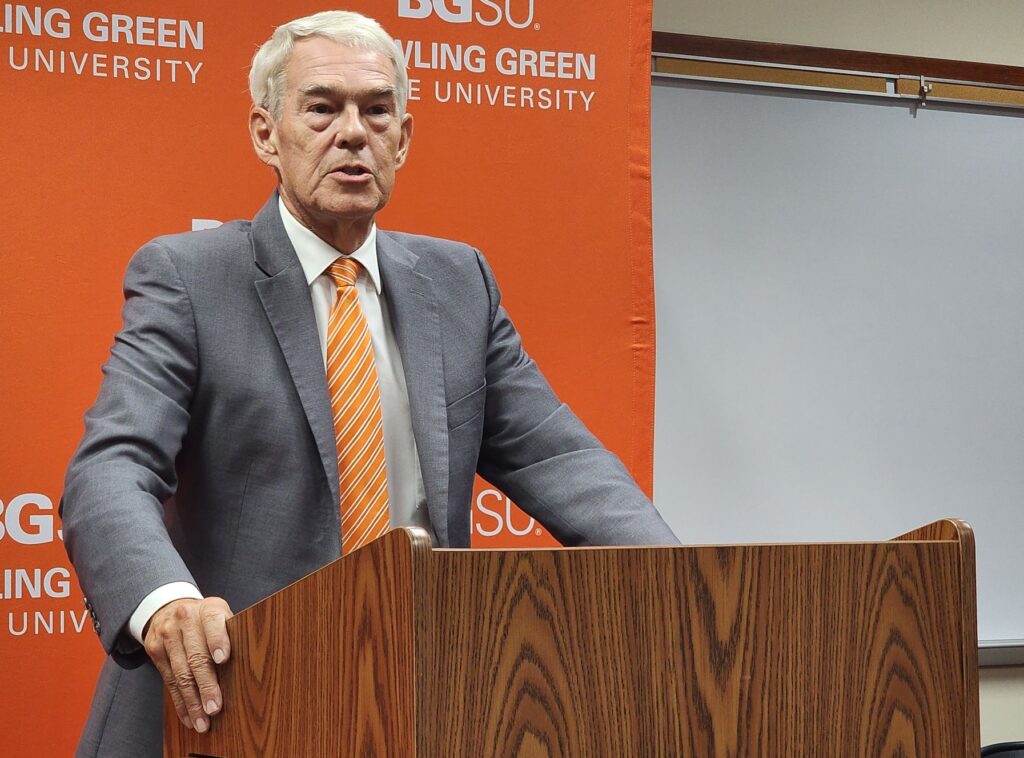
Gardner pointed out that SB 1 has stirred disagreements over addressing controversial subjects in classrooms. His interpretation is that those topics are allowed.
“I’m hoping no legal case or judge says otherwise,” he said.
Feedback from the town hall is intended to help the Democracy and Public Policy Network at BGSU develop future community-focused programming and events.
Founded in the fall of 2024, the Democracy and Public Policy Research Network conducts nonpartisan research, polls and policy briefs that educate and inform the learning and greater community and policymakers in Ohio and beyond.
The network also provides BGSU students with real-world, hands-on experiential learning opportunities and creative activities, including faculty-guided research projects, podcast productions, speaking engagements and workshops.